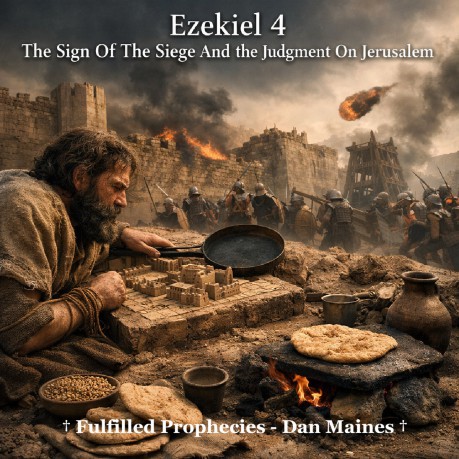
Ezekiel 4 The Sign Of The
Siege And The Judgment On Jerusalem Introduction † Ezekiel 4 shows God commanding the prophet to
act out the coming judgment on Jerusalem, not just speak it. This
wasn't symbolic for a distant future, it was a direct warning to that
generation that judgment was already determined. † God made Ezekiel become a living sign. The
people weren't listening to words anymore, so God showed them
judgment through action. This lines up with how Jesus later used
signs and warnings to that same covenant people before AD 70 (Matthew
24:33-34). † This chapter proves that judgment on
Jerusalem was not random. It was measured, calculated, and deserved
because of their rebellion against God. Ezekiel 4:1-3 Now you, son of man, get yourself a brick, place it before you,
and inscribe a city on it, Jerusalem. Then lay siege against it,
build a siege wall, raise up a ramp, pitch camps, and place battering
rams against it all around. Then get yourself an iron plate and set
it up as an iron wall between you and the city, and set your face
toward it so that it is under siege, and besiege it. This is a sign
to the house of Israel. † God had Ezekiel draw Jerusalem under siege
because the destruction was already determined. † The iron wall shows separation, God was no
longer protecting the city, He was against it. † This sign parallels Jesus declaring judgment
and siege against Jerusalem in His generation. Ezekiel 4:4-8 As for you, lie down on your left side and place the wrongdoing of
the house of Israel on it; you shall bear their wrongdoing for the
number of days that you lie on it. For I have assigned you a number
of days corresponding to the years of their wrongdoing, three hundred
and ninety days; so you shall bear the wrongdoing of the house of
Israel. When you have completed these, you shall lie down a second
time, but on your right side, and bear the wrongdoing of the house of
Judah for forty days; I have assigned you a day for each year. Then
you shall set your face toward the siege of Jerusalem with your arm
bared, and prophesy against it. And behold, I will put ropes on you
so that you cannot turn from one side to the other until you have
completed the days of your siege. † The 390 and 40 days represent years of
accumulated sin, showing God's judgment is based on a long history of
rebellion. † Ezekiel bearing their wrongdoing shows how
serious their guilt was, it had to be accounted for. † This foreshadows Christ bearing sin, but
unlike Israel, He was righteous and took it away. Ezekiel 4:9-11 But as for you, take wheat, barley, beans, lentils, millet, and
spelt, put them in one vessel, and make them into bread for yourself;
you shall eat it according to the number of the days that you lie on
your side, three hundred and ninety days. Your food which you eat
shall be twenty shekels a day by weight; you shall eat it from time
to time. The water you drink shall be the sixth part of a hin by
measure; you shall drink it from time to time. † The rationed food shows famine conditions
during the siege, exactly what happened in Jerusalem. † Eating mixed grains shows desperation and
poverty, not normal provision. † This was fulfilled historically in the Roman
siege of Jerusalem when famine became extreme. Ezekiel 4:12-17 And you shall eat it as a barley cake, having baked it in their
sight over human dung. Then the Lord said, This is how the sons of
Israel will eat their bread unclean among the nations where I will
scatter them. But I said, Oh, Lord God! Behold, I have never been
defiled; for from my youth until now I have never eaten what died of
itself or was torn by animals, nor has any unclean meat ever entered
my mouth. Then He said to me, See, I will give you cow dung in place
of human dung over which you will prepare your bread. Moreover, He
said to me, Son of man, behold, I am going to break the staff of
bread in Jerusalem, and they will eat bread by weight and with
anxiety, and drink water by measure and in horror, because bread and
water will be scarce; and they will be appalled with one another and
waste away in their wrongdoing. † Cooking with dung represents defilement,
showing Israel would be unclean in exile. † The breaking of the staff of bread means God
removed provision, famine was a direct judgment. † Fear, scarcity, and suffering were the result
of their own sin, not random events. Historical References † Josephus records severe famine during the
Roman siege, including people fighting over scraps of food. † Eusebius confirms the destruction of
Jerusalem as fulfillment of prophetic warnings. † Tacitus describes the siege conditions and
suffering within Jerusalem. How It Applies To Us Today † God does not ignore sin, judgment may be
delayed, but it is always measured and just. † We are called to speak truth even when people
don't want to hear it, just like Ezekiel. † Christ has taken away sin for those in Him,
so we don't bear the judgment Israel faced. † We should not take God's patience as approval
of sin, judgment came exactly when He said it would. Q & A Appendix Q: Why did God make Ezekiel act out the siege? Q: What do the 390 and 40 days represent? Q: Why was the food rationed? Q: What does cooking with dung represent? Q: Was this fulfilled historically? † This is the fulfilled perspective we proclaim at
Fulfilled Prophecies † Source Index † Ezekiel 4 † Josephus, Wars of the Jews, Book 5-6;
Eusebius, Ecclesiastical History, Book 3; Tacitus, Histories 5.12-13
By Dan Maines
A:
Because Israel refused to listen to words, so God gave them a visible
sign of judgment (Ezekiel 4:1-3).
A:
They represent years of accumulated sin that God was holding them
accountable for (Ezekiel 4:4-6).
A:
It symbolized the famine that would happen during the siege of
Jerusalem (Ezekiel 4:9-11).
A:
It represents defilement and unclean conditions during exile and
judgment (Ezekiel 4:12-13).
A:
Yes, it was fulfilled in the siege and destruction of Jerusalem,
especially in AD 70.
© Fulfilled Prophecies - Dan
Maines.
Links