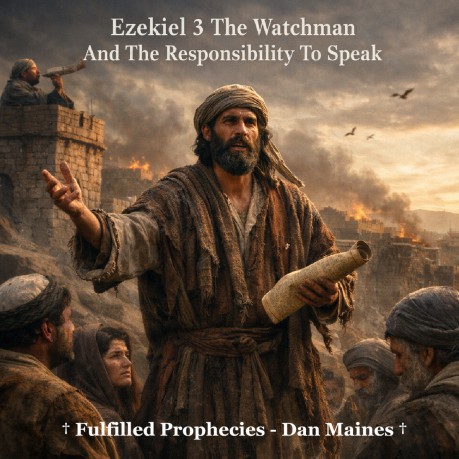
Ezekiel 3 The Watchman And
The Responsibility To Speak Introduction † Ezekiel 3 continues the commissioning of the
prophet, showing that God did not just call him to see visions, but
to speak His word whether people listened or not (Ezekiel 2:5-7) † The focus is responsibility, Ezekiel is made
a watchman, and silence is treated as guilt, not neutrality (Ezekiel
3:17-18) † From the fulfilled perspective, this points
forward to the final warning period before the destruction of
Jerusalem, when God's messengers were sent to call Israel to
repentance before judgment fell in AD 70 (Matthew 23:37-38) Ezekiel 3:1-3 † God is showing that His word must be received
internally before it is spoken outwardly, Ezekiel had to take it in
first (Jeremiah 15:16) † The sweetness shows that God's truth is good
even when the message includes judgment (Psalm 119:103) † This same imagery appears again in Revelation
when John eats the scroll, showing continuity in prophetic
responsibility leading up to fulfillment (Revelation 10:9-10) Ezekiel 3:4-7 † Israel's rejection wasn't due to
misunderstanding, it was rebellion, they understood but refused
(Isaiah 6:9-10) † God makes it clear that the issue is not the
messenger but the heart of the people (John 5:40) † This directly parallels Jesus' ministry,
where Israel rejected Him even though they understood His message
(John 12:37) Ezekiel 3:8-9 † God equips His messenger to stand firm, truth
requires strength in the face of opposition (Jeremiah 1:18) † The hardness here is not stubbornness, it is
resolve to speak God's word without compromise (Acts 4:29) † This same boldness was required of the
apostles before Jerusalem's fall (Acts 5:29) Ezekiel 3:10-11 † The responsibility is to speak, not to
control the outcome (Ezekiel 2:7) † God's standard is obedience, not success in
numbers or response (Galatians 1:10) † This principle carries through to the New
Covenant, where the gospel is proclaimed regardless of response (2
Timothy 4:2) Ezekiel 3:12-15 † Ezekiel feels the weight of the message, the
bitterness reflects the seriousness of judgment (Jeremiah 20:9) † Even though the word is sweet in truth, it is
heavy in responsibility (Revelation 10:10) † The seven days of silence show the gravity of
what he is about to deliver (Job 2:13) Ezekiel 3:16-19 † This is the central theme, silence equals
accountability, God requires the warning to be given (Ezekiel 33:6) † The watchman imagery shows urgency, danger is
coming and must be announced (Isaiah 62:6) † This points forward to the final warnings
before AD 70, when the apostles warned Israel of impending judgment
(Matthew 24:34) Ezekiel 3:20-21 † Responsibility applies to everyone, both
wicked and righteous need warning (Hebrews 3:12-13) † This shows covenant accountability, Israel
was judged based on response to truth (Romans 2:6) † It reinforces that obedience to God's command
to warn is what delivers the messenger (Acts 20:26-27) Ezekiel 3:22-27 † God controls when Ezekiel speaks, showing
that the message is fully God's, not man's (Exodus 4:12) † The restriction shows judgment already set in
motion, silence itself becomes part of the sign (Amos 8:11) † This reflects the hardening seen in Jesus'
time, where many no longer had ears to hear (Matthew 13:13) Historical References † Josephus records that warnings were given
before Jerusalem's destruction, yet the people refused to listen,
confirming the pattern of rejection (Josephus, Wars of the Jews, Book
6) † Eusebius notes that believers were warned and
fled Jerusalem before its fall, showing the watchman role fulfilled
in the first century (Eusebius, Ecclesiastical History 3.5) † Tertullian affirms that the prophets and
apostles were faithful in delivering God's warnings, even when
rejected (Tertullian, Apology) How It Applies To Us Today † The responsibility to speak truth still
stands, we don't measure success by response, but by faithfulness (2
Timothy 4:2) † We must receive God's word deeply before
sharing it, just like Ezekiel eating the scroll (Colossians 3:16) † Warning others is an act of love, not
judgment, silence is not neutral (James 5:20) † God is sovereign over the outcome, our role
is obedience, not results (1 Corinthians 3:6-7) Q & A Appendix Q: What does it mean that Ezekiel ate the
scroll? Q: Why was Israel so resistant to the message? Q: What is a watchman? Q: Is the messenger responsible if people reject
the message? Q: How does this connect to the fulfilled
perspective? † This is the fulfilled perspective we proclaim at
Fulfilled Prophecies † Source Index † Ezekiel 3:1-27
By Dan Maines
Then He said to me, Son of
man, eat what you find, eat this scroll, and go, speak to the house
of Israel. So I opened my mouth, and He fed me this scroll. And He
said to me, Son of man, feed your stomach and fill your body with
this scroll which I am giving you. Then I ate it, and it was sweet as
honey in my mouth.
Then He said to me, Son of
man, go to the house of Israel and speak with My words to them. For
you are not being sent to a people of an unfamiliar language or a
difficult language, but to the house of Israel, nor to many peoples
of unfamiliar language or difficult language whose words you cannot
understand. But I have sent you to them who should listen to you. Yet
the house of Israel will not be willing to listen to you, since they
are not willing to listen to Me. Surely the entire house of Israel is
stubborn and obstinate.
Behold, I have made your face
as hard as their faces and your forehead as hard as their foreheads.
Like emery harder than flint I have made your forehead. Do not be
afraid of them nor be dismayed before them, though they are a
rebellious house.
Moreover, He said to me, Son
of man, take into your heart all My words which I will speak to you
and listen closely. Go to the exiles, to the sons of your people, and
speak to them and tell them, This is what the Lord God says, whether
they listen or do not listen.
Then the Spirit lifted me
up, and I heard a great rumbling sound behind me, Blessed be the
glory of the Lord in His place. And I heard the sound of the wings of
the living beings touching one another and the sound of the wheels
beside them, a great rumbling sound. So the Spirit lifted me up and
took me away, and I went embittered in the rage of my spirit, and the
hand of the Lord was strong on me. Then I came to the exiles who
lived beside the river Chebar at Tel-abib, and I sat there where they
were living, causing consternation among them for seven days.
Now at the end of seven days
the word of the Lord came to me, saying, Son of man, I have appointed
you as a watchman for the house of Israel, whenever you hear a word
from My mouth, warn them from Me. When I say to the wicked, You will
certainly die, and you do not warn him or speak out to warn the
wicked from his wicked way so that he may live, that wicked person
shall die for his wrongdoing, but I will require his blood from your
hand. But if you on your part warn a wicked person and he does not
turn from his wickedness or from his wicked way, he shall die for his
wrongdoing, but you have saved yourself.
Again, when a righteous
person turns away from his righteousness and commits wrongdoing, and
I place an obstacle before him, he will die, since you have not
warned him. He shall die in his sin, and his righteous deeds which he
has done shall not be remembered, but I will require his blood from
your hand. However, if you have warned the righteous person so that
the righteous person should not sin and he does not sin, he shall
certainly live because he accepted the warning, and you have saved
yourself.
The hand of the Lord was on
me there, and He said to me, Get up, go out to the plain, and there I
will speak to you. So I got up and went out to the plain, and behold,
the glory of the Lord was standing there, like the glory that I saw
by the river Chebar, and I fell on my face. Then the Spirit entered
me and set me on my feet, and He spoke with me and said to me, Go,
shut yourself up in your house. As for you, son of man, they will put
ropes on you and bind you with them so that you cannot go out among
them. And I will make your tongue stick to the roof of your mouth so
that you will be unable to speak and be unable to rebuke them, for
they are a rebellious house. But when I speak to you, I will open
your mouth, and you will say to them, This is what the Lord God says,
He who hears, let him hear, and he who refuses, let him refuse, for
they are a rebellious house.
A: It means God's word had to be
internalized before being spoken, Jeremiah 15:16, Revelation 10:9-10
A:
Their hearts were hardened and rebellious, Isaiah 6:9-10, John 12:37
A:
One appointed to warn others of danger, Ezekiel 33:6, Isaiah 62:6
A: No, only if he fails to warn,
Acts 20:26-27
A: It points to the warnings given
before Jerusalem's destruction in that generation, Matthew 24:34
© Fulfilled Prophecies - Dan
Maines.
†
Jeremiah 15:16; Isaiah 6:9-10; Matthew 24:34; Acts 20:26-27
†
Josephus, Wars of the Jews, Book 6; Eusebius, Ecclesiastical History
3.5; Tertullian, Apology
Links