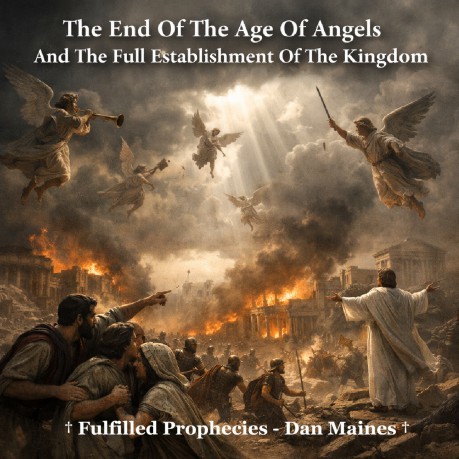
The End Of The Age Of Angels
And The Full Establishment Of The Kingdom Introduction † Most people have been taught that angels are
still actively carrying out covenant roles today, but scripture shows
their ministry was tied to a specific age that has already passed. † The Bible clearly places intense angelic
activity in the last days of the Old Covenant, not in our time today. † If we don't recognize the timing, we'll keep
expecting things that belonged to a world that has already been
judged and removed. Galatians 3:19 † The law itself was administered through
angels, showing they had a covenant role, not an eternal one
(Galatians 3:19). † The word until places a clear stopping point
on their function, meaning their role was temporary (Galatians 3:19). † Once the Seed came and fulfilled the promise,
that system, including angelic mediation, was no longer needed
(Galatians 3:19). Hebrews 2:2-3 † The Old Covenant word was spoken through
angels, confirming they were part of that administration (Hebrews
2:2). † The contrast is now salvation through Christ,
not through angelic mediation (Hebrews 2:3). † This shows a shift from angel involvement to
direct fulfillment in Christ (Hebrews 2:2-3). Hebrews 1:13-14 † Angels are described as ministering spirits
serving those who were about to inherit salvation, not those who have
already fully received it (Hebrews 1:14). † Their role is tied to the process of
inheritance, showing a transitional function, not a permanent one
(Hebrews 1:13-14). † Once the inheritance was fully established,
their covenant role was no longer needed (Hebrews 1:13-14). Matthew 24:31 † Jesus places angelic activity at the time of
His coming in that generation, not thousands of years later (Matthew
24:34). † The gathering of the elect was a first
century event tied to the judgment of Jerusalem (Matthew 24:31). † Angels were actively involved in the closing
of that age, not in an ongoing future mission (Matthew 24:31). Revelation 1:1 † The events of Revelation were said to take
place soon, placing all angelic activity within their lifetime
(Revelation 1:1). † This removes any justification for pushing
these events thousands of years into the future (Revelation 1:1). † The timing confirms the fulfillment was
imminent for them, not distant for us (Revelation 1:1). Revelation 22:10 † Angels were delivering final revelation
because fulfillment was near to them, not distant (Revelation 22:10). † The urgency proves that all angelic activity
in Revelation belonged to their generation (Revelation 22:10). † This wasn't written to a future audience, it
was written to people about to experience these events (Revelation
22:10). Hebrews 12:22-24 † They had already come into the heavenly
reality during that transition period (Hebrews 12:22). † Angels are mentioned as part of that scene,
but the focus is now on Jesus as the mediator (Hebrews 12:24). † The shift is clear, from angelic
administration to direct access through Christ (Hebrews 12:22-24). Hebrews 1:1-2 † God no longer speaks through angels as a
covenant means, but through His Son (Hebrews 1:2). † The phrase last days refers to the end of
that Old Covenant age, not the end of the physical world (Hebrews
1:2). † This confirms the transition was complete,
and the former methods had passed away (Hebrews 1:1-2). Ephesians 1:10 † All things, including angelic administration,
were summed up and brought to completion in Christ (Ephesians 1:10). † This shows the fulfillment wasn't partial, it
was complete and comprehensive (Ephesians 1:10). † There is no ongoing covenant role for angels
because everything has already been brought together in Him
(Ephesians 1:10). Historical References † Josephus records the destruction of Jerusalem
and the temple in AD 70, marking the end of that covenant world (Wars
of the Jews, Book 6). † Eusebius confirms the early church understood
these events as fulfillment of Christ's words concerning that
generation and expected these things within their lifetime
(Ecclesiastical History, Book 3). † Tacitus also records the catastrophic
judgment that came upon Jerusalem, aligning with the timeframe Jesus
gave (Histories 5.13). How It Applies To Us Today † We're not waiting for angels to complete a
mission, Christ has already completed it (Hebrews 10:12-14). † We're living in the fully established
kingdom, not in a transition period (Luke 17:20-21). † Our focus isn't on signs, angels, or future
judgments, it's on the present reign of Christ (Ephesians 1:20-22). † We don't need mediation through angels, we
have direct access to God through Jesus Christ (1 Timothy 2:5). Q & A Appendix Q If angels were active then, do they still work
the same way today? Q What about Matthew 24, doesn't that still apply
to us? Q Why do people still expect angelic activity
like in Revelation? Q Doesn't the Bible say angels are ministering
spirits forever? Q Do angels still exist even if their role
changed? Q Are there any angels today? Q Why don't we see angels like they did in the
Bible? Q Do angels still deliver messages from God
today? † This is the fulfilled perspective we proclaim at
Fulfilled Prophecies † Source Index † Galatians 3:19, Hebrews 2:2-3, Hebrews
1:13-14, Matthew 24:31, 34, Revelation 1:1, Revelation 22:10, Hebrews
12:22-24, Hebrews 1:1-2, Ephesians 1:10, Hebrews 10:12-14, Luke
17:20-21, Ephesians 1:20-22, 1 Timothy 2:5 † Josephus, Wars of the Jews, Book 6; Eusebius,
Ecclesiastical History, Book 3; Tacitus, Histories 5.13
By Dan Maines
Why the Law then? It was
added on account of the violations, having been ordained through
angels by the agency of a mediator, until the Seed would come to whom
the promise had been made.
For if the word spoken through
angels proved unalterable, and every violation and disobedience
received a just penalty,
how will we escape if we neglect so
great a salvation?
But to which of the angels
has He ever said, Sit at My right hand, until I make Your enemies a
footstool for Your feet?
Are they not all ministering spirits,
sent out to provide service for the sake of those who will inherit
salvation?
And He will send forth His
angels with a great trumpet, and they will gather together His elect
from the four winds, from one end of the sky to the other.
The Revelation of Jesus
Christ, which God gave Him to show to His bond-servants, the things
which must soon take place
And he said to me, Do not
seal up the words of the prophecy of this book, for the time is near.
But you have come to Mount
Zion and to the city of the living God, the heavenly Jerusalem, and
to myriads of angels,
to the general assembly and church of the
firstborn who are enrolled in heaven, and to God, the Judge of all,
and to the spirits of the righteous made perfect,
and to Jesus,
the mediator of a new covenant
God, after He spoke long ago
to the fathers in the prophets in many portions and in many ways,
in
these last days has spoken to us in His Son
with a view to an
administration suitable to the fullness of the times, that is, the
summing up of all things in Christ, things in the heavens and things
on the earth
A Scripture shows their
covenant role was temporary and tied to that age, Galatians 3:19,
Hebrews 2:2-3, Hebrews 1:13-14.
A Jesus said all these things would
happen in that generation, Matthew 24:34.
A Because they haven't
recognized that the time was near for them, not us, Revelation 1:1,
Revelation 22:10.
A It says they were sent to
serve those who would inherit salvation, showing a time-bound role
tied to that inheritance, Hebrews 1:14.
A Yes, but their covenant function of
mediating, revealing, and gathering has already been fulfilled in
Christ, Ephesians 1:10.
A
Yes, angels still exist, but scripture shows their active covenant
role was tied to the Old Covenant and its fulfillment, not to an
ongoing system today, Galatians 3:19, Ephesians 1:10.
A Because their visible activity was
concentrated in the time of covenant transition, especially leading
up to the destruction of Jerusalem, Hebrews 1:1-2, Revelation 1:1.
A No, God has now spoken fully through
His Son, and that revelation has been completed, Hebrews 1:1-2,
Revelation 22:10.
© Fulfilled Prophecies - Dan
Maines.
Links