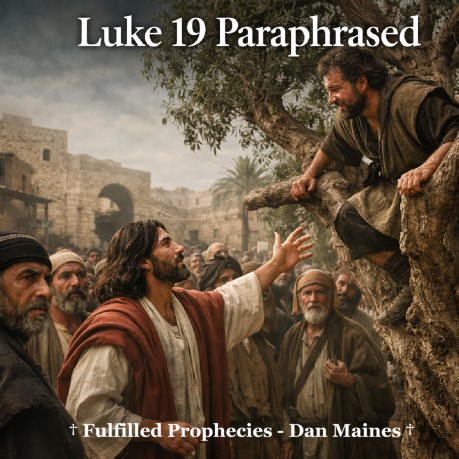
Luke 19
Paraphrased
By Dan Maines
Introduction
†
Jesus is nearing Jerusalem, and everything is building toward
judgment on that city within that generation (Luke 19:41-44).
†
This chapter shows who truly receives the kingdom and who rejects it,
revealing the coming consequences.
† The
focus is on accountability, faithfulness, and recognizing the time of
God's visitation.
Luke 19:1
Jesus entered
Jericho and was passing through.
† This is
part of His final journey toward Jerusalem where judgment would fall
(Luke 18:31-33).
† Jericho represents a place
where unexpected people respond to Him.
Luke 19:2
There
was a man named Zacchaeus, a chief tax collector, and he was rich.
†
Tax collectors were seen as sinners and traitors among Israel (Luke
15:1-2).
† His wealth shows how far he was
from the religious system's approval.
Luke 19:3
He
was trying to see who Jesus was, but he couldn't because of the
crowd, since he was small in stature.
† His
desire shows a heart already being drawn toward truth.
†
The crowd becomes an obstacle, just like tradition often blocks
people from Christ.
Luke 19:4
So he ran
ahead and climbed a sycamore tree to see Him, since Jesus was about
to pass that way.
† He humbles himself
publicly, something the proud leaders refused to do.
†
This shows that seeking Christ requires effort and humility.
Luke
19:5
When Jesus came to the place, He looked up and
said to him, Zacchaeus, hurry and come down, because I must stay at
your house today.
† Jesus initiates the
relationship, showing God's grace toward the undeserving.
†
This reflects God's plan to bring salvation even to those outside
religious approval (Luke 5:32).
Luke 19:6
He
hurried and came down and received Him gladly.
†
True faith responds quickly and with joy.
†
This contrasts with those who rejected Him despite seeing His
works.
Luke 19:7
When they saw it, they
all complained, saying He has gone to stay with a sinful man.
†
The religious mindset always resists grace toward sinners.
†
This exposes their lack of understanding of God's purpose (Luke
15:2).
Luke 19:8
Zacchaeus stood and said
to the Lord, Look, half of my possessions I give to the poor, and if
I have cheated anyone, I repay four times as much.
†
His repentance is proven by action, not just words.
†
True transformation produces fruit immediately (Luke 3:8).
Luke
19:9
Jesus said to him, Today salvation has come to
this house, because he also is a son of Abraham.
†
Being a true son of Abraham is about faith, not lineage (Romans
4:16).
† Salvation is shown to be present,
not future.
Luke 19:10
For the Son of Man
has come to seek and to save what was lost.
†
This summarizes His mission to restore Israel and gather the lost
(Ezekiel 34:11-12).
† The lost refers to
those within the covenant who had gone astray.
Luke
19:11
While they were listening, He went on to tell a
parable, because He was near Jerusalem, and they thought the kingdom
of God was going to appear immediately.
† The
people misunderstood the timing and nature of the kingdom.
†
Jesus corrects their expectation of immediate visible rule.
Luke
19:12
He said, A nobleman went to a distant country to
receive a kingdom for himself and then return.
†
This represents Christ ascending to receive authority (Daniel
7:13-14).
† The return points to judgment
within that generation.
Luke 19:13
He
called ten of his servants and gave them ten minas and told them to
do business until I come back.
† Servants are
entrusted with responsibility before judgment.
†
This reflects stewardship of truth and obedience.
Luke
19:14
But his citizens hated him and sent a delegation
after him, saying we do not want this man to reign over us.
†
This directly reflects Israel rejecting Christ (John 19:15).
†
Their rejection leads to their destruction.
Luke
19:15
When he returned after receiving the kingdom, he
ordered those servants to be called to him to find out what they had
gained.
† This is the time of
accountability.
† It reflects judgment based
on faithfulness (Matthew 25:19).
Luke 19:16
The
first came saying, your mina has made ten more.
†
Faithfulness produces increase.
† This shows
reward tied to obedience.
Luke 19:17
He
said to him, well done, because you were faithful in a small thing,
you shall have authority over ten cities.
†
Authority is given based on proven faithfulness.
†
This reflects participation in the kingdom.
Luke
19:18
The second came saying, your mina has made five
minas.
† Not all produce equally, but
faithfulness is still honored.
† God judges
based on what was given.
Luke 19:19
He
said to him, you are to be over five cities.
†
Rewards are proportional.
† This shows
fairness in judgment.
Luke 19:20
Another
came saying, here is your mina, which I kept put away in a cloth.
†
This represents unfaithfulness and fear.
†
Hiding truth leads to loss.
Luke 19:21
I
was afraid of you, because you are a demanding man.
†
He misunderstands his master, just like many misunderstand God.
†
Fear without faith leads to inaction.
Luke 19:22
He
said, by your own words I will judge you.
†
Judgment exposes the heart.
† Their own
reasoning condemns them.
Luke 19:23
Why
didn't you put my money in the bank, so I would have collected it
with interest?
† Even minimal effort was
expected.
† Neglect is still judged.
Luke
19:24
He said to those standing by, take the mina from
him and give it to the one who has ten.
†
What is unused is taken away.
† This reflects
spiritual loss for the unfaithful.
Luke 19:25
They
said to him, he already has ten minas.
†
God's ways seem unfair to human reasoning.
†
But His judgment is just.
Luke 19:26
I
tell you, to everyone who has, more will be given, but from the one
who does not have, even what he has will be taken away.
†
Faithfulness leads to increase, neglect leads to loss.
†
This principle applies spiritually.
Luke 19:27
But
bring those enemies of mine who did not want me to reign over them
and kill them in front of me.
† This points
directly to the destruction of Jerusalem in AD 70.
†
Those who rejected Christ faced real judgment (Luke 21:20-24).
Luke
19:28
After He said these things, He went on ahead,
going up to Jerusalem.
† This is the final
approach to the place of judgment.
†
Everything is now moving toward fulfillment.
Luke
19:29
As He approached Bethphage and Bethany near the
Mount of Olives, He sent two disciples.
† The
Mount of Olives is connected to judgment imagery (Zechariah 14:4).
†
This sets the stage for what follows.
Luke 19:30
Go
into the village, you will find a colt tied, untie it and bring it.
†
This fulfills prophecy about the King coming humbly (Zechariah
9:9).
† His kingdom is not like earthly
kingdoms.
Luke 19:31
If anyone asks, say
the Lord needs it.
† His authority is
recognized even in small details.
†
Everything is under His control.
Luke 19:32
They
went and found it just as He said.
† His
words are always fulfilled.
† This builds
trust in His authority.
Luke 19:33
As they
were untying it, the owners asked why.
† This
shows real historical detail.
† The moment is
unfolding exactly as planned.
Luke 19:34
They
said the Lord needs it.
† Simple obedience
fulfills God's will.
† His authority is
enough reason.
Luke 19:35
They brought it
to Jesus and placed Him on it.
† This
publicly presents Him as King.
† Yet He comes
in humility, not force.
Luke 19:36
As He
went, they spread their coats on the road.
†
This is a sign of honoring a king (2 Kings 9:13).
†
The people recognize Him temporarily.
Luke 19:37
The
whole crowd began praising God loudly for all the miracles.
†
Their praise is based on signs, not true understanding.
†
Many would soon reject Him.
Luke 19:38
Blessed
is the King who comes in the name of the Lord.
†
This fulfills Psalm 118:26.
† They
acknowledge Him, but not fully.
Luke 19:39
Some
Pharisees said, rebuke your disciples.
†
Religious leaders reject even rightful praise.
†
Their blindness is complete.
Luke 19:40
He
said if these become silent, the stones will cry out.
†
Creation itself testifies to truth.
† His
kingship cannot be silenced.
Luke 19:41
When
He approached, He saw the city and wept over it.
†
Jesus shows compassion even toward those about to be judged.
†
This reveals God's heart before judgment.
Luke 19:42
If
you had known the things that make for peace, but now they are hidden
from your eyes.
† Their blindness is a result
of rejection.
† They missed their
moment.
Luke 19:43
Days will come when
your enemies will surround you.
† This
describes the Roman siege of Jerusalem.
†
Fulfilled in AD 70 historically.
Luke 19:44
They
will level you and not leave one stone upon another because you did
not recognize the time of your visitation.
†
This is a direct prophecy of Jerusalem's destruction.
†
Josephus records this exact devastation.
Luke 19:45
He
entered the temple and began driving out those selling.
†
This shows judgment beginning at the temple.
†
The system had become corrupt.
Luke 19:46
My
house shall be a house of prayer, but you made it a den of robbers.
†
Quoting Isaiah 56:7 and Jeremiah 7:11.
† The
temple system was condemned.
Luke 19:47
He
was teaching daily in the temple.
† Truth was
still being offered before judgment.
† There
was still opportunity to respond.
Luke 19:48
They
were trying to destroy Him, but couldn't, because the people were
listening closely.
† Leadership sought to
kill Him, showing their hardened hearts.
†
Yet God's timing controlled everything.
Historical
References
† Josephus, Wars of the
Jews, describes the siege and destruction of Jerusalem in AD 70.
†
Eusebius, Ecclesiastical History, records early Christian
understanding of these fulfilled events.
†
Clement of Alexandria, Stromata, confirms early church teaching on
judgment and fulfillment.
How it applies to us today
†
We must recognize the time of God's working and not ignore truth when
it's revealed.
† Faithfulness matters, what
we do with what we're given will be judged.
†
Outward religion means nothing without a transformed heart.
†
God desires repentance, but judgment comes when truth is rejected.
†
We are called to respond like Zacchaeus, not like those who resisted
Christ.
Q & A Appendix
Q:
What does Zacchaeus represent
A: A sinner
within Israel being restored through repentance and faith (Ezekiel
34:11-12)
Q: What does the nobleman
represent
A: Christ receiving His kingdom and
returning in judgment (Daniel 7:13-14)
Q: Who
are the enemies killed in verse 27
A: Those in
Israel who rejected Christ and faced judgment in AD 70 (Luke
21:20-24)
Q: What does the destruction of
Jerusalem show
A: That Jesus' prophecy was
fulfilled in that generation (Luke 19:43-44)
Q:
What is the main warning of this chapter
A:
Recognize God's visitation and respond before judgment comes (Luke
19:44)
† This is the fulfilled perspective we proclaim
at Fulfilled Prophecies †
© Fulfilled Prophecies -
Dan Maines.
Source Index
†
Luke 19
† Josephus, Wars of the Jews
†
Eusebius, Ecclesiastical History
† Clement of
Alexandria, Stromata
Links