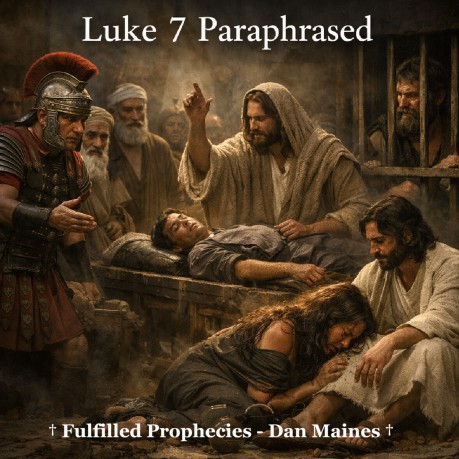
Luke 7
Paraphrased
By Dan Maines
Introduction
†
This chapter shows the authority of Christ over distance, death,
doubt, and forgiveness, all fulfilled within that generation
†
It reveals the transition from the old covenant system into the
reality of faith, mercy, and fulfillment in Christ
†
Every account points to what was being fulfilled in their days, not
something thousands of years later
Luke 7:1
After
finishing His teaching to the people, He entered Capernaum
†
Jesus moves from teaching into action, showing His words are backed
by authority (Matthew 7:29)
† The fulfilled
work connects doctrine with real power in their present time
Luke
7:2
A Roman officer had a servant he valued deeply who
was sick and near death
† A Gentile shows
greater faith than many in Israel (Romans 9:30-31)
†
This points to the inclusion of the nations already beginning
Luke
7:3
When he heard about Jesus, he sent Jewish elders
asking Him to come heal his servant
† Even
the Gentile respected the covenant people, showing humility
†
This reflects the gospel first going to the Jew, then outward (Acts
1:8)
Luke 7:4
They came to Jesus and urged
Him strongly, saying he was worthy
† Man
judges worth by deeds, but Jesus responds to faith
†
This exposes the difference between law-based thinking and grace
Luke
7:5
They said he loved the nation and built them a
synagogue
† Good works are noted, but they
are not the basis of the miracle
† This shows
how Israel still leaned on external righteousness
Luke
7:6
Jesus went with them, but as He got close, the
officer sent friends
† The man grows in
humility as Jesus approaches
† True faith
doesn't rely on physical presence
Luke 7:7
He
said he wasn't worthy for Jesus to come, but just speak the word
†
This is pure faith in authority, not ritual or location
†
It shows understanding of spiritual power beyond sight
Luke
7:8
He explained authority through his own command over
soldiers
† He recognizes Jesus' authority
over sickness just like command over men
†
Faith here is rooted in understanding, not emotion
Luke
7:9
Jesus marveled and said He hadn't found such faith
in Israel
† This exposes Israel's failure
despite having the law (John 1:11)
† The
nations begin to show greater response than covenant Israel
Luke
7:10
Those sent returned and found the servant healed
†
The healing confirms Jesus' authority without presence
†
Fulfillment shows power is not tied to temple or location
Luke
7:11
Soon after, He went to a city called Nain with His
disciples
† Jesus continues moving through
Israel bringing fulfillment
† His ministry is
active, not confined
Luke 7:12
A dead man
was being carried out, the only son of his mother
†
This represents hopelessness under the old covenant
†
Death here is both physical and symbolic of Israel's condition
Luke
7:13
Jesus saw her and felt compassion and told her not
to weep
† Christ brings comfort before the
miracle
† Compassion is central to the
fulfilled kingdom
Luke 7:14
He touched the
coffin and told the young man to arise
†
Touching death shows authority over uncleanness (Numbers 19:11)
†
Jesus reverses what the law could not
Luke 7:15
The
dead man sat up and began to speak, and Jesus gave him back
†
This is restoration, not just resurrection
†
It points to covenant restoration of life
Luke 7:16
Fear
came over all, and they said a great prophet had arisen
†
They recognized prophetic fulfillment (Deuteronomy 18:15)
†
Yet they still didn't fully grasp who He was
Luke
7:17
This news spread throughout Judea
†
Fulfillment was becoming widely known
† The
message was not hidden or future
Luke 7:18
John's
disciples reported all these things to him
†
Even John needed confirmation
† This shows
transition from expectation to fulfillment
Luke
7:19
John sent two disciples to ask if Jesus was the
one
† Doubt arises even among the greatest
(Matthew 11:11)
† This reflects the struggle
of shifting covenants
Luke 7:20
They asked
Jesus directly if He was the one to come
†
The question centers on fulfillment of prophecy
†
It shows anticipation was immediate
Luke 7:21
At
that moment He healed many and gave sight to the blind
†
Jesus answers with action, not argument
†
Fulfillment is demonstrated, not debated
Luke 7:22
He
told them to report what they saw, the blind see, the dead are
raised
† This directly fulfills Isaiah
(Isaiah 35:5-6)
† Proof is in present
reality, not future speculation
Luke 7:23
Blessed
is the one who doesn't stumble over Him
†
Many would reject Him despite clear fulfillment
†
Offense comes when expectations are wrong
Luke
7:24
After they left, Jesus spoke about John to the
crowd
† He affirms John's role as
forerunner
† John belongs to the transition
period
Luke 7:25
He asked if they expected
luxury, but John was not that
† John wasn't
part of worldly systems
† He stood outside
corruption
Luke 7:26
He said John was more
than a prophet
† John closes the prophetic
era
† He stands at the edge of
fulfillment
Luke 7:27
This is the
messenger who prepares the way
† Malachi is
fulfilled here (Malachi 3:1)
† The way was
prepared in their generation
Luke 7:28
No
one greater than John, yet the least in the kingdom is greater
†
The kingdom reality surpasses the old system
†
Fulfillment elevates even the least
Luke 7:29
People
acknowledged God's justice, having been baptized by John
†
Those who responded entered preparation
†
They aligned with God's revealed plan
Luke 7:30
The
Pharisees rejected God's purpose for themselves
†
Rejection was willful, not accidental
† This
leads directly to judgment
Luke 7:31
Jesus
compares them to children dissatisfied
† They
rejected both John and Jesus
† Their hearts
were hardened
Luke 7:32
They complained no
matter what was done
† Nothing satisfied them
because they resisted truth
† This shows
stubborn unbelief
Luke 7:33
John came
fasting and they said he had a demon
† They
rejected strictness
† They misunderstood
God's messengers
Luke 7:34
Jesus came
eating and they called Him a sinner
† They
rejected grace as well
† Their issue wasn't
style, it was truth
Luke 7:35
Wisdom is
proven by her children
† Truth is validated
by results
† Fulfillment reveals who is
right
Luke 7:36
A Pharisee invited Jesus
to eat, and He went
† Jesus engages even His
critics
† Opportunity for repentance is
always present
Luke 7:37
A sinful woman
came and brought perfume
† She represents
repentance and brokenness
† Her actions show
true faith
Luke 7:38
She wept and wiped
His feet with her hair
† This is humility and
devotion
† Love flows from forgiveness
Luke
7:39
The Pharisee judged her and questioned Jesus
†
Self-righteousness blinds understanding
† He
fails to see grace at work
Luke 7:40
Jesus
responded with a parable
† He addresses the
heart, not just behavior
† Truth exposes
motives
Luke 7:41
Two debtors owed
different amounts
† Both needed forgiveness
†
Sin levels differ, but all need grace
Luke 7:42
Neither
could repay, and both were forgiven
†
Forgiveness is not earned
† Grace is freely
given
Luke 7:43
The one forgiven more
loves more
† Awareness of sin increases
love
† Pride reduces gratitude
Luke
7:44
Jesus contrasts her actions with the Pharisee's
neglect
† The Pharisee showed no honor
†
She showed complete devotion
Luke 7:45
She
didn't stop showing affection
† Her love was
continuous
† True faith produces ongoing
response
Luke 7:46
She anointed His feet
while he offered nothing
† External religion
failed again
† True worship comes from the
heart
Luke 7:47
Her sins are forgiven
because she loved much
† Love reveals
forgiveness received
† This is evidence, not
cause
Luke 7:48
He told her her sins are
forgiven
† Authority to forgive is present in
Christ
† Fulfillment removes the need for
temple sacrifice
Luke 7:49
Others
questioned who can forgive sins
† They still
didn't recognize Him
† Unbelief persists
despite evidence
Luke 7:50
He told her her
faith saved her, go in peace
† Salvation is
by faith, not works
† Peace replaces guilt in
the fulfilled reality
Historical References
†
Josephus describes the condition of Judea leading to judgment
†
Eusebius records the spread of the gospel in that generation
†
Clement of Alexandria writes about faith replacing ritual systems
How
it applies to us today
† We don't
rely on distance or rituals, Christ's authority is already
established
† True faith trusts His word
without needing physical proof
† Forgiveness
produces love, not fear
† We live in the
fulfilled reality where access to God is already open
Q
& A Appendix
Q What does the
centurion's faith show?
A Faith trusts Christ's
authority without needing physical presence (Luke 7:7-9)
Q
Why did Jesus raise the widow's son?
A To show
authority over death and compassion (Luke 7:13-15)
Q
Why did John question Jesus?
A He was
confirming fulfillment during the transition (Luke 7:19-22)
Q
What does the sinful woman's actions show?
A
True repentance and love from forgiveness (Luke 7:38-47)
Q
What replaces the old system here?
A Faith and
forgiveness through Christ, not sacrifices (Luke 7:48-50)
†
This is the fulfilled perspective we proclaim at Fulfilled Prophecies
†
© Fulfilled Prophecies - Dan Maines.
Source
Index
† Luke 7
†
Josephus, Wars of the Jews
† Eusebius,
Ecclesiastical History
† Clement of
Alexandria, Stromata
Links