Luke 5
Paraphrased
By Dan Maines
Introduction
†
This chapter shows Jesus calling His disciples, revealing His
authority over sin, sickness, and the old system that was passing
away.
† It reveals the transition from the
Law to the fulfillment found in Christ, happening in their
generation.
† What we see here isn't future,
it's the beginning of what would be fully revealed by AD 70.
Luke
5:1
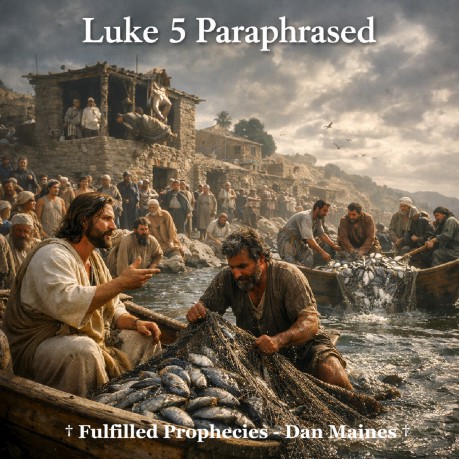
The crowd pressed in around Him as He stood by the
lake, eager to hear the message of God.
† The
hunger for truth was already building among the people.
†
This shows the shift from temple-centered teaching to Christ-centered
teaching (John 4:21-23).
† The word of God
was now being revealed through the Son, not the system (Hebrews
1:1-2).
Luke 5:2
He saw two boats by the
shore, and the fishermen had stepped out and were washing their
nets.
† These were ordinary men about to be
called into something greater.
† God uses
common people to accomplish His purposes (1 Corinthians 1:26-29).
†
The setting shows the beginning of a new work outside the religious
system.
Luke 5:3
He got into one of the
boats, which belonged to Simon, and asked him to push out a little
from shore, then He sat down and taught the crowd.
†
Teaching from the boat shows His authority over creation and His role
as teacher.
† Sitting was the posture of
authority in teaching.
† Simon is already
being drawn into his calling.
Luke 5:4
When
He finished speaking, He told Simon to go out deeper and let down the
nets for a catch.
† Jesus moves from teaching
to demonstration.
† Obedience to His word
leads to provision.
† This foreshadows the
gathering of people into the kingdom.
Luke 5:5
Simon
answered, saying they had worked all night and caught nothing, but he
would do it because Jesus said so.
† Faith
isn't based on circumstances but on His word.
†
This shows the beginning of trust in Christ.
†
Obedience comes before understanding.
Luke 5:6
When
they did this, they caught such a large number of fish that their
nets began to break.
† This shows the power
of Christ over creation.
† It symbolizes the
coming harvest of souls (Jeremiah 16:16).
†
The abundance points to the fullness of the new covenant work.
Luke
5:7
They signaled their partners in the other boat to
come help, and both boats were filled so full they began to sink.
†
The blessing overflowed beyond one group.
†
The gospel would extend beyond Israel to the nations.
†
The kingdom isn't limited, it's expanding.
Luke 5:8
When
Simon saw this, he fell at Jesus' knees and said he was a sinful man
and unworthy.
† True encounters with Christ
reveal our condition.
† This mirrors Isaiah's
response (Isaiah 6:5).
† Recognition of sin
is the beginning of transformation.
Luke 5:9
He
and all who were with him were amazed at the catch of fish.
†
Awe is the natural response to divine power.
†
This moment confirms Jesus' authority.
† It
prepares them for their calling.
Luke 5:10
James
and John were also amazed, and Jesus told Simon not to fear, because
from now on he would catch people.
† Fear is
replaced with purpose.
† The mission shifts
from fish to people.
† This is the beginning
of the gospel mission.
Luke 5:11
They
brought the boats to land, left everything, and followed Him.
†
True discipleship requires leaving the old life.
†
This shows total commitment.
† The call of
Christ overrides all else.
Luke 5:12
While
He was in a city, a man full of leprosy came and begged to be
cleansed.
† Leprosy represents uncleanness
under the Law.
† This shows the condition of
Israel under sin.
† The man recognizes Jesus
as the source of cleansing.
Luke 5:13
Jesus
touched him and said he was willing, and immediately the leprosy
left.
† Jesus touches what the Law declared
unclean.
† This shows the superiority of
Christ over the Law (Mark 1:41).
† Cleansing
comes through Him, not rituals.
Luke 5:14
He
told him not to tell anyone, but to show himself to the priest and
offer what Moses commanded.
† This confirms
the Law was still in effect at that time.
†
Jesus fulfills the Law while it was still standing.
†
This points to the transition period.
Luke 5:15
The
news spread even more, and large crowds gathered to hear Him and be
healed.
† The demand for truth and healing
was growing.
† The old system couldn't meet
their needs.
† Christ became the center.
Luke
5:16
But He would withdraw to deserted places and
pray.
† Even in power, He remained in
communion with the Father.
† This shows
dependence, not independence.
† Prayer
remained central.
Luke 5:17
One day He was
teaching, and Pharisees and teachers of the Law were present, and the
power of the Lord was there to heal.
† The
religious leaders were witnessing but not understanding.
†
The power of God was present in Christ.
†
This highlights the contrast between religion and truth.
Luke
5:18
Some men brought a paralyzed man on a bed and
tried to bring him in.
† Faith acts, it
doesn't wait.
† This shows determination to
reach Christ.
† The need for healing drives
action.
Luke 5:19
Unable to get in, they
went up on the roof and lowered him down before Jesus.
†
Obstacles don't stop real faith.
† This shows
persistence.
† Christ responds to faith.
Luke
5:20
Seeing their faith, He said the man's sins were
forgiven.
† The greater problem was sin, not
paralysis.
† Forgiveness comes first.
†
This reveals His authority.
Luke 5:21
The
scribes questioned how He could forgive sins.
†
They understood only God forgives sins.
†
They missed that God was standing before them.
†
Their blindness shows the failure of the system.
Luke
5:22
Jesus knew their thoughts and asked why they
questioned.
† He reveals divine knowledge.
†
This confirms His identity.
† Nothing is
hidden from Him.
Luke 5:23
He asked
whether it was easier to say sins are forgiven or to say get up and
walk.
† Both require divine authority.
†
He ties forgiveness to visible power.
† This
exposes their unbelief.
Luke 5:24
He told
the man to get up, take his bed, and go home, showing He had
authority to forgive sins.
† The miracle
confirms the authority.
† The visible proves
the invisible.
† Christ has authority over
sin.
Luke 5:25
Immediately the man stood
up, took what he had been lying on, and went home glorifying God.
†
Restoration was complete.
† Healing leads to
praise.
† This shows the power of Christ in
action.
Luke 5:26
Everyone was amazed and
glorified God, filled with fear.
† The people
recognized something divine.
† Fear here
means reverence.
† This shows the impact of
Christ's work.
Luke 5:27
After that, He
saw a tax collector named Levi and told him to follow Him.
†
Levi was rejected by society.
† Christ calls
the outcast.
† This shows grace over
status.
Luke 5:28
Levi left everything and
followed Him.
† Immediate obedience.
†
No hesitation.
† This is true
discipleship.
Luke 5:29
Levi held a large
feast for Him, and many tax collectors were there.
†
The gospel reaches the rejected.
† Fellowship
replaces separation.
† This shows
inclusion.
Luke 5:30
The Pharisees
complained about eating with sinners.
†
Religion separates, Christ restores.
† They
focused on status, not truth.
† This reveals
their hearts.
Luke 5:31
Jesus said the
healthy don't need a doctor, but the sick do.
†
He defines His mission.
† He came for the
broken.
† This exposes the
self-righteous.
Luke 5:32
He said He came
to call sinners to repentance.
† The call is
to change direction.
† This is the purpose of
His ministry.
† It points to
transformation.
Luke 5:33
They questioned
why His disciples didn't fast like others.
†
They compared outward practices.
† They
missed the reality before them.
† Religion
focuses on form.
Luke 5:34
Jesus said you
can't make wedding guests fast while the bridegroom is with them.
†
He identifies Himself as the bridegroom.
†
This is a time of fulfillment, not mourning.
†
The kingdom had arrived.
Luke 5:35
He said
the time would come when He would be taken away, and then they would
fast.
† This points to His death.
†
It shows a coming change.
† The transition
was underway.
Luke 5:36
He spoke of not
putting new cloth on old garments.
† The new
covenant can't be patched onto the old.
†
They are incompatible.
† This shows a full
replacement.
Luke 5:37
He said new wine
isn't put into old wineskins.
† The new work
can't fit into old structures.
† The Law
system couldn't contain it.
† Something new
was happening.
Luke 5:38
New wine must be
put into fresh wineskins.
† The new covenant
requires a new framework.
† This is fulfilled
in Christ.
† The old system was fading.
Luke
5:39
People used to old wine don't want the new because
they say the old is better.
† Many resisted
the change.
† Tradition blinds people.
†
This explains rejection of Christ.
Historical
References
† Josephus describes the
corruption and failure of the priesthood leading up to AD 70.
†
Eusebius records how the early believers followed Christ and
separated from the old system.
† Irenaeus
speaks of Christ fulfilling the Law and bringing in the new
covenant.
† Clement of Alexandria explains
the transition from shadow to reality in Christ.
How It
Applies To Us Today
† We don't try
to mix old covenant thinking with what Christ has already
fulfilled.
† We trust His finished work
instead of striving under a system that ended.
†
We follow Him fully, just like the disciples did.
†
We recognize that the kingdom was established, not future.
Q
& A Appendix
Q What does the catch
of fish represent?
A It represents the
gathering of people into the kingdom (Jeremiah 16:16)
Q
Why did Jesus forgive sins before healing?
A
Because sin was the greater issue, and He has authority over it
(Isaiah 53:5)
Q What do the wineskins
represent?
A The old covenant system versus the
new covenant in Christ (Hebrews 8:13)
Q Why did
the Pharisees reject Him?
A Because they clung
to tradition and missed fulfillment (Isaiah 29:13)
Q
What does leaving everything mean?
A It shows
full commitment to Christ over the old life (Philippians 3:8)
†
This is the fulfilled perspective we proclaim at Fulfilled Prophecies
†
© Fulfilled Prophecies - Dan Maines.
Source
Index
† Luke 5
†
Josephus, Wars of the Jews
† Irenaeus,
Against Heresies
† Eusebius, Ecclesiastical
History
† Clement of Alexandria, Stromata
Links