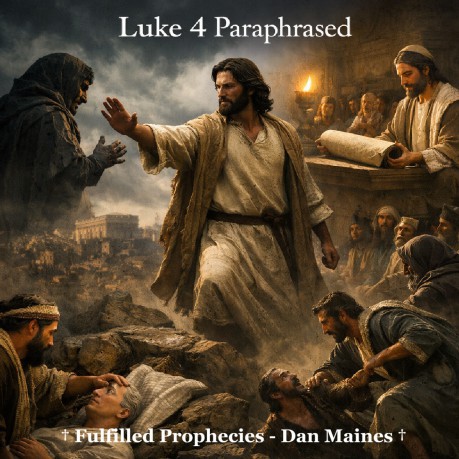
Luke 4
Paraphrased
By Dan Maines
Introduction
†
This chapter shows Jesus being tested, declaring His mission, and
proving His authority in Israel
† It reveals
that the promised time of fulfillment had arrived in their
generation
† It also shows rejection from His
own people and power over demons and sickness
Luke
4:1
Jesus, filled with the Holy Spirit, left the Jordan
and was led by the Spirit into the wilderness
†
The Spirit leads Him into testing, showing this was part of God's
plan (Matthew 4:1)
† This connects to Israel
in the wilderness, but He succeeds where they failed (Deuteronomy
8:2)
† Irenaeus said Christ retraced Israel's
steps and overcame where they fell
Luke 4:2
He
was there for forty days being tempted by the devil, and He ate
nothing during that time, and when it ended He was hungry
†
The forty days mirror Israel's forty years, showing a covenant
testing pattern (Numbers 14:33)
† Hunger
highlights His humanity, yet He remains obedient
†
Eusebius noted this as preparation for His public ministry
Luke
4:3
The devil said to Him, If You are the Son of God,
tell this stone to become bread
† The
temptation challenges His identity and trust in God
†
Satan attacks where there is physical weakness
†
Tertullian wrote that the enemy always tests what God has
declared
Luke 4:4
Jesus answered him, It
is written, Man shall not live on bread alone
†
Jesus responds with Scripture, showing the authority of God's word
(Deuteronomy 8:3)
† Life is sustained by God,
not just physical provision
† Clement of
Alexandria emphasized reliance on divine truth over material
need
Luke 4:5
And he led Him up and showed
Him all the kingdoms of the world in a moment of time
†
This represents worldly authority and dominion
†
The offer is immediate power without suffering
†
This reflects Satan's limited control over earthly systems
Luke
4:6
And the devil said to Him, I will give You all this
domain and its glory, for it has been handed over to me, and I give
it to whoever I wish
† Satan claims
authority, but it's temporary and permitted
†
This shows the corrupted state of the world
†
Early writers noted this as a false shortcut to kingship
Luke
4:7
Therefore if You worship before me, it shall all be
Yours
† The temptation is idolatry in
exchange for power
† This is a direct
violation of the first commandment
† It
reveals Satan's goal, worship
Luke 4:8
Jesus
answered and said to him, It is written, You shall worship the Lord
your God and serve Him only
† Jesus stands
firm on exclusive worship (Deuteronomy 6:13)
†
Authority comes through obedience, not compromise
†
Irenaeus taught that Christ restored true worship through
obedience
Luke 4:9
And he led Him to
Jerusalem and had Him stand on the pinnacle of the temple, and said
to Him, If You are the Son of God, throw Yourself down from here
†
The setting shifts to the temple, the center of Israel's worship
†
This temptation targets public display and pride
†
It challenges God's protection
Luke 4:10
For
it is written, He will command His angels concerning You to guard
You
† Satan twists Scripture for deception
(Psalm 91:11)
† This shows misuse of truth
†
Early church fathers warned against taking Scripture out of
context
Luke 4:11
And, On their hands they
will bear You up, so that You will not strike Your foot against a
stone
† Partial truth is used to justify
testing God
† Protection promises are not
meant for reckless actions
Luke 4:12
And
Jesus answered and said to him, It is said, You shall not put the
Lord your God to the test
† Jesus corrects
misuse with proper application (Deuteronomy 6:16)
†
Faith does not demand proof from God
† This
reflects Israel's failure in the wilderness
Luke
4:13
When the devil had finished every temptation, he
left Him until an opportune time
† The
testing ends, but opposition continues
† This
shows ongoing spiritual conflict
† Eusebius
noted this marked the start of open ministry opposition
Luke
4:14
And Jesus returned to Galilee in the power of the
Spirit, and news about Him spread through all the surrounding
district
† His ministry begins with power and
recognition
† The Spirit empowers His work
†
Fame spreads quickly
Luke 4:15
And He
began teaching in their synagogues and was praised by all
†
Initially, He is accepted and honored
†
Teaching was central to His mission
Luke 4:16
And
He came to Nazareth, where He had been brought up, and as was His
custom, He entered the synagogue on the Sabbath, and stood up to
read
† He returns to His hometown
†
This sets up the coming rejection
† Synagogue
reading was a normal teaching setting
Luke 4:17
And
the book of the prophet Isaiah was handed to Him, and He opened the
book and found the place where it was written
†
He intentionally selects a prophetic passage
†
This shows fulfillment is about to be declared
Luke
4:18
The Spirit of the Lord is upon Me, because He
anointed Me to preach good news to the poor, He has sent Me to
proclaim release to the captives, recovery of sight to the blind, to
set free those who are oppressed
† This
defines His mission from Isaiah 61
† It shows
fulfillment happening in their time
†
Irenaeus taught this proves Christ as the promised anointed one
Luke
4:19
To proclaim the favorable year of the Lord
†
This refers to Jubilee restoration
† It marks
covenant fulfillment
Luke 4:20
And He
closed the book, gave it back to the attendant and sat down, and the
eyes of all in the synagogue were fixed on Him
†
All attention is on Him
† The moment of
declaration is set
Luke 4:21
And He began
to say to them, Today this Scripture has been fulfilled in your
hearing
† Fulfillment is present, not
future
† This directly supports the fulfilled
perspective
† Eusebius noted this as a clear
time statement
Luke 4:22
And all were
speaking well of Him, and wondering at the gracious words which were
falling from His lips, and they were saying, Is this not Joseph's
son
† They admire Him but doubt His
identity
† Familiarity leads to unbelief
Luke
4:23
And He said to them, No doubt you will quote this
proverb to Me, Physician, heal yourself, whatever we heard was done
at Capernaum, do here in your hometown as well
†
They demand signs
† This shows unbelief
seeking proof
Luke 4:24
And He said, Truly
I say to you, no prophet is welcome in his hometown
†
Rejection is expected
† This is a pattern in
Israel's history
Luke 4:25
But I say to
you in truth, there were many widows in Israel in the days of
Elijah
† He reminds them of past rejection
†
God worked outside Israel
Luke 4:26
And
yet Elijah was sent to none of them, but only to Zarephath, in the
land of Sidon, to a woman who was a widow
†
God's grace extended to Gentiles
† This
challenges Jewish exclusivity
Luke 4:27
And
there were many lepers in Israel in the time of Elisha the prophet,
and none of them was cleansed, but only Naaman the Syrian
†
Again, Gentile inclusion
† This provokes
anger
Luke 4:28
And all the people in the
synagogue were filled with rage as they heard these things
†
Truth exposes pride and leads to anger
†
Rejection intensifies
Luke 4:29
And they
got up and drove Him out of the city, and led Him to the brow of the
hill on which their city had been built, in order to throw Him down
the cliff
† They attempt to kill Him
†
This shows total rejection
Luke 4:30
But
passing through their midst, He went His way
†
He escapes unharmed
† His time had not yet
come
Luke 4:31
And He came down to
Capernaum, a city of Galilee, and He was teaching them on the
Sabbath
† Ministry continues elsewhere
†
Authority shifts locations
Luke 4:32
And
they were amazed at His teaching, for His message was with
authority
† His authority is unmatched
†
This contrasts with traditional teachers
Luke 4:33
In
the synagogue there was a man possessed by the spirit of an unclean
demon, and he cried out with a loud voice
†
Demonic presence is exposed
† Evil reacts to
truth
Luke 4:34
Let us alone, what
business do we have with each other, Jesus of Nazareth, have You come
to destroy us, I know who You are, the Holy One of God
†
Demons recognize His identity
† Spiritual
authority is revealed
Luke 4:35
But Jesus
rebuked him, saying, Be quiet and come out of him, and when the demon
had thrown him down in the midst of the people, he came out of him
without doing him any harm
† Jesus commands
with authority
† Deliverance is
immediate
Luke 4:36
And amazement came
upon them all, and they began talking with one another saying, What
is this message, for with authority and power He commands the unclean
spirits and they come out
† The people
recognize His power
† Authority confirms His
identity
Luke 4:37
And the report about
Him was spreading into every locality in the surrounding district
†
His fame continues to grow
Luke 4:38
Then
He got up and left the synagogue, and entered Simon's home, now
Simon's mother-in-law was suffering from a high fever, and they asked
Him to help her
† Personal healing shows
compassion
† His power extends beyond public
ministry
Luke 4:39
And standing over her,
He rebuked the fever, and it left her, and she immediately got up and
waited on them
† Immediate healing confirms
authority
† Restoration is complete
Luke
4:40
While the sun was setting, all those who had any
who were sick with various diseases brought them to Him, and laying
His hands on each one of them, He was healing them
†
Healing continues widely
† His power is
consistent
Luke 4:41
Demons also were
coming out of many, shouting, You are the Son of God, but rebuking
them, He would not allow them to speak, because they knew Him to be
the Christ
† He controls the revelation of
His identity
† Demons testify but are
silenced
Luke 4:42
When day came, Jesus
left and went to a secluded place, and the crowds were searching for
Him, and came to Him and tried to keep Him from going away from
them
† People seek Him for what He provides
†
He doesn't stay in one place
Luke 4:43
But
He said to them, I must preach the kingdom of God to the other cities
also, for I was sent for this purpose
† His
mission is broader than one location
† The
kingdom message is central
Luke 4:44
So He
kept on preaching in the synagogues of Judea
†
His ministry continues throughout the region
†
The message spreads across Israel
Historical
References
† Josephus records unrest
and expectation of deliverance in this time
†
Irenaeus, Against Heresies, affirms Christ fulfilling Isaiah's
prophecy
† Eusebius, Ecclesiastical History,
confirms early recognition of fulfillment
†
Clement of Alexandria, Stromata, teaches Christ as the true teacher
of righteousness
How It Applies To Us Today
†
Jesus already fulfilled the mission He declared, we're living in that
completed reality
† We don't wait for
deliverance, it's already been accomplished
†
His authority over sin, death, and evil is already established
†
We walk in the freedom He proclaimed, not in expectation of a future
system
Q & A Appendix
Q What did Jesus
mean by Today this Scripture has been fulfilled
A He was
declaring fulfillment in their present time, not a future age Luke
4:21
Q Why was He tempted in the wilderness
A To succeed
where Israel failed and prove obedience Deuteronomy 8:3
Q Why
did the people reject Him in Nazareth
A Because familiarity led
to unbelief Luke 4:24
Q What does His authority over demons
show
A That the kingdom had already arrived Luke 4:36
Q Why
did He silence the demons
A Because revelation of His identity
followed God's timing Luke 4:41
† This is the
fulfilled perspective we proclaim at Fulfilled Prophecies †
©
Fulfilled Prophecies - Dan Maines.
Source Index
†
Luke 4
† Josephus, Wars of the Jews
†
Irenaeus, Against Heresies
† Eusebius,
Ecclesiastical History
† Clement of
Alexandria, Stromata
Links