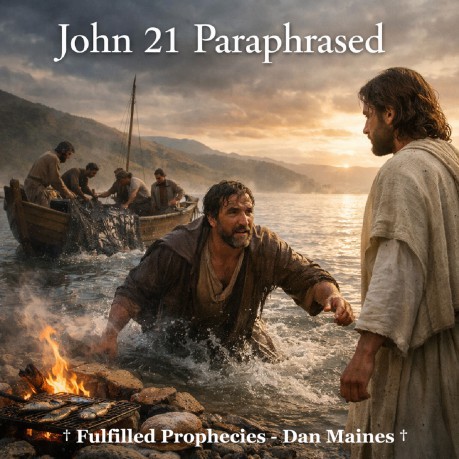
John 21 Paraphrased Introduction John 21:1 John 21:2 John 21:3 John 21:4 John 21:5 John 21:6 John 21:7 John 21:8 John 21:9 John 21:10 John 21:11 John 21:12 John 21:13 John 21:14 John 21:15 John 21:16 John 21:17 John 21:18 John 21:19 John 21:20 John 21:21 John 21:22 John 21:23 John 21:24 John 21:25 Historical References How It Applies To Us Today Q & A Appendix: Q: Why was Peter restored three times? Q: What does the miracle of fish represent? Q: Was the resurrection already active at this
time? Q: Does this chapter point to future
fulfillment? † This is the fulfilled perspective we proclaim at
Fulfilled Prophecies † Source Index
By Dan Maines
† This final
chapter shows Jesus after His resurrection, appearing again to His
disciples, proving His work was complete and His authority fully
established
† It also restores Peter and
confirms the mission going forward, not in a future age, but in their
generation where fulfillment was unfolding
†
The focus is not delay, but confirmation, restoration, and commission
before the end of that covenant age
After these things Jesus showed
Himself again to the disciples by the Sea of Tiberias, and this is
how it happened
† Jesus is appearing in the
same world, same place, showing continuity after resurrection
†
This isn't a different realm, but confirmation that He is alive among
them (Acts 1:3)
† The resurrection is already
active and visible
Simon Peter, Thomas called the
Twin, Nathanael from Cana in Galilee, the sons of Zebedee, and two
others were together
† The witnesses are
specific, grounded in real people and history
†
Multiple eyewitnesses confirm what follows (1 Corinthians 15:5-7)
†
This is not symbolic, but actual historical appearance
Simon Peter said I'm going
fishing, and they said we'll go with you, so they went out and got
into the boat, but that night they caught nothing
†
They return to their old life temporarily, showing uncertainty
†
Without Christ's direction, their efforts produce nothing (John
15:5)
† This sets up the lesson of dependence
When day was breaking, Jesus stood
on the shore, but the disciples didn't know it was Him
†
Recognition isn't immediate, showing a transformed yet real
presence
† This echoes earlier resurrection
appearances (Luke 24:16)
† Their
understanding is still unfolding
Jesus said children, you don't
have any fish, do you, and they answered no
†
Jesus initiates the moment, guiding them again
†
Their lack highlights their need for Him
†
This mirrors earlier calling moments (Luke 5:5)
He said cast the net on the right
side of the boat and you'll find a catch, so they cast and couldn't
haul it in because of the great number of fish
†
Obedience brings immediate provision
† This
is a clear sign connecting back to their original calling
†
It shows His authority still governs their work
The disciple whom Jesus loved said
to Peter it's the Lord, so when Peter heard it he put on his outer
garment and threw himself into the sea
†
Recognition comes through understanding, not just sight
†
Peter's response shows urgency and restored affection
†
This contrasts his earlier denial
The other disciples came in the
boat dragging the net full of fish, for they weren't far from land
†
The miracle is practical and visible
† The
group witnesses it together
† This reinforces
shared testimony
When they got out on land they saw
a charcoal fire already laid and fish placed on it and bread
†
Jesus provides what they couldn't produce
†
The setting recalls Peter's denial by a charcoal fire (John 18:18)
†
Restoration is about to take place
Jesus said bring some of the fish
you have just caught
† They participate in
what He already provided
† This shows
partnership, not independence
† Their work
now flows from His authority
Simon Peter went up and drew the
net to land full of large fish, one hundred fifty three, and although
there were so many the net wasn't torn
† The
detail shows eyewitness accuracy
† The
unbroken net points to preservation and completeness
†
This reflects the gathering of people without loss
Jesus said come and have
breakfast, none of the disciples dared ask who are You knowing it was
the Lord
† Recognition is now settled
†
There's reverence and certainty
† The
relationship is restored and strengthened
Jesus came and took the bread and
gave it to them and the fish likewise
† This
mirrors earlier fellowship and provision
† It
echoes covenant meal imagery (Luke 24:30)
†
He remains the source of life
This was now the third time Jesus
was revealed to the disciples after He was raised from the dead
†
Repeated appearances confirm reality
† This
establishes certainty before their mission begins
†
The resurrection isn't hidden, it's proven
When they finished breakfast
Jesus said Simon son of John do you love Me more than these, he said
yes Lord You know I love You, He said tend My lambs
†
Peter is being restored after denial
† Love
is tied to responsibility
† Leadership flows
from devotion
He said again do you love Me, he
said yes Lord You know I love You, He said shepherd My sheep
†
Repetition confirms restoration
† The role
expands from lambs to sheep
† Care for the
people of God is central
He said the third time do you
love Me, Peter was grieved and said Lord You know all things You know
I love You, Jesus said tend My sheep
†
Threefold restoration matches three denials
†
Peter's grief shows sincerity
† Christ
restores fully, not partially
Truly I say to you when you were
younger you used to dress yourself and walk where you wished, but
when you grow old you'll stretch out your hands and someone else will
carry you where you don't wish
† This
predicts Peter's death
† It shows the cost of
following Christ
† Fulfillment includes
suffering within their lifetime
He said this to show by what kind
of death he would glorify God, and after saying this He said follow
Me
† Death itself becomes testimony
†
Following Christ includes total commitment
†
This happens within that generation
Peter turned and saw the disciple
whom Jesus loved following them
† Comparison
begins to enter Peter's mind
† This sets up a
correction
† Each disciple has a distinct
role
Peter said Lord what about this
man
† Peter looks at another's path
†
This reflects human tendency
† Christ
redirects focus
Jesus said if I want him to
remain until I come what is that to you, you follow Me
†
Jesus speaks of His coming within their timeframe
†
This ties directly to the coming judgment of that age (Matthew
16:27-28)
† The focus is personal
faithfulness
So the saying spread that this
disciple wouldn't die, yet Jesus didn't say that, but if I want him
to remain until I come what is that to you
†
Misunderstanding spreads quickly
† Jesus'
words were about timing, not immortality
†
This again confirms a near coming
This is the disciple who
testifies to these things and wrote them, and we know his testimony
is true
† The author affirms eyewitness
truth
† This is grounded in real testimony
†
The account is reliable
There are also many other things
Jesus did, if they were written in detail I suppose the world itself
wouldn't contain the books
† The works of
Christ are vast beyond record
† What is
written is sufficient for faith
† The focus
remains on what was fulfilled and revealed
†
Josephus records the events leading up to the fall of Jerusalem,
confirming the timeframe of judgment within that generation
†
Irenaeus affirms apostolic testimony as grounded in eyewitness
accounts
† Eusebius preserves early church
understanding of these events happening in the first century
†
Clement of Alexandria speaks of the apostles' roles and martyrdom
within that period
†
We see that Christ's work is complete and proven, not waiting for
fulfillment
† Our role is the same as
Peter's, follow Him faithfully without distraction
†
We don't compare callings, we walk in what we've been given
†
The kingdom is established, and we live in the reality of that
finished work
† His authority still directs
our lives just as it directed theirs
Q: Did
Jesus already come as He said in this passage?
A:
Yes, Matthew 16:27-28 shows His coming would happen in their lifetime
A:
It matches his three denials and shows complete restoration
A:
It shows success only comes through Christ's authority (John 15:5)
A: Yes, Jesus appeared physically and
interacted with them (Acts 1:3)
A: No, it confirms events
unfolding in their generation
© Fulfilled Prophecies - Dan
Maines.
† John 21
†
Josephus, Wars of the Jews
† Irenaeus,
Against Heresies
† Eusebius, Ecclesiastical
History
† Clement of Alexandria, Stromata
Links