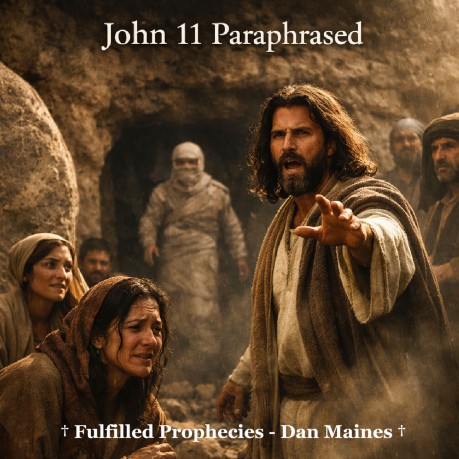
John 11
Paraphrased
By Dan Maines
Introduction
†
This chapter shows the raising of Lazarus, but it is not just about a
miracle, it's about revealing Christ as the resurrection and the life
in that generation (John 5:25)
† Jesus delays
on purpose, showing that God's timing is tied to His glory, not man's
urgency
† This event points forward to the
greater resurrection reality fulfilled in that generation, when death
as a covenant separation was removed (1 Corinthians 15:54)
John
11:1
A man named Lazarus was sick, he was from Bethany,
the village of Mary and her sister Martha
†
This sets the stage, Lazarus represents more than an individual, he
becomes a sign
† Bethany was close to
Jerusalem, placing this event right near the center of coming
judgment (John 11:18)
† God often uses real
people to reveal spiritual truths
John 11:2
This
was the same Mary who would later anoint the Lord with perfume and
wipe His feet with her hair, her brother Lazarus was sick
†
John connects this to a known act, showing continuity of witness
†
This highlights devotion and recognition of Jesus' authority
†
The family already had faith, yet still faced suffering
John
11:3
So the sisters sent word to Jesus saying, Lord,
the one you love is sick
† Their appeal is
based on relationship, not works
† They
expected immediate help, but Jesus responds differently
†
Love does not always mean immediate relief
John
11:4
When Jesus heard this He said, this sickness will
not end in death, but is for God's glory, so the Son of God may be
glorified through it
† Jesus reveals the
purpose before the outcome
† Death here is
not final, pointing to a greater reality
†
Glory is the goal, not comfort
John 11:5
Now
Jesus loved Martha and her sister and Lazarus
†
This confirms His delay is not lack of care
†
Love sometimes allows hardship for a greater purpose
†
God's love works through deeper plans
John 11:6
So
when He heard that Lazarus was sick, He stayed two days longer in the
place where He was
† This delay is
intentional
† Jesus is not reacting, He is
directing events
† Timing is tied to
revelation
John 11:7
Then after this He
said to the disciples, let us go to Judea again
†
Jesus moves toward danger willingly
† Judea
is where opposition is strongest
† This shows
His authority over fear
John 11:8
The
disciples said to Him, Rabbi, the Jews were just now trying to stone
You, and You are going there again
† They are
thinking naturally
† Fear of man clouds
understanding
† Jesus is not governed by
threats
John 11:9
Jesus answered, are
there not twelve hours in the day, if anyone walks in the day, he
does not stumble, because he sees the light of this world
†
Jesus speaks of divine timing
† Walking in
the light means walking in God's will
† There
is a set time for everything
John 11:10
But
if anyone walks in the night, he stumbles, because the light is not
in him
† Darkness represents ignorance and
fear
† Without Christ, people stumble
†
This applies spiritually, not just physically
John
11:11
He said these things, and after that He said to
them, our friend Lazarus has fallen asleep, but I go so that I may
awaken him
† Jesus calls death sleep
†
This shows His authority over death
†
Awakening points to resurrection
John 11:12
The
disciples then said to Him, Lord, if he has fallen asleep, he will
recover
† They misunderstand again
†
Natural thinking misses spiritual meaning
†
Jesus speaks beyond the physical
John 11:13
Now
Jesus had spoken of his death, but they thought that He was speaking
of literal sleep
† Clarifies their
confusion
† This shows how often spiritual
truth is missed
† Understanding requires
revelation
John 11:14
So Jesus then said
to them plainly, Lazarus is dead
† Jesus
removes ambiguity
† Death is real, but not
final
† Truth is sometimes direct
John
11:15
And I am glad for your sakes that I was not
there, so that you may believe, but let us go to him
†
His absence served a purpose
† Faith is
strengthened through what seems like delay
†
Belief grows through revelation
John 11:16
Therefore
Thomas, who is called Didymus, said to his fellow disciples, let us
also go, so that we may die with Him
† Thomas
shows loyalty mixed with fear
† They expected
danger
† Their understanding was still
limited
John 11:17
So when Jesus came, He
found that he had already been in the tomb four days
†
Four days confirms death was certain
† There
is no doubt about the situation
† This
magnifies the miracle
John 11:18
Now
Bethany was near Jerusalem, about two miles away
†
Close proximity to Jerusalem ties this to coming judgment
†
Many witnesses would see this
† This is a
public sign
John 11:19
And many of the
Jews had come to Martha and Mary, to console them concerning their
brother
† Large crowd increases the impact
†
This is not hidden
† Witnesses matter in
testimony
John 11:20
Martha then, when she
heard that Jesus was coming, went to meet Him, but Mary stayed at the
house
† Martha acts quickly
†
Mary remains in grief
† Different responses
to pain
John 11:21
Martha then said to
Jesus, Lord, if You had been here, my brother would not have died
†
She believes in His power
† Yet she limits it
to presence
† Faith is growing but
incomplete
John 11:22
Even now I know that
whatever You ask of God, God will give You
†
She still has hope
† She recognizes His
authority
† Faith is mixed with
uncertainty
John 11:23
Jesus said to her,
your brother will rise again
† Jesus speaks
truth directly
† This points to
resurrection
† But she misunderstands
timing
John 11:24
Martha said to Him, I
know that he will rise again in the resurrection on the last day
†
She holds a future expectation
† This
reflects common belief
† But Jesus shifts it
to present reality
John 11:25
Jesus said
to her, I am the resurrection and the life, the one who believes in
Me will live even if he dies
† Resurrection
is not just an event, it is a person
† Life
is found in Him
† This is fulfilled in that
generation
John 11:26
And everyone who
lives and believes in Me will never die, do you believe this
†
This speaks of spiritual death
† Believers
are no longer separated from God
† This is
covenant life
John 11:27
She said to Him,
yes Lord, I have believed that You are the Christ, the Son of God,
who comes into the world
† She confesses
truth
† Recognition of identity is key
†
Faith is growing
John 11:28
When she had
said this, she went away and called Mary her sister, saying secretly,
the Teacher is here and is calling for you
†
She shares the message
† Jesus calls
individuals personally
† This reflects
invitation
John 11:29
And when she heard
it, she got up quickly and was coming to Him
†
Mary's response is immediate
† Hearing leads
to action
† Faith responds
John
11:30
Now Jesus had not yet come into the village, but
was still in the place where Martha met Him
†
He remains outside
† Timing and movement are
intentional
† Everything unfolds by
design
John 11:31
Then the Jews who were
with her in the house, consoling her, when they saw that Mary got up
quickly and went out, they followed her, thinking that she was going
to the tomb to weep there
† The crowd
continues to follow
† More witnesses are
gathered
† This is building toward
revelation
John 11:32
Therefore, when Mary
came where Jesus was, she saw Him and fell at His feet, saying to
Him, Lord, if You had been here, my brother would not have died
†
Same words as Martha
† Shows shared belief
†
Yet still limited understanding
John 11:33
When
Jesus therefore saw her weeping, and the Jews who came with her also
weeping, He was deeply moved in spirit and troubled
†
Jesus enters into human sorrow
† He is not
detached
† Compassion is real
John
11:34
And He said, where have you laid him, they said
to Him, Lord, come and see
† He invites them
into the moment
† Action follows compassion
†
He engages directly
John 11:35
Jesus
wept
† Short but powerful
†
Shows true humanity
† He shares in grief
John
11:36
So the Jews were saying, see how He loved him
†
They recognize His love
† His emotions are
visible
† Love is demonstrated
John
11:37
But some of them said, could not this man, who
opened the eyes of the blind, have also kept this man from dying
†
Doubt enters
† People question His power
†
Unbelief is present
John 11:38
So Jesus,
again being deeply moved within, came to the tomb, now it was a cave,
and a stone was lying against it
† The tomb
represents death
† The stone represents
finality
† Jesus approaches both
John
11:39
Jesus said, remove the stone, Martha, the sister
of the deceased, said to Him, Lord, by this time there will be a
stench, for he has been dead four days
† She
focuses on decay
† Natural thinking again
†
Jesus moves beyond it
John 11:40
Jesus
said to her, did I not say to you that if you believe, you will see
the glory of God
† Faith precedes sight
†
Glory is revealed through belief
† Trust is
required
John 11:41
So they removed the
stone, then Jesus raised His eyes and said, Father, I thank You that
You have heard Me
† Public prayer
†
Shows unity with the Father
† This is for the
witnesses
John 11:42
I knew that You
always hear Me, but because of the people standing around I said it,
so that they may believe that You sent Me
†
This is for their faith
† Jesus reveals His
mission
† Belief is the goal
John
11:43
When He had said these things, He cried out with
a loud voice, Lazarus, come out
† Authority
over death
† His voice gives life
†
This is a command, not a request
John 11:44
The
man who had died came out, bound hand and foot with wrappings, and
his face was wrapped around with a cloth, Jesus said to them, unbind
him, and let him go
† Life restored
†
Others participate in freeing him
† This
shows transition from death to life
John 11:45
Therefore
many of the Jews who came to Mary, and saw what He had done, believed
in Him
† The sign leads to belief
†
Witness produces faith
† This fulfills
purpose
John 11:46
But some of them went
to the Pharisees and told them the things which Jesus had done
†
Others reject
† Truth divides
†
Opposition grows
John 11:47
Therefore the
chief priests and the Pharisees convened a council, and were saying,
what are we doing, for this man is performing many signs
†
They acknowledge the signs
† Yet refuse to
believe
† Hardness of heart
John
11:48
If we let Him go on like this, all men will
believe in Him, and the Romans will come and take away both our place
and our nation
† Fear of losing power
†
Self-interest drives rejection
† This reveals
their motives
John 11:49
But one of them,
Caiaphas, who was high priest that year, said to them, you know
nothing at all
† Leadership speaks
arrogantly
† They think politically
†
Not spiritually
John 11:50
Nor do you take
into account that it is better for you that one man die for the
people, and that the whole nation not perish
†
He unknowingly prophesies
† Christ would die
for the people
† This is substitution
John
11:51
Now he did not say this on his own, but being
high priest that year, he prophesied that Jesus was going to die for
the nation
† God uses even enemies
†
Truth comes through unexpected means
† This
confirms purpose
John 11:52
And not for
the nation only, but also in order that He might gather together into
one the children of God who are scattered abroad
†
This includes the nations
† Unity in Christ
†
Fulfillment of gathering
John 11:53
So
from that day on they planned together to kill Him
†
Decision is made
† Rejection is complete
†
Judgment is coming
John 11:54
Therefore
Jesus no longer continued to walk publicly among the Jews, but went
away from there to the country near the wilderness, into a city
called Ephraim, and there He stayed with the disciples
†
He withdraws
† Timing continues
†
The final moments are approaching
John 11:55
Now
the Passover of the Jews was near, and many went up to Jerusalem out
of the country before the Passover to purify themselves
†
The setting is Passover
† This connects to
His sacrifice
† Timing is exact
John
11:56
So they were seeking for Jesus, and were saying
to one another as they stood in the temple, what do you think, that
He will not come to the feast at all
†
Expectation builds
† The people are
watching
† Tension rises
John
11:57
Now the chief priests and the Pharisees had given
orders that if anyone knew where He was, he was to report it, so that
they might seize Him
† Opposition is
organized
† The plot is set
†
This leads directly to the cross
Historical References
†
Josephus records the tension in Jerusalem leading up to its
destruction, showing how leadership rejected truth and sought
control
† Eusebius wrote that the signs of
Jesus were widely known and contributed to both belief and
opposition
† Irenaeus affirmed that Christ's
works revealed life overcoming death, pointing to the greater
fulfillment
† Clement of Alexandria taught
that Christ's works were signs of spiritual truths, not just physical
events
How It Applies To Us Today
†
We trust God's timing even when it seems delayed
†
We understand that life in Christ means no separation from God
†
We walk in the light, not fear
† We see that
belief brings life now, not just in the future
†
We recognize that Christ already fulfilled resurrection life
Q
& A Appendix:
Q: What does Lazarus
represent
A: He represents the power of Christ
over death and points to the greater resurrection reality fulfilled
in that generation (John 5:25)
Q: Why did Jesus
delay
A: To reveal God's glory and strengthen
belief (John 11:4, 15)
Q: What does it mean
that Jesus is the resurrection
A: It means life
is found in Him, not in a future event (John 11:25-26)
Q:
Why did some believe and others reject
A:
Because truth reveals hearts, some respond in faith, others in fear
(John 11:45-46)
Q: What does this teach about
death
A: That in Christ, death is no longer
separation from God (1 Corinthians 15:54)
† This is
the fulfilled perspective we proclaim at Fulfilled Prophecies †
©
Fulfilled Prophecies - Dan Maines.
Source Index
†
John 11
† Josephus, Antiquities of the Jews
†
Irenaeus, Against Heresies
† Eusebius,
Ecclesiastical History
† Clement of
Alexandria, Stromata
Links