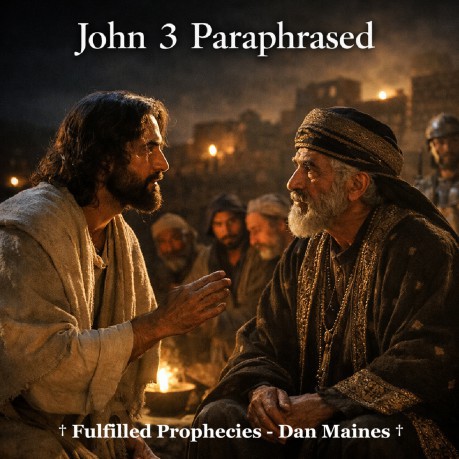
John 3
Paraphrased
By Dan Maines
Introduction
†
Jesus is revealing spiritual truth to a leader of Israel, showing
that entrance into the kingdom was not about physical descent but
about transformation.
† This chapter exposes
the failure of Israel's leadership to understand the promises given
to them.
† The focus is on transition, from
fleshly identity under the Old Covenant to spiritual life in Christ
before judgment came on that generation.
John 3:1
There
was a man from the Pharisees named Nicodemus, a ruler among the
Jews
† This shows he had authority and
knowledge, yet he still lacked understanding (Matthew 23:2-3)
†
Leadership in Israel did not guarantee spiritual insight
†
Even those teaching the law were in darkness without Christ
John
3:2
He came to Jesus at night and said, Rabbi, we know
you are a teacher from God, because no one can do these signs unless
God is with him
† Coming at night shows fear
of men and lack of boldness (John 12:42-43)
†
He recognized truth but had not yet submitted to it
†
Many saw the signs but did not understand the purpose
John
3:3
Jesus answered him, unless someone is born again he
cannot see the kingdom of God
† Jesus goes
straight to the heart, not outward religion but inward
transformation
† Seeing the kingdom was tied
to spiritual rebirth, not lineage
† This was
about entering the new covenant reality
John
3:4
Nicodemus said, how can a man be born when he is
old, he cannot enter his mother's womb again, can he
†
He is thinking physically, missing the spiritual meaning
†
Israel often misunderstood spiritual truths (Isaiah 6:9-10)
†
This shows the blindness of the leaders
John 3:5
Jesus
answered, unless someone is born of water and the Spirit he cannot
enter the kingdom of God
† Water points to
cleansing, Spirit points to transformation (Ezekiel 36:25-27)
†
This is covenant language, not physical birth
†
It connects to promises God gave Israel about renewal
John
3:6
What is born of flesh is flesh, and what is born of
the Spirit is spirit
† Natural descent from
Abraham was not enough
† Flesh refers to the
old covenant identity
† Spirit refers to new
life through Christ
John 3:7
Do not be
amazed that I said you must be born again
†
This should have been understood by a teacher of Israel
†
The prophets already spoke of renewal
† Their
surprise shows how far they had drifted
John 3:8
The
wind blows where it wishes, and you hear its sound but do not know
where it comes from or where it is going, so is everyone born of the
Spirit
† The Spirit's work is unseen but
real
† God moves beyond human control or
expectation
† This emphasizes divine action,
not human effort
John 3:9
Nicodemus
answered, how can these things be
† Again,
confusion shows lack of understanding
† He
knew scripture but did not grasp its fulfillment
†
Knowledge without revelation is empty
John 3:10
Jesus
answered, you are the teacher of Israel and do not understand these
things
† This is a rebuke of Israel's
leadership
† They had the scriptures but
missed their meaning
† Their failure led the
people astray
John 3:11
Truly, truly, we
speak what we know and testify what we have seen, and you do not
accept our testimony
† Jesus speaks with
authority from God
† Israel rejected the
testimony of truth
† This rejection leads to
judgment
John 3:12
If I told you earthly
things and you do not believe, how will you believe if I tell you
heavenly things
† They could not understand
basic truths
† Deeper revelation was beyond
them without faith
† This exposes hardened
hearts
John 3:13
No one has ascended into
heaven except the one who came down from heaven, the Son of Man
†
Jesus alone has authority from heaven
† He is
the mediator of truth
† This points to His
unique role
John 3:14
Just as Moses lifted
up the serpent in the wilderness, so must the Son of Man be lifted
up
† This connects to Numbers 21:8-9
†
The lifting up points to the cross
† Those
who look in faith receive life
John 3:15
So
that whoever believes will have eternal life in Him
†
Eternal life is covenant life, not just future existence
†
It begins in Christ
† This was being offered
before judgment came
John 3:16
For God
loved the world in this way, He gave His only Son so that everyone
believing in Him would not perish but have eternal life
†
World includes Jews and Gentiles
† Perishing
refers to covenant judgment
† Life is found
only in Christ
John 3:17
God did not send
the Son into the world to judge the world, but so that the world
might be saved through Him
† His first coming
was for salvation
† Judgment would come later
on that generation
† Salvation was being
offered before destruction
John 3:18
The
one who believes in Him is not judged, but the one who does not
believe has already been judged
† Judgment
was already set for unbelief
† Rejecting
Christ sealed their fate
† This points to the
coming destruction of Jerusalem
John 3:19
This
is the judgment, that the light has come into the world, and people
loved darkness rather than the light
† Light
is Christ
† Darkness is rejection and sin
†
Israel chose darkness
John 3:20
Everyone
who does evil hates the light and does not come to the light
†
Sin avoids exposure
† Truth reveals the
heart
† This explains rejection of
Christ
John 3:21
But the one who practices
truth comes to the light
† True believers are
drawn to Christ
† Their works are revealed as
from God
† This shows genuine faith
John
3:22
After this Jesus and His disciples went into the
land of Judea, and He was spending time with them and baptizing
†
Ministry continued among the people
† Baptism
represented transition and repentance
† This
was preparation before judgment
John 3:23
John
was also baptizing in Aenon near Salim because there was much water
there
† John's ministry was still active
†
He prepared the way for Christ
† This shows
overlap in ministries
John 3:24
John had
not yet been thrown into prison
† This marks
the timeline
† It shows the transition
period
† God's plan was unfolding
John
3:25
There arose a discussion about purification
†
The focus was still on external cleansing
†
They missed the deeper meaning
† True
cleansing is spiritual
John 3:26
They came
to John and said, the one who was with you is baptizing and all are
going to Him
† Jealousy and comparison
arose
† People were shifting to Christ
†
This fulfilled John's role
John 3:27
John
answered, a person cannot receive anything unless it has been given
from heaven
† All authority comes from God
†
John understood his place
† This shows
humility
John 3:28
You yourselves are
witnesses that I said I am not the Christ, but I have been sent ahead
of Him
† John never claimed to be the
Messiah
† He pointed to Christ
†
This confirms his mission
John 3:29
The
one who has the bride is the bridegroom
†
Christ is the bridegroom
† The people are the
bride
† This is covenant imagery
John
3:30
He must increase, but I must decrease
†
Christ takes center place
† John fades as his
role ends
† This shows fulfillment
John
3:31
He who comes from above is above all
†
Christ's authority is supreme
† He is from
heaven
† No one compares to Him
John
3:32
He testifies what He has seen and heard, yet no
one accepts His testimony
† Truth was
rejected by many
† This shows hardness of
heart
† It leads to judgment
John
3:33
The one who has accepted His testimony has
affirmed that God is true
† Belief confirms
God's truth
† Faith aligns with God
†
This separates believers from unbelievers
John 3:34
He
whom God sent speaks the words of God, for He gives the Spirit
without measure
† Christ speaks fully from
God
† He has complete authority
†
The Spirit rests fully on Him
John 3:35
The
Father loves the Son and has given all things into His hand
†
Christ has full authority over all
† This
includes judgment and salvation
† He is the
center of God's plan
John 3:36
The one who
believes in the Son has eternal life, but the one who does not obey
the Son will not see life, but the wrath of God remains on him
†
Life is present for believers
† Wrath
remained on that generation rejecting Him
†
This connects directly to the coming judgment in AD 70
Historical
References
† Josephus describes the
judgment that came upon Jerusalem in AD 70, showing the wrath that
remained on that generation
† Eusebius
records the destruction as fulfillment of Christ's warnings
†
Irenaeus speaks of Christ as the one bringing life through belief
†
Clement of Alexandria connects spiritual rebirth with transformation
in Christ
How it applies to us today
†
We are not saved by heritage or religion, only by being made new in
Christ
† True life is found in believing Him,
not just knowing about Him
† We must walk in
the light, not hide in darkness
† Christ is
the center, we decrease and He increases in our lives
†
We live in the fulfilled reality of what He established
Q
& A Appendix
Q What does born
again mean
A It means being spiritually
transformed by God, not physically reborn (Ezekiel 36:26-27)
Q
What is the kingdom of God in this chapter
A It
is the covenant life and reign established through Christ (Luke
17:20-21)
Q What does perish refer to
A
It refers to covenant judgment on that generation (Matthew
23:36-38)
Q What is eternal life here
A
It is present spiritual life in Christ, not just future existence
(John 5:24)
Q What does the wrath of God
remaining mean
A It means judgment was already
set for those rejecting Christ (Matthew 24:34)
† This
is the fulfilled perspective we proclaim at Fulfilled Prophecies †
©
Fulfilled Prophecies - Dan Maines.
Source Index
†
John 3
† Josephus, Wars of the Jews
†
Irenaeus, Against Heresies
† Eusebius,
Ecclesiastical History
† Clement of
Alexandria, Stromata
Links