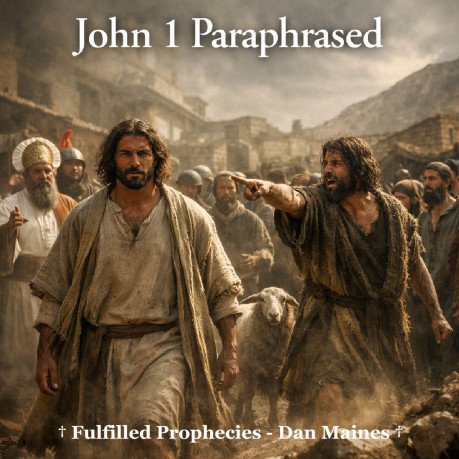
John 1
Paraphrased
By Dan Maines
Introduction
†
John begins by showing that Jesus did not begin in Bethlehem, He
existed from the very beginning as the eternal Word.
†
This chapter reveals who Christ is, why John the Baptist came, and
how the old covenant world was being confronted by the true Light.
†
It also shows the shift from Moses to Christ, from shadow to
fulfillment, from expectation to realization.
John
1:1
In the beginning, the Word was already there, and
the Word was with God, and the Word was God.
†
This reaches back to Genesis and shows that Christ was present before
creation itself.
† John is not presenting
Jesus as a mere man who later became important, but as the eternal
one.
† The Word is God's own self-expression,
fully divine and fully distinct in person.
John 1:2
He
was with God in the beginning.
† John repeats
this to make Christ's eternal existence unmistakably clear.
†
Jesus was not a later plan, He was there from the start.
†
Everything that follows in the Gospel rests on this truth.
John
1:3
Everything came into being through Him, and apart
from Him not even one thing came into being that has come into
being.
† Christ is not part of creation, He
is the one through whom creation came.
† That
means He has full authority over the world He made.
†
No created thing can stand above the Creator.
John
1:4
Life was in Him, and that life was the light of
men.
† Jesus is the source of life, not
merely a teacher about life.
† The light here
speaks of revelation, truth, purity, and divine understanding.
†
Men do not find life apart from Him, because life is in Him.
John
1:5
The light shines in the darkness, and the darkness
did not overpower it.
† Darkness cannot
defeat what comes from God.
† Even when
Christ was opposed by unbelief, hatred, and blindness, the darkness
still could not stop Him.
† This is a
declaration of victory from the very start.
John
1:6
There was a man sent from God, whose name was
John.
† John the Baptist was a real
historical witness sent by God.
† He was not
self-appointed, his ministry had divine purpose.
†
God sent a messenger before the full revelation of His Son.
John
1:7
He came as a witness, to testify about the light,
so that all might believe through him.
†
John's role was to point away from himself and toward Christ.
†
He served as a witness so people would know who Jesus was.
†
God gave clear testimony before bringing judgment on unbelief.
John
1:8
He was not the light, but he came to testify about
the light.
† John had an important role, but
he was never the center.
† A faithful servant
points to Christ, not to himself.
† This
keeps the focus exactly where it belongs.
John 1:9
The
true light, which gives light to every man, was coming into the
world.
† Jesus is not one light among many,
He is the true light.
† He brings real
revelation, not partial shadows.
† His coming
exposed hearts and made truth plain.
John 1:10
He
was in the world, and the world came into being through Him, and yet
the world did not know Him.
† The tragedy is
that the Creator came into His own creation and was not recognized.
†
Blindness to Christ is not due to lack of evidence, but hardness of
heart.
† The world benefited from Him while
failing to know Him.
John 1:11
He came to
His own, and His own did not receive Him.
†
This speaks especially of Israel, the covenant people, rejecting
their Messiah.
† The nation that had the
promises failed to embrace the one those promises pointed to.
†
Their rejection became part of the case for the judgment that came on
that generation.
John 1:12
But as many as
received Him, to them He gave the right to become children of God, to
those who believe in His name.
† Not all
rejected Him, and those who did receive Him were given a new standing
before God.
† Sonship is tied to faith in
Christ, not fleshly descent.
† This is the
new covenant family being formed around Him.
John
1:13
Who were born, not from blood, nor from the will
of the flesh, nor from the will of man, but from God.
†
Entrance into God's family is spiritual, not biological.
†
Natural birth does not make anyone part of the new creation.
†
God is the source of this birth, not human effort.
John
1:14
And the Word became flesh and lived among us, and
we saw His glory, glory as the one and only from the Father, full of
grace and truth.
† The eternal Word truly
entered human history.
† He did not merely
appear human, He became flesh and dwelt among men.
†
In Him, God's glory was seen in a way greater than the tabernacle or
temple ever displayed.
John 1:15
John
testified about Him and cried out, saying, This was He of whom I
said, He who comes after me ranks above me, because He existed before
me.
† John the Baptist was older in earthly
ministry, yet he confessed Christ's supremacy.
†
Jesus came after John in time, but before John in eternal
existence.
† This is another clear statement
of Christ's preexistence.
John 1:16
For
from His fullness we have all received, and grace upon grace.
†
Christ is not lacking anything, He is full, and from that fullness
His people receive.
† Grace does not trickle
from Him, it overflows from Him.
† The
blessings of the new covenant come from His abundance.
John
1:17
For the law was given through Moses, grace and
truth came through Jesus Christ.
† John is
not attacking Moses, he is showing the greater reality that arrived
in Christ.
† The law belonged to the old
covenant order, grace and truth arrive in their fullness in Jesus.
†
What was shadowed before is realized in Him.
John
1:18
No one has seen God at any time, the one and only
Son, who is in the bosom of the Father, He has made Him known.
†
Jesus is the perfect revealer of the Father.
†
Men do not come to know God by speculation, but by Christ.
†
If you want to know what God is like, you look to the Son.
John
1:19
This is the testimony of John, when the Jews sent
priests and Levites from Jerusalem to ask him, Who are you?
†
The religious authorities were already investigating John's
ministry.
† Jerusalem represents the
leadership of the old covenant system.
†
Their questions reveal both concern and resistance.
John
1:20
And he confessed and did not deny, but confessed,
I am not the Christ.
† John spoke plainly and
did not try to build himself into something greater.
†
Faithful witness requires humility.
† He made
sure there was no confusion about his identity.
John
1:21
They asked him, What then? Are you Elijah? And he
said, I am not. Are you the Prophet? And he answered, No.
†
They were thinking in fleshly and literal categories.
†
John fulfilled the Elijah role prophetically, but he was not
literally Elijah returned.
† Their questions
show they knew prophecy mattered, but they did not understand it
rightly.
John 1:22
Then they said to him,
Who are you, so that we may give an answer to those who sent us? What
do you say about yourself?
† The leaders
wanted a report that would let them classify John's ministry.
†
Religious systems like to control what they can label.
†
But God's work is not bound by their categories.
John
1:23
He said, I am a voice of one crying in the
wilderness, Make straight the way of the Lord, just as Isaiah the
prophet said.
† John understood his mission
from Scripture.
† He saw himself as the
forerunner preparing the people for the Lord's coming.
†
Prophecy was being fulfilled in their own generation.
John
1:24
Now they had been sent from the Pharisees.
†
This identifies the group behind the questioning.
†
The Pharisees were deeply invested in preserving their authority and
traditions.
† That helps explain the hostile
tone that soon grows in the Gospel.
John 1:25
They
asked him and said to him, Why then are you baptizing, if you are not
the Christ, nor Elijah, nor the Prophet?
†
They were questioning his right to call Israel to repentance.
†
Baptism challenged the assumption that covenant people were
automatically clean.
† John's ministry
exposed the spiritual need of the nation.
John 1:26
John
answered them saying, I baptize in water, but among you stands One
whom you do not know.
† Their great blindness
was not that Christ was absent, but that He was present and
unrecognized.
† They were questioning the
servant while missing the Master.
† This is
how unbelief often works, it examines everything except the
heart.
John 1:27
It is He who comes after
me, the straps of whose sandal I am not worthy to untie.
†
John knew his place before Christ.
† Even the
greatest prophet under that order confessed his unworthiness before
Jesus.
† Christ is not merely greater by
degree, but greater by nature and dignity.
John
1:28
These things took place in Bethany beyond the
Jordan, where John was baptizing.
† John
roots this testimony in a real place and real history.
†
The Gospel is not myth, it is anchored in actual events.
†
God's redemptive work unfolded in the world, not in imagination.
John
1:29
The next day he saw Jesus coming to him and said,
Look, the Lamb of God who takes away the sin of the world.
†
This is one of the clearest identifications of Christ's sacrificial
role.
† The lamb imagery reaches back to
Passover and the whole sacrificial system.
†
Jesus is presented as the final and effective sacrifice.
John
1:30
This is He in behalf of whom I said, After me is
coming a man who ranks above me, because He existed before me.
†
John repeats this because Christ's preexistence is central.
†
Jesus is not greater merely because of what He does, but because of
who He is.
† John's witness is consistent and
unmistakable.
John 1:31
I did not
recognize Him, but so that He might be revealed to Israel, I came
baptizing in water.
† John's ministry had a
revealing purpose.
† He was sent to prepare
the nation and identify the Messiah publicly.
†
This shows that Israel was given witness before being held
accountable.
John 1:32
John testified
saying, I have seen the Spirit descending as a dove out of heaven,
and He remained upon Him.
† This sign marked
Jesus out as the chosen one.
† The Spirit did
not merely touch Him for a moment, but remained upon Him.
†
This confirms His identity and divine approval.
John
1:33
I did not recognize Him, but He who sent me to
baptize in water said to me, He upon whom you see the Spirit
descending and remaining upon Him, this is the One who baptizes in
the Holy Spirit.
† John's certainty came from
God's own revelation.
† Jesus brings a
greater baptism than John's, not merely outward washing, but
covenantal and spiritual reality.
† This
points to the new covenant work that Christ would bring.
John
1:34
I myself have seen, and have testified that this
is the Son of God.
† John ends the matter
with a clear confession.
† Jesus is not just
a prophet, not just a king, but the Son of God.
†
This testimony leaves no room for a lesser view of Christ.
John
1:35
Again the next day John was standing with two of
his disciples,
† John's ministry was
transitional and temporary.
† His disciples
were about to be redirected toward Jesus.
† A
true minister rejoices when people move closer to Christ.
John
1:36
And he looked at Jesus as He walked, and said,
Look, the Lamb of God.
† John repeats the
same title because it is central to who Jesus is.
†
He did not change the message to keep attention on himself.
†
His witness remained fixed on Christ's sacrificial identity.
John
1:37
The two disciples heard him speak, and they
followed Jesus.
† This is what faithful
witness produces, people leave the messenger and follow the Lord.
†
John did not compete with Christ for disciples.
†
The right response to testimony is to follow Jesus.
John
1:38
And Jesus turned and saw them following, and said
to them, What are you seeking? They said to Him, Rabbi, which
translated means Teacher, where are You staying?
†
Jesus begins with a heart-searching question.
†
He is not interested in shallow curiosity, but in true pursuit.
†
Their answer shows they want to be with Him and learn from Him.
John
1:39
He said to them, Come, and you will see. So they
came and saw where He was staying, and they stayed with Him that day,
for it was about the tenth hour.
† Jesus
invites seekers into personal fellowship.
†
Real discipleship is not distant observation, but nearness to
Christ.
† The detail about the hour shows the
memory of an eyewitness account.
John 1:40
One
of the two who heard John speak and followed Him was Andrew, Simon
Peter's brother.
† Andrew is introduced
through witness and response.
† He first
heard testimony, then personally followed Jesus.
†
That is the pattern of gospel faith.
John 1:41
He
first found his own brother Simon and said to him, We have found the
Messiah, which translated means Christ.
†
Andrew did not keep the news to himself.
†
Finding Christ moved him to bring others.
†
The expectation of Israel was now meeting its fulfillment.
John
1:42
He brought him to Jesus. Jesus looked at him and
said, You are Simon the son of John, you shall be called Cephas,
which is translated Peter.
† Jesus shows
authority even in renaming Simon.
† He knows
men before they fully know themselves.
† This
points to Christ's power to define identity and calling.
John
1:43
The next day He intended to go into Galilee, and
He found Philip. And Jesus said to him, Follow Me.
†
Jesus takes the initiative in calling disciples.
†
His call is direct and personal.
† The right
response is simple obedience.
John 1:44
Now
Philip was from Bethsaida, from the city of Andrew and Peter.
†
John includes these details to ground the account historically.
†
The disciples came from real towns and real lives.
†
Christ called ordinary men into extraordinary service.
John
1:45
Philip found Nathanael and said to him, We have
found Him of whom Moses in the Law and also the Prophets wrote, Jesus
of Nazareth, the son of Joseph.
† Philip
understood that Jesus fulfilled the whole scriptural hope of
Israel.
† Moses and the prophets were always
pointing forward to Christ.
† Fulfillment is
one of the great themes of this chapter.
John
1:46
Nathanael said to him, Can anything good come out
of Nazareth? Philip said to him, Come and see.
†
Nathanael's prejudice could only be overcome by meeting Jesus.
†
Philip does not argue endlessly, he invites him to come and see.
†
Christ answers objections better than human debate alone.
John
1:47
Jesus saw Nathanael coming to Him, and said about
him, Look, truly an Israelite in whom there is no deceit.
†
Jesus sees the inner man, not just outward appearance.
†
This statement echoes Jacob and points to a true Israelite in
heart.
† It also shows that integrity matters
to God.
John 1:48
Nathanael said to Him,
How do You know me? Jesus answered and said to him, Before Philip
called you, when you were under the fig tree, I saw you.
†
Jesus demonstrates supernatural knowledge.
†
He knew Nathanael before Nathanael approached Him.
†
This is a sign that more than ordinary humanity is present here.
John
1:49
Nathanael answered Him, Rabbi, You are the Son of
God, You are the King of Israel.
† Nathanael
moves quickly from doubt to confession.
†
When Christ reveals Himself, honest hearts respond.
†
Son of God and King of Israel are both messianic confessions.
John
1:50
Jesus answered and said to him, Because I said to
you that I saw you under the fig tree, do you believe? You will see
greater things than these.
† Nathanael had
seen enough to believe, but much more was coming.
†
Christ's signs were not random displays, they pointed to His
identity.
† Greater revelation was ahead for
those who followed Him.
John 1:51
And He
said to him, Truly, truly, I say to you, you will see heaven opened
and the angels of God ascending and descending on the Son of Man.
†
This echoes Jacob's ladder and places Jesus as the true meeting point
between heaven and earth.
† He is the true
access to God, replacing temple imagery and covenant shadows.
†
In Christ, the realities once pictured in symbols are fully
present.
Historical References
†
Irenaeus spoke of Christ as the eternal Word made flesh, defending
the truth that John presents in this chapter.
†
Clement of Alexandria emphasized that the Son reveals the Father and
brings full truth beyond the elementary shadows.
†
Eusebius recorded the fulfillment of Christ's warnings against
Jerusalem, showing the seriousness of rejecting the one sent to
Israel.
† Justin Martyr repeatedly argued
that the Law and the Prophets pointed forward to Christ as their
fulfillment.
How It Applies To Us Today
†
We must see Jesus for who He truly is, not just as a teacher, but as
the eternal Word and Son of God.
† We don't
stand in the shadows of the old covenant, we've been brought into the
reality that those shadows pointed toward.
†
Like John the Baptist, our role is to point people to Christ and not
to ourselves.
† Like Andrew and Philip, when
we've found Christ, we should bring others to Him.
†
Like Nathanael, we should let Christ correct our assumptions and lead
us into deeper faith.
Q & A Appendix
Q:
Who is the Word in John 1?
A: The Word is Jesus
Christ, the eternal one who was with God and was God, John
1:1-3.
Q: What does it mean that the
Word became flesh?
A: It means the eternal Son
truly entered human history and lived among men, revealing the Father
in a visible way, John 1:14, 18.
Q:
Why is Jesus called the Lamb of God?
A: He is
the final sacrifice who takes away sin, fulfilling what the old
sacrificial system pointed to, John 1:29, 36.
Q:
What is the difference between Moses and Christ in this chapter?
A:
The law came through Moses, but grace and truth came in full through
Jesus Christ, John 1:17.
Q:
What does John 1 teach about Israel's response to Christ?
A:
It teaches that He came to His own and many did not receive Him,
showing covenant privilege without faith was not enough, John
1:11-12.
Q: What does the image of
angels ascending and descending on the Son of Man mean?
A:
It means Jesus is the true connection between heaven and earth, the
reality that earlier covenant symbols only pictured, John
1:51.
† This is the fulfilled perspective we
proclaim at Fulfilled Prophecies †
© Fulfilled
Prophecies - Dan Maines.
Source Index
†
John 1
† Irenaeus, Against Heresies
†
Clement of Alexandria, Stromata
† Eusebius,
Ecclesiastical History
† Justin Martyr,
Dialogue With Trypho
Links