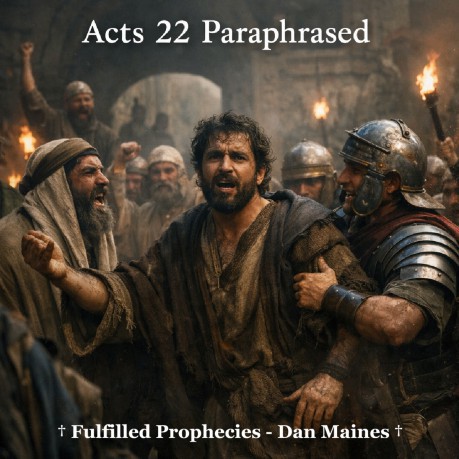
Acts 22 Paraphrased Introduction Acts 22:1 Acts 22:2 Acts 22:3 Acts 22:4 Acts 22:5 Acts 22:6 Acts 22:7 Acts 22:8 Acts 22:9 Acts 22:10 Acts 22:11 Acts 22:12 Acts 22:13 Acts 22:14 Acts 22:15 Acts 22:16 Acts 22:17 Acts 22:18 Acts 22:19 Acts 22:20 Acts 22:21 Acts 22:22 Acts 22:23 Acts 22:24 Acts 22:25 Acts 22:26 Acts 22:27 Acts 22:28 Acts 22:29 Acts 22:30 Historical References How it applies to us today Q & A Appendix † This is the fulfilled perspective we proclaim at
Fulfilled Prophecies † Source Index
By Dan Maines
† This
chapter records Paul's defense before the Jewish crowd, showing how
his calling came directly from Christ
† It
reveals the transition from the old covenant zeal to the fulfilled
reality in Christ
† It confirms that the
message to the Gentiles was always part of God's plan (Isaiah 49:6)
Men, brothers and fathers, listen
to my defense that I'm now making to you
†
Paul addresses them with respect, showing he isn't rejecting Israel
but speaking to them
† This reflects how the
gospel came to the Jew first before going to the nations (Romans
1:16)
† His defense isn't rebellion, it's
fulfillment of what they were taught
When they heard he was speaking to
them in the Hebrew language, they became more quiet, and he said
†
Speaking Hebrew connects him to their heritage, showing he's not a
foreign enemy
† This silence shows their
respect for their own language and traditions
†
God meets people where they are to reveal truth
I'm a Jew, born in Tarsus of
Cilicia, but raised in this city, educated under Gamaliel, strictly
according to the law of our fathers, being zealous for God just like
all of you are today
† Paul establishes his
credibility as fully trained in the law
† His
past zeal mirrors theirs, showing he understands their mindset
†
This exposes that zeal without knowledge leads to error (Romans 10:2)
I persecuted this Way to the point
of death, binding and putting both men and women into prisons
†
Paul admits his former opposition, showing honesty and
transformation
† The Way refers to the early
believers in Christ
† His past proves that
even the most zealous opponent can be changed
As also the high priest and all
the council of elders can testify, from them I received letters to
the brothers, and started off for Damascus to bring those there also
bound to Jerusalem to be punished
† His
authority came from the Jewish leadership
†
This shows persecution was officially sanctioned
†
The system itself opposed Christ, proving the old order was passing
away
But it happened that as I was on
my way, approaching Damascus about noon, suddenly a very bright light
flashed around me from heaven
† The light
represents divine intervention
† Christ
interrupts Paul's mission directly
† This
shows salvation is initiated by God, not man
I fell to the ground and heard a
voice saying to me, Saul, Saul, why are you persecuting Me
†
Persecuting believers is persecuting Christ Himself
†
This reveals the unity between Christ and His people
†
It confirms the living presence of Christ after His resurrection
And I answered, Who are You, Lord
And He said to me, I'm Jesus the Nazarene, whom you are persecuting
†
Jesus identifies Himself as the one Paul opposed
†
This confirms Jesus is alive and reigning
†
The name Nazarene ties Him to His earthly identity and fulfillment
Those who were with me saw the
light, but didn't understand the voice of the One who was speaking to
me
† Not everyone receives the same
revelation
† Spiritual understanding is
given, not assumed
† This shows God's
selective calling
I said, What shall I do, Lord And
the Lord said to me, Get up and go into Damascus, and there you'll be
told of all that has been appointed for you to do
†
Paul submits immediately to Christ
† His
mission was already appointed
† God's purpose
is established before our actions (Ephesians 2:10)
But since I couldn't see because
of the brightness of that light, I was led by the hand by those who
were with me and came into Damascus
†
Physical blindness reflects spiritual transformation
†
He who thought he saw clearly is now dependent
†
God humbles before He commissions
A certain Ananias, a devout man
according to the Law, and well spoken of by all the Jews who lived
there
† Ananias is respected within Jewish
circles
† This shows continuity between
law-observant Jews and believers
† Not all
Jews rejected Christ
Came to me, and standing near
said to me, Brother Saul, receive your sight And at that very moment
I looked up at him
† Healing confirms divine
authority
† Calling him brother shows
immediate acceptance
† Restoration follows
obedience
And he said, The God of our
fathers has appointed you to know His will and to see the Righteous
One and to hear a voice from His mouth
† Paul
is chosen by the same God of Israel
† The
Righteous One refers to Christ
† This
connects the gospel directly to Israel's promises
For you'll be a witness for Him
to all men of what you've seen and heard
†
Paul's mission extends to all men, not just Jews
†
Witnessing is based on real encounter
† This
fulfills the expansion to the nations
Now why do you delay Get up and
be baptized, and wash away your sins, calling on His name
†
Baptism symbolizes cleansing and identification with Christ
†
Calling on His name shows faith and submission
†
This marks entry into the new covenant life
It happened when I returned to
Jerusalem and was praying in the temple, that I fell into a trance
†
God continues to reveal Himself in Jerusalem
†
The temple is still standing but about to pass
†
This moment bridges old and new covenant realities
And I saw Him saying to me, Hurry
and get out of Jerusalem quickly, because they won't accept your
testimony about Me
† Jerusalem rejects the
message
† This fulfills the pattern of
prophetic rejection
† Judgment is tied to
this refusal
And I said, Lord, they themselves
understand that in one synagogue after another I used to imprison and
beat those who believed in You
† Paul appeals
to his past as credibility
† He expects his
transformation to persuade them
† But
rejection isn't based on evidence, it's hardness of heart
And when the blood of Your
witness Stephen was being shed, I also was standing by approving and
watching out for the coats of those who were killing him
†
Paul confesses involvement in Stephen's death
†
This shows deep repentance
† Stephen's
martyrdom was a turning point (Acts 7:59-60)
And He said to me, Go, because
I'll send you far away to the Gentiles
† This
is the turning point of the chapter
† The
Gentile mission was commanded by Christ
†
This fulfills God's promise to include the nations
They listened to him up to this
statement, and then they raised their voices and said, Away with such
a man from the earth, for he shouldn't be allowed to live
†
Their anger is triggered by Gentile inclusion
†
This reveals their rejection of God's plan
†
The same pattern led to Jerusalem's judgment
And as they were shouting and
throwing off their cloaks and tossing dust into the air
†
This shows intense rage and rejection
† Their
reaction mirrors past rebellion
† Emotional
response replaces truth
The commander ordered him to be
brought into the barracks, stating that he should be examined by
scourging so that he might find out the reason why they were shouting
against him that way
† Roman authority steps
in
† This shows the tension between Jewish
hostility and Roman control
† God uses even
authorities to protect His servant
But when they stretched him out
with thongs, Paul said to the centurion who was standing by, Is it
lawful for you to scourge a man who's a Roman and uncondemned
†
Paul uses his legal rights
† Wisdom doesn't
reject lawful protection
† God provides means
of deliverance
When the centurion heard this, he
went to the commander and told him, saying, What are you about to do
For this man is a Roman
† Roman citizenship
changes the situation
† Fear shifts from Paul
to the authorities
† Authority structures are
used by God
The commander came and said to
him, Tell me, are you a Roman And he said, Yes
†
Paul's identity brings protection
† Truth
changes outcomes
† God positions His people
strategically
The commander answered, I
acquired this citizenship with a large sum of money And Paul said,
But I was actually born a citizen
† Paul's
status is higher than the commander's
† This
shows providence in Paul's life
† God's
preparation started long before this moment
Therefore those who were about to
examine him immediately let go of him, and the commander also was
afraid when he found out that he was a Roman, because he had put him
in chains
† Fear replaces aggression
†
Justice restrains injustice
† God reverses
situations quickly
But on the next day, wishing to
know for certain why he had been accused by the Jews, he released him
and ordered the chief priests and all the council to assemble, and
brought Paul down and set him before them
†
Paul is brought before the Jewish leadership again
†
This continues the confrontation between old covenant leaders and
fulfilled truth
† The stage is set for
further testimony
†
Josephus, Wars of the Jews, describes the same hostility of Jerusalem
toward perceived threats
† Eusebius,
Ecclesiastical History, records early Christian persecution by Jewish
authorities
† Clement of Alexandria,
Stromata, confirms the spread of the gospel to the Gentiles as
fulfillment
†
We're reminded that zeal without truth leads to opposition against
God
† We're called to stand firm even when
truth is rejected
† We see that God's plan
always included all nations, and it's already fulfilled in Christ
†
We trust that God uses every circumstance, even opposition, to
accomplish His purpose
Q Why
did Paul speak in Hebrew
A To connect with his
audience and show he wasn't abandoning Israel (Acts 21:40)
Q
What does the light from heaven represent
A
Divine revelation and the authority of Christ (Acts 9:3)
Q
Why did they react violently to the Gentiles being mentioned
A
Because they rejected the idea of equal inclusion (Acts 13:46)
Q
Was Paul's mission planned ahead of time
A Yes,
God appointed his work before he carried it out (Galatians 1:15-16)
Q
What does this chapter prove about fulfillment
A
That the gospel had already moved beyond Israel exactly as prophesied
(Isaiah 49:6)
© Fulfilled Prophecies - Dan
Maines.
† Acts 22
†
Josephus, Wars of the Jews
† Eusebius,
Ecclesiastical History
† Clement of
Alexandria, Stromata
Links