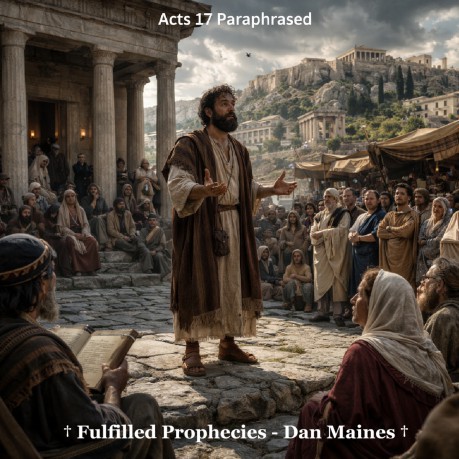
Acts 17
Paraphrased
By Dan Maines
Introduction
†
This chapter shows the gospel entering cities filled with religion,
politics, and philosophy
† It shows that
Christ was being preached as the already promised King
†
It also shows how some searched the Scriptures honestly, while others
resisted the truth
Acts 17:1
After
traveling through Amphipolis and Apollonia, they came to
Thessalonica, where the Jews had a synagogue
†
The mission keeps moving forward from place to place
†
Paul begins where the Scriptures were already known
†
This shows the message of Christ was tied to what God had already
promised
Acts 17:2
As he usually did, Paul
went in to them, and for three Sabbaths he reasoned with them from
the Scriptures
† Paul did not preach a new
religion detached from Scripture
† He proved
his message from the written word
† He stayed
with it long enough to make the case clearly
Acts
17:3
He opened the meaning of the Scriptures and showed
that the Christ had to suffer and rise from the dead, saying, This
Jesus I am preaching to you is the Christ
†
Paul explained that the suffering of Christ was not an accident
†
The resurrection was part of God's plan from the beginning
†
He identified Jesus directly as the promised Messiah
Acts
17:4
Some of them were persuaded and joined Paul and
Silas, along with a large number of God fearing Greeks and many
prominent women
† The gospel was gathering
both Jews and Gentiles
† The truth was not
hidden from important people or common people
†
This is the widening of the kingdom in real time
Acts
17:5
But the unbelieving Jews became jealous, gathered
some wicked men from the marketplace, formed a mob, and threw the
city into confusion, and they attacked Jason's house, trying to bring
them out to the crowd
† Their problem was not
lack of evidence, it was jealousy
† When
truth threatens power, people often turn to chaos
†
Opposition to the gospel was emotional and political
Acts
17:6
When they did not find them, they dragged Jason
and some of the brethren before the city rulers, shouting, These men
who have turned the world upside down have come here too
†
Even enemies admitted the gospel was having major impact
†
The world they were upsetting was the old order that was passing
away
† This was happening in their own
generation
Acts 17:7
Jason has welcomed
them, and they all act against Caesar's decrees, saying there is
another king, Jesus
† The charge centered on
kingship
† Jesus was being preached as the
true ruler
† The gospel was not a private
opinion, it declared authority
Acts 17:8
The
crowd and the city rulers were disturbed when they heard this
†
The message of Christ always presses on men's loyalties
†
Earthly systems are troubled when Christ's rule is proclaimed
†
Truth does not leave rebellion comfortable
Acts
17:9
After taking security from Jason and the others,
they let them go
† The early church often
suffered financially and legally
†
Persecution came through pressure as well as violence
†
Yet the message kept moving
Acts 17:10
That
night the brethren sent Paul and Silas away to Berea, and when they
arrived, they went into the synagogue of the Jews
†
Opposition did not stop the mission
† Paul
stayed focused on preaching rather than protecting comfort
†
The pattern remains the same, Scripture first, Christ proclaimed
Acts
17:11
Now these people were more noble minded than
those in Thessalonica, because they received the word eagerly and
examined the Scriptures every day to see whether these things were
so
† Noble character is shown by honest
examination of Scripture
† They did not
reject the message just because it challenged tradition
†
This verse condemns blind loyalty to religious systems
Acts
17:12
So many of them believed, along with quite a few
Greek women and men of high standing
† Honest
testing of Scripture led many to faith
† The
gospel continued breaking social boundaries
†
Truth stands up under examination
Acts 17:13
But
when the Jews of Thessalonica learned that the word of God had been
preached by Paul in Berea also, they came there too, stirring up and
troubling the crowds
† Unbelief often follows
truth in order to silence it
† Their
hostility was organized and determined
† This
shows how hard men fight against fulfillment when it exposes
them
Acts 17:14
Then the brethren
immediately sent Paul away to go as far as the sea, but Silas and
Timothy remained there
† The work required
wisdom as well as boldness
† Not every
servant moved at the same time
† God
preserved His messengers for continued labor
Acts
17:15
Now those who escorted Paul brought him as far as
Athens, and after receiving instructions for Silas and Timothy to
come to him as soon as possible, they left
†
Paul was not working alone, he labored with fellow servants
†
The mission was ordered, not random
† Even
under pressure, communication and purpose remained clear
Acts
17:16
While Paul was waiting for them in Athens, his
spirit was deeply troubled within him as he saw that the city was
full of idols
† Paul was not impressed by
Athens, he was grieved
† Idolatry provoked
him because it dishonored the true God
†
Spiritual blindness should stir sorrow, not admiration
Acts
17:17
So he was reasoning in the synagogue with the
Jews and the God fearing Gentiles, and in the marketplace every day
with those who happened to be present
† Paul
spoke wherever people were found
† He brought
the truth into both religious and public spaces
†
The gospel was not confined to a church building
Acts
17:18
Some of the Epicurean and Stoic philosophers were
also talking with him. Some were saying, What would this babbler like
to say? Others said, He seems to be preaching foreign gods, because
he was preaching Jesus and the resurrection
†
Human wisdom often mocks what it does not understand
†
They reduced Paul to a fool because they judged by pride
†
Yet the heart of his message remained Jesus and the resurrection
Acts
17:19
They took him and brought him to the Areopagus,
saying, May we know what this new teaching is that you are
presenting
† Athens wanted novelty more than
submission
† They were curious, but not yet
humble
† Still, God gave Paul a platform
before learned men
Acts 17:20
For you are
bringing strange things to our ears, so we want to know what these
things mean
† The gospel sounds strange to
minds trained by error
† Truth often sounds
foreign in places ruled by idols
† Their
question opened the door for a direct witness
Acts
17:21
Now all the Athenians and the foreigners visiting
there used their time for nothing else except telling or hearing
something new
† This exposes the emptiness of
intellectual vanity
† They chased new ideas
without coming to truth
† Curiosity alone
does not save anyone
Acts 17:22
So Paul
stood in the middle of the Areopagus and said, Men of Athens, I see
that in every way you are very religious
†
Paul began with what was visible in their culture
†
He did not flatter them, he exposed their condition
†
Being religious is not the same as knowing God
Acts
17:23
As I was passing through and looking carefully at
the objects of your worship, I even found an altar with this
inscription, TO AN UNKNOWN GOD. Therefore what you worship in
ignorance, this I proclaim to you
† Their
altar confessed their ignorance
† Paul used
their own admission to point to the truth
†
God was not unknown because He hid Himself, but because they were
blind
Acts 17:24
The God who made the
world and everything in it, since He is Lord of heaven and earth,
does not live in temples made by human hands
†
Paul begins with God as Creator and Lord
†
This destroys the entire foundation of idol worship
†
The true God cannot be contained by man's buildings
Acts
17:25
Nor is He served by human hands as though He
needed anything, because He Himself gives to all people life and
breath and all things
† God is not dependent
on man
† Every breath they had came from the
One they ignored
† Idolatry reverses reality
by making man the giver
Acts 17:26
He made
from one man every nation of mankind to live on all the face of the
earth, having determined their appointed times and the boundaries of
where they would live
† All nations share one
human origin
† History and geography are
under God's rule
† Men do not rise beyond the
boundaries God sets
Acts 17:27
So that
they would seek God, if perhaps they might feel their way toward Him
and find Him, though He is not far from each one of us
†
God ordered history so men would seek Him
†
Their blindness did not mean God was distant
†
The problem was not His absence, but their darkness
Acts
17:28
For in Him we live and move and exist, as even
some of your own poets have said, For we also are His offspring
†
Paul even used their own words where they matched truth
†
Every moment of life depends on God
† Man's
existence itself testifies against idolatry
Acts
17:29
Since we are God's offspring, we ought not think
that the Divine Nature is like gold or silver or stone, an image
formed by human art and imagination
† If man
lives by God, then God cannot be reduced to carved matter
†
Idols are the product of human imagination, not divine reality
†
Paul tears down the false image of God made by human minds
Acts
17:30
So having overlooked the times of ignorance, God
is now declaring to all people everywhere that they should repent
†
The command is universal
† The nations were
no longer left in the same darkness as before
†
This was a present call, not a distant offer
Acts
17:31
Because He has fixed a day in which He will judge
the world in righteousness through a Man whom He has appointed,
having given proof to all by raising Him from the dead
†
Judgment was certain because the day had been fixed
†
The risen Christ is the proof and the Judge
†
This fits the coming covenant judgment tied to Christ's
authority
Acts 17:32
Now when they heard
about the resurrection of the dead, some began to sneer, but others
said, We shall hear you again concerning this
†
The resurrection divided the audience
† Some
mocked, others delayed
† Truth still produces
those same responses
Acts 17:33
So Paul
went out from among them
† Paul delivered the
truth and left the results to God
† Not every
sermon ends with mass repentance
†
Faithfulness is measured by truth spoken, not applause gained
Acts
17:34
But some men joined him and believed, among whom
also were Dionysius the Areopagite and a woman named Damaris and
others with them
† God still gathered His
people even in Athens
† The gospel was
powerful enough to save people in the heart of pagan thought
†
Christ's kingdom reached even those surrounded by idols and
philosophy
Historical References
†
Eusebius wrote that the apostles carried the message of Christ into
the nations, showing the spread described in Acts was real history
†
Clement of Alexandria referred to Greek philosophy as something that
exposed man's searching, but could not save apart from the truth of
God in Christ
† Irenaeus testified that the
apostles proclaimed one God, the Creator of heaven and earth,
directly against pagan error
† Tertullian
argued against idolatry by showing that carved images are man's work
and not the living God
How It Applies To Us Today
†
We must test everything by Scripture like the Bereans did
†
We must not confuse being religious with knowing God
†
We must preach Christ clearly even when the culture mocks the
message
† We must remember that human wisdom
cannot replace divine truth
† We must call
men to repentance because Christ reigns now
Q:
Why did Paul always begin in the synagogue?
A:
Because the promises were first given through Israel, and Christ was
the fulfillment of what the Scriptures had already declared. That is
why he reasoned from the Scriptures first. See Acts 17:2-3.
Q:
What made the Bereans more noble minded?
A:
They did not blindly accept or reject the message. They searched the
Scriptures daily to test what Paul was saying. See Acts 17:11.
Q:
Why was Paul troubled in Athens?
A: He saw a
city consumed by idols. His grief came from seeing God's glory
exchanged for false worship. See Acts 17:16.
Q:
What was wrong with the altar to an unknown god?
A:
It admitted religious activity without true knowledge of God. Paul
used it to show that their worship was rooted in ignorance. See Acts
17:23.
Q: What proof did God give that Jesus is
the appointed Judge?
A: He raised Him from the
dead. The resurrection was God's public confirmation of Christ's
authority. See Acts 17:31.
Q: What does this
chapter teach us about philosophy and human wisdom?
A:
It teaches that human wisdom may ask questions, but only the gospel
reveals the true God. Philosophy without Christ leaves men in
ignorance. See Acts 17:18-21, 24-31.
† This is the
fulfilled perspective we proclaim at Fulfilled Prophecies †
©
Fulfilled Prophecies - Dan Maines.
Source Index
†
Acts 17
† Eusebius, Ecclesiastical History
†
Clement of Alexandria, Stromata
† Irenaeus,
Against Heresies
† Tertullian, On Idolatry
Links