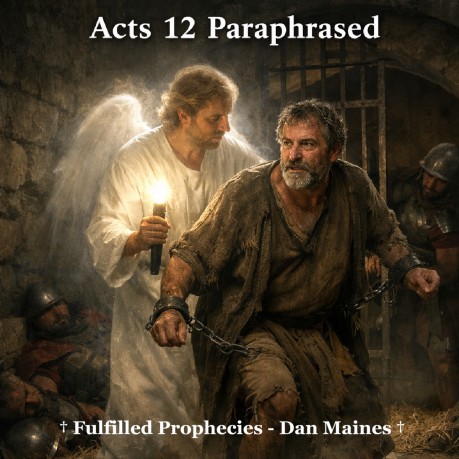
Acts 12 Paraphrased Introduction Acts 12:1 Acts 12:2 Acts 12:3 Acts 12:4 Acts 12:5 Acts 12:6 Acts 12:7 Acts 12:8 Acts 12:9 Acts 12:10 Acts 12:11 Acts 12:12 Acts 12:13 Acts 12:14 Acts 12:15 Acts 12:16 Acts 12:17 Acts 12:18 Acts 12:19 Acts 12:20 Acts 12:21 Acts 12:22 Acts 12:23 Acts 12:24 Acts 12:25 Historical References How it applies to us today Q & A Appendix † This is the fulfilled perspective we proclaim at
Fulfilled Prophecies † Source Index
By Dan Maines
† This
chapter shows the pressure against the early church, the death of
James, the imprisonment of Peter, and God's direct intervention in
that generation.
† It lines up with what
Jesus said about persecution coming upon that same generation
(Matthew 23:34-36).
† It also shows that
earthly rulers thought they were in control, but God was already
bringing judgment on that old system.
Around that time, King Herod began
attacking some from the church to harm them
†
This is Herod Agrippa I, a ruler tied directly to Rome, showing the
beastly authority working through kings (Revelation 13:2).
†
Persecution wasn't random, it was targeted against the covenant
people who followed Christ.
† This fulfills
what Jesus warned, that they would be handed over to rulers (Luke
21:12).
He had James, the brother of John,
killed with the sword
† This is the first
apostle martyred, showing the seriousness of that coming judgment
period.
† James was part of Jesus' inner
circle, proving even the closest followers weren't exempt.
†
This lines up with Revelation's martyrs crying out for justice
(Revelation 6:9-11).
When he saw it pleased the Jews,
he arrested Peter also, this happened during the days of Unleavened
Bread
† The Jewish leadership approving shows
their continued rejection of Christ.
† Their
alignment with Rome exposes the harlot working with the beast
(Revelation 17:3).
† The timing during a
feast highlights their hypocrisy, keeping rituals while rejecting the
Messiah.
After arresting him, he put him in
prison, handing him over to four squads of soldiers to guard him,
planning to bring him out after the Passover
†
Four squads means sixteen soldiers, showing extreme security.
†
This reflects fear of divine intervention, since Peter had already
been freed before (Acts 5:19).
† Passover
timing again connects this to covenant transition and judgment.
So Peter was kept in prison, but
the church was earnestly praying to God for him
†
The church responds with prayer, not force, showing their trust in
God.
† This mirrors Jesus' instruction to
watch and pray (Matthew 26:41).
† Their unity
in prayer shows the strength of the body even under pressure.
On the night before Herod was
going to bring him out, Peter was sleeping between two soldiers,
bound with chains, and guards were at the door watching the prison
†
Peter sleeping shows complete peace and trust in God.
†
The chains and guards emphasize that escape was humanly impossible.
†
This sets up a clear display of God's power.
Suddenly an angel of the Lord
appeared, and a light shone in the cell, he struck Peter on the side
and woke him, saying get up quickly, and the chains fell off his
hands
† Divine intervention breaks physical
restraints instantly.
† This mirrors earlier
deliverance in Acts 5:19, showing consistency.
†
The light represents God's presence overcoming darkness.
The angel said to him, dress
yourself and put on your sandals, and he did so, then he said wrap
your cloak around you and follow me
† Peter
is guided step by step, showing obedience matters even in miracles.
†
God doesn't bypass action, He directs it.
†
This reflects how believers are led, not forced.
He went out and kept following,
and he didn't know what was happening through the angel was real, but
thought he was seeing a vision
† Peter
initially doubts reality, showing how unexpected God's work can be.
†
This is similar to Acts 10 when Peter had a vision.
†
It highlights the supernatural nature of the event.
When they passed the first and
second guards, they came to the iron gate that leads into the city,
which opened for them by itself, and they went out and went along one
street, and immediately the angel left him
†
The gate opening on its own shows total divine control.
†
Once Peter is safe, the angel leaves, showing the mission is
complete.
† God intervenes exactly when
needed, no more, no less.
When Peter came to himself, he
said now I know for sure that the Lord has sent His angel and rescued
me from Herod's hand and from everything the Jewish people were
expecting
† Peter recognizes both Roman and
Jewish opposition.
† Deliverance confirms
God's authority over both systems.
† This
shows God's protection over His purpose.
When he realized this, he went to
the house of Mary, the mother of John who is also called Mark, where
many were gathered together praying
† The
church was still praying, showing persistence.
†
This house becomes a center for early believers.
†
John Mark later becomes important in spreading the gospel.
When he knocked at the door of
the gate, a servant girl named Rhoda came to answer
†
A simple servant becomes part of a major moment.
†
God uses ordinary people in His work.
† This
shows the humility of the early church setting.
When she recognized Peter's
voice, because of her joy she didn't open the gate, but ran in and
announced that Peter was standing in front of the gate
†
Her excitement shows genuine faith and joy.
†
Even in answered prayer, people can be overwhelmed.
†
This adds real human detail to the account.
They said to her you're out of
your mind, but she kept insisting it was so, and they kept saying it
is his angel
† Even believers struggled to
believe the answer to their own prayers.
†
This shows their humanity and lack of expectation.
†
It highlights how God works beyond what people expect.
But Peter continued knocking, and
when they opened the door, they saw him and were amazed
†
The miracle is confirmed publicly.
† Their
amazement shows the reality of the event.
†
This strengthens the faith of the church.
But motioning to them with his
hand to be silent, he described to them how the Lord had led him out
of the prison, and he said report these things to James and the
brethren, then he left and went to another place
†
Peter gives full credit to the Lord.
† He
instructs them to share the testimony.
† He
leaves to avoid further arrest, showing wisdom.
Now when day came, there was no
small disturbance among the soldiers as to what could have become of
Peter
† The guards are thrown into
confusion.
† This shows the failure of human
authority.
† It exposes the limits of earthly
power.
When Herod had searched for him
and had not found him, he examined the guards and ordered that they
be led away to execution, then he went down from Judea to Caesarea
and was spending time there
† The guards pay
the price, showing harsh Roman justice.
†
Herod reacts with control and anger.
† This
sets up his coming judgment.
Now he was very angry with the
people of Tyre and Sidon, and with one accord they came to him, and
having won over Blastus the king's chamberlain, they were asking for
peace, because their country was fed by the king's country
†
Political power and dependence are shown clearly.
†
Herod controls resources, giving him influence.
†
This reflects worldly systems of control.
On an appointed day Herod, having
put on his royal apparel, took his seat on the platform and began
delivering an address to them
† Herod
presents himself with authority and pride.
†
This public display sets up his downfall.
†
It mirrors rulers who exalt themselves above God.
The people kept crying out the
voice of a god and not of a man
† The crowd
gives him divine honor.
† This is direct
blasphemy.
† It reflects the worship of
emperors in that time.
Immediately an angel of the Lord
struck him because he didn't give God the glory, and he was eaten by
worms and died
† This is immediate divine
judgment.
† God doesn't share His glory.
†
Josephus records a similar account of Herod's death, confirming this
historically.
But the word of the Lord
continued to grow and be multiplied
† Even
with persecution, the message spreads.
† This
shows that God's plan cannot be stopped.
†
The kingdom continues advancing.
And Barnabas and Saul returned
from Jerusalem when they had fulfilled their mission, taking along
with them John who is also called Mark
† The
mission continues despite opposition.
†
Leadership transitions and expands.
† This
sets the stage for the wider spread of the gospel.
†
Josephus, Antiquities of the Jews, records Herod Agrippa's death in a
similar way, struck suddenly after accepting divine praise.
†
Eusebius, Ecclesiastical History, confirms early persecutions and
apostolic martyrdom.
† Irenaeus, Against
Heresies, affirms the early suffering of the apostles as part of
God's redemptive timeline.
†
God is still in control even when leaders oppose truth.
†
Prayer is powerful, even when results seem impossible.
†
Pride brings judgment, but humility brings life.
†
The message of Christ cannot be stopped.
† We
can trust God even in persecution or uncertainty.
Q: Why was James allowed
to die but Peter delivered?
A: God had different purposes for
each, James fulfilled his testimony, Peter continued his mission,
Revelation 6:11
Q: Does God still intervene like this today?
A:
God still works, but these events were tied to that unique
transitional period, Hebrews 1:1-2
Q: Why was Herod judged so
quickly?
A: Because he accepted worship that belongs only to
God, Isaiah 42:8
Q: What does this show about prayer?
A:
Prayer matters even when we doubt, James 5:16
Q: What does this
chapter prove about God's authority?
A: God rules over kings and
nations, Psalm 22:28
© Fulfilled Prophecies - Dan
Maines.
† Acts 12
†
Josephus, Antiquities of the Jews
† Irenaeus,
Against Heresies
† Eusebius, Ecclesiastical
History
Links