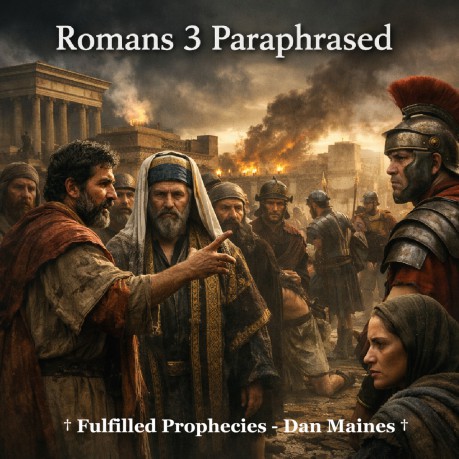
Romans 3 Paraphrased Introduction Romans 3:1 Romans 3:2 Romans 3:3 Romans 3:4 Romans 3:5 Romans 3:6 Romans 3:7 Romans 3:8 Romans 3:9 Romans 3:10 Romans 3:11 Romans 3:12 Romans 3:13 Romans 3:14 Romans 3:15 Romans 3:16 Romans 3:17 Romans 3:18 Romans 3:19 Romans 3:20 Romans 3:21 Romans 3:22 Romans 3:23 Romans 3:24 Romans 3:25 Romans 3:26 Romans 3:27 Romans 3:28 Romans 3:29 Romans 3:30 Romans 3:31 Historical References How it applies to us today Q & A Appendix Q: Why did Paul spend so much time proving
everyone was guilty of sin? Q: Does Romans 3 teach that the Law was
useless? Q: Why is faith emphasized instead of works? Q: Does the gospel only apply to Israel? Q: Did Christ fulfill the purpose of the Law? † This is the fulfilled perspective we proclaim at
Fulfilled Prophecies † Source Index
By Dan Maines
† Romans
chapter 3 continues Paul's argument that both Jews and Gentiles stood
guilty before God under the old covenant system.
†
Paul isn't destroying the value of Israel's history, he's showing
that privilege didn't remove accountability before God.
†
The chapter builds toward the central message of the gospel,
righteousness now comes through faith in Jesus Christ, not through
the works of the Law.
So what advantage did the Jews
actually have, and what value was there in being circumcised?
†
Paul begins by addressing the obvious question raised in the previous
chapter, if the Law could not justify, then what benefit did Israel
have? (Romans 9:4)
† The advantage was
covenant privilege, they were entrusted with God's revelation and
promises. (Deuteronomy 4:7-8)
† Yet privilege
without obedience still resulted in judgment.
There was great benefit in every
way, first of all they were entrusted with the very words of God.
†
Israel's greatest privilege was stewardship of divine revelation, the
Law, prophets, and promises came through them. (Psalm 147:19-20)
†
This responsibility meant they were accountable for how they handled
that truth.
† The gospel itself later went
first to the Jew because of this historical role. (Romans 1:16)
But what if some of them were
unfaithful, would their lack of faith cancel out God's
faithfulness?
† Israel's failure did not
cancel God's covenant promises. (2 Timothy 2:13)
†
God remained faithful even when many in Israel rejected His
Messiah.
† The promise would still stand
through the faithful remnant.
Absolutely not. God must be true
even if every human being turns out to be a liar. As the Scriptures
say, so that You will be proven right in Your words and will win Your
case when You are judged.
† Paul quotes Psalm
51:4 to show that God's justice is never dependent on human
behavior.
† Even when men accuse God, His
righteousness is always proven true.
† The
fall of Jerusalem later demonstrated that God's warnings were not
empty threats.
But if our wrongdoing highlights
God's righteousness, what should we say then, is God unjust when He
brings His wrath? I'm speaking in human reasoning.
†
Paul anticipates an objection that human sin somehow makes God look
better.
† Some twisted logic tried to argue
that if sin glorifies God, then judgment would be unfair.
†
Paul exposes that reasoning as flawed human thinking.
Absolutely not, because if that
were true, how could God judge the world?
†
Judgment proves that God is righteous, not unjust. (Genesis 18:25)
†
Without divine judgment the world would descend into moral chaos.
†
Paul's entire argument rests on God's role as righteous judge.
But if my lie increases God's
truth and brings Him more glory, why am I still judged as a sinner?
†
Paul again exposes the absurd argument used by critics of the
gospel.
† Some falsely accused Paul of
teaching that sin was acceptable if it produced a greater result.
†
This twisting of grace was already circulating in the early church.
And why not say, let us do evil
so that good may come from it? That is exactly what some people
slanderously claim we say. Their condemnation is deserved.
†
The gospel of grace was already being slandered by critics.
†
Paul clearly states that those who distort the message of grace
deserve judgment.
† Grace never becomes
permission to practice evil.
So then, are we better than they
are? Not at all. We've already shown that both Jews and Gentiles are
all under sin.
† This statement summarizes
Paul's argument from Romans chapters 1 through 3.
†
Both groups were guilty, pagans without the Law and Jews under the
Law.
† Sin placed the entire human race under
condemnation.
As it is written, there is no
one righteous, not even one.
† Paul begins
quoting a series of Old Testament passages describing human
corruption. (Psalm 14:1-3)
† The point is
universal guilt, no one achieves righteousness through their own
effort.
† This prepares the reader for the
need of God's righteousness through Christ.
There is no one who understands,
no one who seeks after God.
† Sin darkens
human understanding and distorts spiritual desire. (Isaiah 64:6)
†
Humanity naturally drifts away from God unless God intervenes.
†
This explains why salvation had to come through divine initiative.
All have turned aside, together
they have become worthless, there is no one who does good, not even
one.
† Paul continues quoting Psalm 14
showing the widespread corruption of humanity.
†
Even Israel, with the Law, still fell into the same condition.
†
The Law revealed sin but could not remove it.
Their throat is an open grave,
with their tongues they keep deceiving, the poison of snakes is under
their lips.
† Paul describes the destructive
power of human speech. (Psalm 5:9)
† Words
reveal the corruption inside the human heart.
†
The Law condemned these sins but did not transform the heart.
Their mouths are full of curses
and bitterness.
† Human speech often reflects
anger and hostility toward others. (Psalm 10:7)
†
This demonstrates how deeply sin affects daily behavior.
†
Paul shows that the problem isn't only external actions but internal
corruption.
Their feet are quick to shed
blood.
† Violence has always been a mark of
fallen humanity. (Isaiah 59:7)
† From Cain
onward human history proves this pattern.
†
The Law restrained violence but never removed the sinful nature
behind it.
Destruction and misery follow
their paths.
† Sin doesn't only damage the
sinner, it spreads suffering to others.
†
Entire societies collapse when injustice becomes normal.
†
Israel experienced this during the corruption leading up to AD 70.
They have not known the path of
peace.
† True peace comes only through
reconciliation with God. (Isaiah 59:8)
†
Without that reconciliation mankind continually produces conflict.
†
Christ came to establish the true peace promised in the prophets.
There is no fear of God before
their eyes.
† The absence of reverence for
God is the root of moral collapse. (Psalm 36:1)
†
When people lose the fear of God, lawlessness increases.
†
The prophets repeatedly warned Israel about this condition.
Now we know that whatever the
Law says, it speaks to those under the Law, so that every mouth may
be silenced and the whole world becomes accountable to God.
†
The Law exposed guilt rather than providing justification. (Galatians
3:19)
† Its purpose was to bring people face
to face with their sin.
† When Jerusalem fell
in AD 70 the old covenant system that revealed sin finally ended.
Because no one will be declared
righteous in His sight by works of the Law, through the Law comes the
knowledge of sin.
† The Law functioned as a
mirror revealing sin. (Galatians 3:24)
† It
never provided the power to remove that sin.
†
This verse dismantles the belief that law keeping could produce
salvation.
But now apart from the Law the
righteousness of God has been revealed, being witnessed by the Law
and the Prophets.
† The gospel didn't
contradict the Old Testament, it fulfilled what the Law and prophets
foretold. (Jeremiah 31:31-34)
† A new
covenant righteousness had now appeared through Christ.
†
This transition was unfolding in the first century.
This righteousness of God comes
through faith in Jesus Christ for all who believe, because there is
no distinction.
† The barrier between Jew and
Gentile was removed through faith. (Galatians 3:28)
†
Faith became the basis of righteousness, not covenant lineage.
†
This was revolutionary in the first century Jewish world.
For all have sinned and fall
short of God's glory.
† Both Jews and
Gentiles shared the same problem, universal sin.
†
This verse summarizes the human condition under the Law.
†
No one could stand before God based on personal merit.
They are justified freely by His
grace through the redemption that is in Christ Jesus.
†
Justification means being declared righteous by God.
†
Redemption refers to the liberation purchased by Christ's
sacrifice.
† The cross accomplished what the
Law never could.
God presented Him as the
sacrifice of atonement through faith in His blood, to demonstrate His
righteousness because in His patience God had passed over the sins
previously committed.
† Christ's sacrifice
revealed God's justice and mercy together.
†
The sacrificial system pointed forward to this final atonement.
(Hebrews 10:1-4)
† God delayed judgment until
the fulfillment came through Christ.
This was done to demonstrate His
righteousness at the present time, so that He would be just and also
the one who justifies those who have faith in Jesus.
†
God remained perfectly just while providing forgiveness.
†
The cross satisfied divine justice while offering mercy.
†
This balance lies at the center of the gospel.
So where is boasting then? It is
excluded. By what law? The law of works? No, but by the law of
faith.
† Faith eliminates human boasting
because salvation isn't earned.
† The system
of works was replaced by the principle of faith.
†
This humbles both Jew and Gentile before God.
We conclude that a person is
justified by faith apart from works of the Law.
†
This statement summarizes Paul's teaching about justification.
†
Salvation comes through trusting Christ, not through legal
obedience.
† This truth later became central
to Christian teaching throughout history.
Or is God the God of Jews only?
Isn't He also the God of Gentiles? Yes, of Gentiles also.
†
The gospel revealed that God's plan always included the nations.
(Isaiah 49:6)
† Israel's role was to bring
the knowledge of God to the world.
† Christ
fulfilled that global mission.
Since there is one God, He will
justify the circumcised by faith and the uncircumcised through the
same faith.
† The same path of salvation
applies to everyone.
† Circumcision no longer
defined covenant membership.
† Faith in
Christ became the defining mark.
Do we then overthrow the Law
through faith? Absolutely not. Instead we establish the Law.
†
Faith doesn't destroy the Law's purpose, it fulfills it. (Matthew
5:17)
† The Law pointed forward to Christ all
along.
† When Christ fulfilled it, the Law's
testimony was confirmed.
†
Josephus records the corruption and lawlessness in Jerusalem leading
up to its destruction in AD 70, showing how Israel had fallen into
the very sins Paul described.
† Irenaeus
wrote that Christ fulfilled the Law and brought its promises to
completion through His death and resurrection.
†
Eusebius documented the destruction of Jerusalem as divine judgment
fulfilling Jesus' warnings to that generation.
†
We must never place confidence in religious systems or traditions
instead of Christ.
† Faith in Jesus remains
the only basis for righteousness before God.
†
The gospel humbles everyone because salvation is entirely by grace.
†
Understanding this frees us from legalism and restores confidence in
what Christ already accomplished.
A: Because without
recognizing universal guilt, people won't see their need for the
righteousness that comes through Christ (Romans 3:19-23).
A: No. The Law revealed sin and
pointed people toward the need for redemption (Romans 3:20; Galatians
3:24).
A:
Because human effort cannot produce righteousness before God,
salvation must come through grace (Romans 3:24-28).
A:
No. The gospel was always intended for both Jews and Gentiles (Romans
3:29-30).
A:
Yes. Jesus fulfilled everything the Law and prophets pointed toward
(Matthew 5:17; Romans 3:31).
© Fulfilled Prophecies - Dan
Maines.
† Romans 3
†
Josephus, Wars of the Jews
† Irenaeus,
Against Heresies
† Eusebius, Ecclesiastical
History
Links