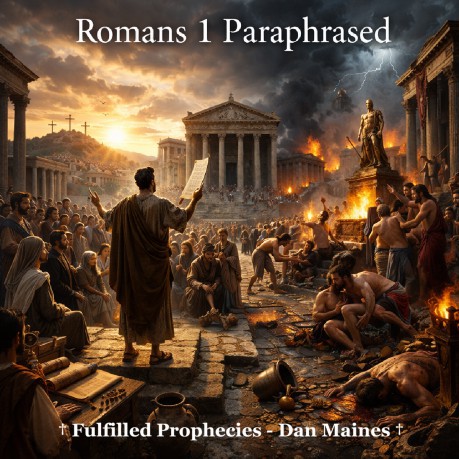
Romans 1 Paraphrased Introduction Romans 1:1 Romans 1:2 Romans 1:3 Romans 1:4 Romans 1:5 Romans 1:6 Romans 1:7 Romans 1:8 Romans 1:9 Romans 1:10 Romans 1:11 Romans 1:12 Romans 1:13 Romans 1:14 Romans 1:15 Romans 1:16 Romans 1:17 Romans 1:18 Romans 1:19 Romans 1:20 Romans 1:21 Romans 1:22 Romans 1:23 Romans 1:24 Romans 1:25 Romans 1:26 Romans 1:27 Romans 1:28 Romans 1:29 Romans 1:30 Romans 1:31 Romans 1:32 Historical References How It Applies To Us Today Q & A Appendix Q: Why did Paul say people are without excuse? Q: What is the power of God for salvation? Q: Why did Paul say the gospel went to the Jew
first? Q: What happens when people suppress the truth
about God? Q: What is the result of rejecting God's
design? † This is the fulfilled perspective we proclaim at
Fulfilled Prophecies † Source Index
By Dan Maines
† Romans
opens with Paul explaining the authority and purpose of the gospel.
He shows that the message about Jesus wasn't invented by men but was
promised long before through the prophets.
†
The chapter also explains why the world needs the gospel. Humanity
rejected the knowledge of God that was already visible in creation.
Because of that rejection, God allowed people to follow the
corruption of their own desires.
† From the
fulfilled perspective, Paul was addressing the first century world
where the old covenant age was passing away and the gospel was
spreading to the nations.
Paul, a servant of Jesus Christ,
called to be an apostle and set apart for the good news of God.
†
Paul begins by identifying himself as one completely devoted to
Christ's service. His authority didn't come from religious leaders
but from Christ Himself (Galatians 1:1).
†
The gospel Paul preached wasn't a new invention but the unfolding of
God's long promised plan.
† Irenaeus wrote
that the apostles were sent into the world with authority to proclaim
the gospel to every nation.
This good news was promised
beforehand through God's prophets in the holy Scriptures.
†
The gospel wasn't a surprise development. The prophets had already
spoken about it centuries earlier.
† Passages
such as Isaiah 52:7 and Isaiah 53 pointed directly to the coming
salvation through the Messiah.
† Clement of
Alexandria explained that the gospel fulfilled what the prophets had
long declared.
It concerns His Son, who came
from the line of David according to the flesh.
†
Jesus fulfilled the promise that the Messiah would come from David's
royal line (2 Samuel 7:12-16).
† His human
ancestry proves the promises to Israel were truly fulfilled in
history.
† Early Christian writers
consistently affirmed Jesus as the promised Son of David.
He was declared to be the Son of
God with power through the Spirit of holiness by His resurrection
from the dead, Jesus Christ our Lord.
† The
resurrection publicly confirmed Jesus' identity as the Son of God.
†
The resurrection was the decisive event that validated His authority
and message (Acts 2:24-36).
† Eusebius wrote
that the resurrection was the foundation upon which the apostles
boldly proclaimed Christ to the nations.
Through Him we received grace and
apostleship to bring about obedience of faith among all the nations
for His name's sake.
† The apostles were sent
beyond Israel to the nations. This fulfilled God's promise that all
nations would be blessed through Abraham.
†
Faith wasn't just belief but obedience that flowed from trusting
Christ.
† Tertullian noted that the apostles
carried the gospel into every region of the known world.
Among those nations you also are
called to belong to Jesus Christ.
† The Roman
believers were part of the expanding family of God among the
nations.
† The gospel was already
transforming communities across the empire.
†
This shows the fulfillment of the promise that the nations would be
included in God's people.
To all who are in Rome, loved by
God and called as saints, grace to you and peace from God our Father
and the Lord Jesus Christ.
† Paul refers to
the believers as saints, meaning those set apart for God.
†
Grace and peace summarize the blessings of the new covenant
established through Christ.
† Early Christian
communities often greeted one another with these same words.
First, I thank my God through
Jesus Christ for all of you, because your faith is being proclaimed
throughout the whole world.
† The Roman
church had gained a strong reputation for faithfulness.
†
The phrase whole world refers to the Roman world where the gospel was
spreading rapidly.
† Eusebius recorded that
the church in Rome became widely known in the early Christian
movement.
God, whom I serve in my spirit in
the gospel of His Son, is my witness that I constantly remember
you.
† Paul's ministry was deeply personal
and spiritual, not merely institutional.
†
His prayers showed his genuine concern for believers he had not yet
visited.
Always asking in my prayers that
somehow, by God's will, I may finally come to you.
†
Paul longed to visit Rome to strengthen the believers there.
†
Travel in the first century was difficult, yet Paul continually
sought opportunities to spread the gospel.
For I long to see you so that I
may share some spiritual gift to strengthen you.
†
Paul desired to encourage the believers with teaching and spiritual
encouragement.
† The early church grew
through direct instruction from the apostles.
That is, that we may be
encouraged together by each other's faith, both yours and mine.
†
Christian fellowship involved mutual encouragement, not one sided
teaching.
† Even an apostle recognized the
value of shared faith.
I don't want you to be unaware,
brothers, that I often planned to come to you but have been prevented
until now, so that I may obtain some fruit among you also as among
the rest of the nations.
† Paul had already
seen many Gentiles come to faith in other regions.
†
Rome represented another major center where the gospel could spread
further.
I am obligated both to Greeks
and to barbarians, both to the wise and to the foolish.
†
The gospel wasn't limited by culture or education.
†
The message of Christ was meant for every group in society.
So for my part, I am eager to
preach the gospel to you also who are in Rome.
†
Rome was the heart of the empire, making it a strategic location for
spreading the message.
For I am not ashamed of the
gospel, because it is the power of God for salvation to everyone who
believes, to the Jew first and also to the Greek.
†
The gospel carries God's power to rescue people from sin.
†
The message first went to Israel and then to the nations as promised
in prophecy.
† Irenaeus affirmed that
salvation through Christ was proclaimed to Jews and Gentiles alike.
For in it the righteousness of
God is revealed from faith to faith, just as it is written, the
righteous will live by faith.
† Paul quotes
Habakkuk 2:4 to show that faith has always been the basis of
righteousness.
† This righteousness isn't
earned through law but received through trusting God.
For the wrath of God is revealed
from heaven against all ungodliness and unrighteousness of people who
suppress the truth in unrighteousness.
†
Humanity knew the truth about God but chose to suppress it.
†
This rejection leads to moral corruption and judgment.
Because what may be known about
God is evident within them, for God made it evident to them.
†
God revealed Himself through creation and conscience.
†
No one could claim complete ignorance of God's existence.
For since the creation of the
world His invisible attributes, His eternal power and divine nature,
have been clearly seen through what has been made, so that they are
without excuse.
† The created world testifies
to God's existence and power.
† Humanity's
rejection of God is therefore deliberate.
For even though they knew God,
they didn't honor Him as God or give thanks, but their thinking
became futile and their foolish hearts were darkened.
†
The failure to honor God leads to intellectual and moral confusion.
†
Rejecting God results in spiritual darkness.
Claiming to be wise, they became
fools.
† Human wisdom that rejects God
becomes self destructive.
They exchanged the glory of the
incorruptible God for images resembling corruptible man and birds and
animals and crawling creatures.
† Idolatry
replaced true worship.
† The Roman world was
filled with statues and images representing false gods.
Therefore God gave them over to
the desires of their hearts to impurity, so that their bodies would
be dishonored among them.
† God allowed
people to experience the consequences of their chosen path.
They exchanged the truth of God
for a lie and worshiped and served the creation rather than the
Creator, who is blessed forever. Amen.
† This
summarizes the core problem of idolatry.
For this reason God gave them
over to dishonorable passions, for their women exchanged natural
relations for those that are contrary to nature.
†
Moral confusion follows spiritual rebellion.
In the same way the men
abandoned natural relations with women and burned in their desire for
one another, men committing indecent acts with men and receiving in
themselves the due penalty of their error.
†
Paul describes how rejection of God's design leads to destructive
behavior.
Since they didn't see fit to
acknowledge God, God gave them over to a depraved mind to do things
that are not proper.
† When people reject
truth repeatedly, their thinking becomes corrupted.
They were filled with all
unrighteousness, wickedness, greed, and evil, full of envy, murder,
strife, deceit, and malice, they are gossips.
†
Paul lists the moral consequences of rejecting God.
Slanderers, haters of God,
arrogant, proud, boastful, inventors of evil, disobedient to
parents.
† These behaviors show how deeply
corruption spreads when God is rejected.
Without understanding,
untrustworthy, unloving, and unmerciful.
†
These traits describe a society that has abandoned God's truth.
Although they know God's
righteous decree that those who practice such things deserve death,
they not only do them but also approve of those who practice them.
†
The final stage of corruption is celebrating what God condemns.
†
Irenaeus explained that Paul described the moral collapse of the
pagan world before the gospel transformed it.
†
Clement of Alexandria wrote that the knowledge of God existed in
creation but was ignored by idol worshipers.
†
Eusebius recorded that the Roman Empire was filled with idolatry and
moral corruption before the spread of Christianity.
†
Creation still reveals God's existence to every generation.
†
The gospel remains the power of God to rescue people from sin.
†
Rejecting God's truth still leads to moral confusion.
†
Faith in Christ brings righteousness that can't be earned through
human effort.
A:
Because God's existence and power are visible in creation, leaving
humanity responsible for rejecting Him (Romans 1:20).
A:
The gospel message about Jesus Christ (Romans 1:16).
A: Because the promises and covenants
were first given to Israel before spreading to the nations (Romans
1:16).
A: Their thinking becomes futile and
their hearts become darkened (Romans 1:21).
A: Moral corruption and a depraved mind
that approves what God condemns (Romans 1:28-32).
© Fulfilled Prophecies - Dan
Maines.
† Romans 1
†
Irenaeus, Against Heresies
† Clement of
Alexandria, Stromata
† Eusebius,
Ecclesiastical History
Links