Mark 16 Paraphrased Introduction Mark 16:1 Mark 16:2 Mark 16:3 Mark 16:4 Mark 16:5 Mark 16:6 Mark 16:7 Mark 16:8 Mark 16:9 Mark 16:10 Mark 16:11 Mark 16:12 Mark 16:13 Mark 16:14 Mark 16:15 Mark 16:16 Mark 16:17 Mark 16:18 Mark 16:19 Mark 16:20 Historical References How It Applies To Us Today Q & A Appendix Q: Why did the women go to the tomb with
spices? Q: Why is the empty tomb important? Q: Why did the disciples doubt the reports at
first? Q: What was the purpose of the signs that
followed the apostles? Q: Why did Jesus send the disciples to preach to
the world? † This is the fulfilled perspective we proclaim at
Fulfilled Prophecies † Source Index
By Dan Maines
† Mark
closes his Gospel by showing that the resurrection of Jesus was not
hidden, it was announced, witnessed, and preached immediately.
†
The events recorded here happened shortly after the crucifixion when
the tomb was discovered empty and the message began spreading among
the disciples.
† Early Christians constantly
pointed to the empty tomb as the foundation of their faith (1
Corinthians 15:3-8).
After the Sabbath ended, Mary
Magdalene, Mary the mother of James, and Salome bought spices so they
could go and place them on Jesus' body.
† The
women expected a body to be there, which shows they were not
anticipating a resurrection (Luke 24:1).
†
Their actions confirm the burial was real and the tomb location was
known.
† Josephus records
Jewish burial customs that included spices and perfumes for honoring
the dead (Josephus, Antiquities of the Jews 17.8.3).
Very early on the first day of the
week, just after the sun came up, they went to the tomb.
†
The timing shows the women came at the earliest possible moment after
the Sabbath restrictions ended.
† This early
visit also explains why the tomb discovery was witnessed by multiple
people (John 20:1).
† Eusebius
later noted that the resurrection was proclaimed publicly in
Jerusalem where the tomb could be checked (Eusebius, Ecclesiastical
History 3.39).
On the way they were asking each
other who would move the heavy stone away from the entrance of the
tomb.
† This concern proves the stone was
known to be large and difficult to move.
†
Their worry also shows they had no expectation that the tomb would
already be open.
† Clement of
Alexandria commented that the women came in simple devotion
without knowing what God had already done (Clement of Alexandria,
Stromata 6).
But when they arrived and looked
up, they saw the stone had already been rolled away, and it was
extremely large.
† The moved stone was the
first visible evidence that something had happened.
†
The Gospel writers emphasize the size to show it wasn't easily moved
by human effort.
† Irenaeus
used this event as evidence that the resurrection was a public
historical event (Irenaeus, Against Heresies 3.10).
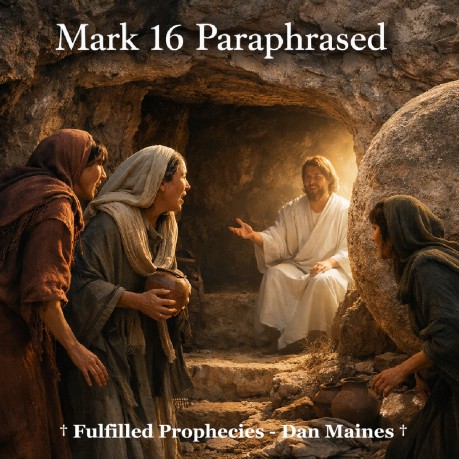
When they entered the tomb they
saw a young man dressed in a white robe sitting on the right side,
and they were shocked and afraid.
† The young
man is described as a messenger announcing what had happened.
†
White garments were commonly associated with heavenly messengers in
Jewish writings.
† Eusebius
records that early Christians understood this figure as an angelic
witness to the resurrection (Ecclesiastical History 1.2).
He told them not to be afraid. He
said they were looking for Jesus of Nazareth who had been crucified,
but he had risen and was no longer there. He told them to look at the
place where his body had been laid.
† The
empty location itself became evidence that Jesus had risen.
†
The message connects the crucifixion directly with the
resurrection.
† Irenaeus
emphasized that the resurrection was proclaimed first at the empty
tomb (Against Heresies 3.11).
He told them to go and tell the
disciples and Peter that Jesus was going ahead of them into Galilee
and they would see him there just as he had told them before.
†
This instruction confirms Jesus had already predicted these events
earlier (Mark 14:28).
† Peter is specifically
mentioned, showing restoration after his denial.
†
Clement of Alexandria wrote that the resurrection
message was meant to restore and strengthen the disciples (Stromata
5).
The women ran from the tomb
trembling and amazed, and at first they said nothing to anyone
because they were afraid.
† Fear and
amazement were natural reactions to the unexpected discovery.
†
This moment shows the emotional shock before the message spread
further.
† Eusebius noted
that despite the fear, the resurrection message quickly spread
throughout the early church (Ecclesiastical History 2.1).
After rising early on the first
day of the week, Jesus first appeared to Mary Magdalene, the woman he
had freed from seven demons.
† Mary Magdalene
became one of the first witnesses of the risen Christ.
†
Her testimony shows how the risen Jesus revealed himself to followers
who had been transformed by him.
† Irenaeus
records this appearance as one of the earliest testimonies of the
resurrection (Against Heresies 3.11).
She went and told those who had
been with him while they were mourning and crying.
†
The disciples were grieving because they believed Jesus was dead.
†
Her report shows that the first proclamation of the resurrection came
through eyewitness testimony.
† Eusebius
said the apostles eventually confirmed this testimony through their
own encounters with Christ (Ecclesiastical History 3.24).
But when they heard that he was
alive and that she had seen him, they did not believe it.
†
The disciples initially doubted the report.
†
This detail shows the resurrection story was not created by believers
expecting it.
† Clement of Alexandria
observed that the apostles needed direct evidence before they were
convinced (Stromata 6).
After that Jesus appeared in a
different form to two of them while they were walking in the
countryside.
† This likely refers to the
encounter described on the road to Emmaus (Luke 24:13-35).
†
These appearances confirmed that the resurrection was witnessed by
multiple individuals.
† Irenaeus
noted that many saw Christ alive after the crucifixion (Against
Heresies 3.12).
They returned and told the
others, but they did not believe them either.
†
Multiple testimonies were initially doubted.
†
This strengthens the credibility of the narrative because disbelief
is openly recorded.
† Eusebius
wrote that repeated appearances eventually convinced the apostles
(Ecclesiastical History 1.13).
Later Jesus appeared to the
eleven while they were eating and corrected them for their unbelief
and stubborn hearts because they refused to believe those who had
seen him after he rose.
† Jesus confronted
their doubt directly.
† The correction
prepared them for their role in proclaiming the message.
†
Irenaeus said the apostles were transformed from
doubters into bold witnesses (Against Heresies 3.13).
He told them to go into the whole
world and announce the good news to every creature.
†
This instruction launched the global mission of the early church.
†
The message of Christ was meant to reach every nation.
†
Eusebius records that the apostles carried this
message across the Roman world (Ecclesiastical History 3.1).
Whoever believes and is baptized
will be saved, but whoever does not believe will be condemned.
†
Faith in Christ became the dividing line between acceptance and
rejection of the message.
† Baptism served as
the public expression of belief in the early church.
†
Clement of Alexandria wrote about baptism as the
sign of entering the new life in Christ (Stromata 7).
These signs would accompany those
who believed: they would drive out demons in his name, speak in new
languages,
† These signs confirmed the
authority of the early gospel message.
† They
served as proof that the apostles were sent by Christ.
†
Irenaeus testified that miraculous signs accompanied
the early church's preaching (Against Heresies 2.32).
They would pick up snakes safely
and even if they drank something poisonous it would not harm them.
They would place their hands on the sick and they would recover.
†
These signs symbolized protection and healing that accompanied the
early mission.
† The miracles confirmed the
divine authority of the message being preached.
†
Eusebius wrote about many miraculous works
attributed to the apostles in the early church (Ecclesiastical
History 2.3).
After speaking with them, the
Lord Jesus was taken up into heaven and sat down at the right hand of
God.
† This marks the completion of his
earthly mission.
† Sitting at God's right
hand symbolizes authority and rule.
†
Irenaeus wrote that Christ ascended and reigns with
the Father (Against Heresies 3.16).
The disciples went out and
preached everywhere while the Lord worked with them and confirmed the
message through the signs that followed.
†
The gospel spread rapidly across the Roman world.
†
The message was confirmed through both preaching and divine
confirmation.
† Eusebius
documented how Christianity spread throughout the empire in the first
centuries (Ecclesiastical History 2.2).
†
Josephus recorded burial customs and the context of first century
Judea (Antiquities of the Jews).
† Irenaeus
described the resurrection appearances and apostolic preaching
(Against Heresies).
† Eusebius preserved
early church history and apostolic testimony (Ecclesiastical
History).
† Clement of Alexandria discussed
early Christian teachings and practices (Stromata).
†
The resurrection reminds us that Christ's victory over death changed
everything.
† The apostles carried the
message across the world, and that same gospel still transforms lives
today.
† The empty tomb continues to stand as
the foundation of the Christian faith.
A: They expected to honor a dead body
because they did not yet understand the resurrection (Luke 24:1).
A:
It became the first evidence that Jesus had risen (1 Corinthians
15:3-4).
A: They were grieving and did not expect
a resurrection (Luke 24:11).
A: They confirmed that
the message came from God (Hebrews 2:3-4).
A: The gospel was meant for every
nation (Matthew 28:19-20).
© Fulfilled Prophecies - Dan
Maines.
† Mark 16
†
Josephus, Antiquities of the Jews
† Irenaeus,
Against Heresies
† Eusebius, Ecclesiastical
History
† Clement of Alexandria, Stromata
Links