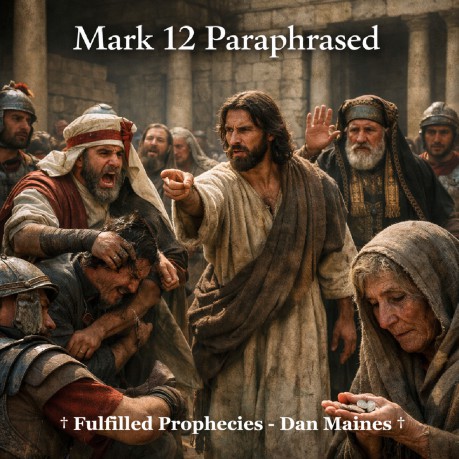
Mark 12
Paraphrased
By Dan Maines
Introduction
†
In this chapter Jesus confronts the corrupt leadership of Israel
through parables, questions, and direct teaching, exposing their
hypocrisy while revealing the coming judgment that would fall upon
Jerusalem in that generation (Matthew 23:36).
†
The religious leaders attempt to trap Jesus with political,
theological, and legal questions, but every attempt exposes their
ignorance of Scripture and the power of God (Luke 20:20-26).
†
This entire confrontation happens in the temple during the final week
before the destruction that would come upon that covenant system,
exactly as Jesus had already warned (Luke 21:5-6).
Mark
12:1
Jesus began speaking to them using a story. A man
planted a vineyard, built a fence around it, dug a pit for the
winepress, and built a tower. Then he leased the vineyard to farmers
and traveled to another country.
† The
vineyard represents Israel, imagery drawn directly from Isaiah's
prophecy about God's covenant people (Isaiah 5:1-7).
†
The farmers represent the religious leaders who were entrusted with
Israel but failed to produce righteousness (Ezekiel 34:2-10).
Mark
12:2
At harvest time he sent a servant to the farmers
to collect some of the fruit from the vineyard.
†
The servants represent the prophets whom God repeatedly sent to
Israel (Jeremiah 7:25).
† The fruit
represents justice, righteousness, and obedience to God (Micah
6:8).
Mark 12:3
But they grabbed the
servant, beat him, and sent him away with nothing.
†
Israel repeatedly rejected and mistreated the prophets God sent to
them (2 Chronicles 36:15-16).
† Jesus exposes
the long history of rebellion among the leadership of Israel.
Mark
12:4
So he sent another servant to them, but they
struck him on the head and treated him shamefully.
†
The pattern of rejecting God's messengers continued for centuries
(Nehemiah 9:26).
† This reveals the hardened
condition of the leadership Jesus was confronting.
Mark
12:5
Then he sent another, and they killed him. He sent
many others, some they beat and others they killed.
†
This reflects the persecution of prophets such as Zechariah who was
killed in the temple court (2 Chronicles 24:20-21).
†
Jesus shows that their actions against Him were part of a long
pattern of rebellion.
Mark 12:6
He still
had one person left to send, his beloved son. Finally he sent him to
them saying, They'll respect my son.
† The
son represents Christ Himself, the heir and rightful authority over
Israel (Hebrews 1:2).
† Jesus is clearly
identifying Himself as the Son sent by the Father.
Mark
12:7
But those farmers said to one another, This is the
heir. Come on, let's kill him and the inheritance will be ours.
†
The leaders wanted control of the nation and its religious system
(John 11:48).
† Their rejection of Christ
revealed their desire for power rather than truth.
Mark
12:8
So they seized him, killed him, and threw his body
out of the vineyard.
† Jesus foretold His own
rejection and crucifixion outside the city (Hebrews 13:12).
†
The parable also hints at the coming removal of those leaders.
Mark
12:9
What will the owner of the vineyard do? He'll
come, destroy those farmers, and give the vineyard to others.
†
This points directly to the destruction of Jerusalem and the removal
of the corrupt leadership (Luke 21:20-24).
†
The kingdom would be given to a people producing fruit, including
believers from all nations (Matthew 21:43).
Mark
12:10
Haven't you read this scripture: The stone the
builders rejected became the chief cornerstone.
†
Jesus quotes Psalm 118 which the leaders knew well (Psalm 118:22).
†
The rejected Messiah would become the foundation of God's
kingdom.
Mark 12:11
This came from the
Lord, and it's amazing in our eyes.
† God's
plan of redemption through rejection was foretold long before (Isaiah
53:3).
† The leaders were witnessing the
fulfillment of that prophecy.
Mark 12:12
They
wanted to arrest him because they knew the story was about them, but
they feared the crowd, so they left and went away.
†
Their reaction proves they understood the message but refused to
repent.
† Fear of people often keeps leaders
from obeying truth (Proverbs 29:25).
Mark 12:13
Later
they sent some Pharisees and supporters of Herod to trap him with his
own words.
† The Pharisees and Herodians
normally opposed each other but united against Jesus (Psalm 2:2).
†
Their goal was political entrapment.
Mark 12:14
They
came and said, Teacher, we know you're truthful and don't care about
anyone's status. You teach the way of God honestly. Is it lawful to
pay taxes to Caesar or not?
† Their flattery
was manipulation intended to set a trap.
† If
Jesus rejected taxes they could accuse Him of rebellion against
Rome.
Mark 12:15
Should we pay or
shouldn't we? But Jesus knew their hypocrisy and said, Why are you
testing me? Bring me a denarius so I can look at it.
†
Jesus immediately exposes their motives (Psalm 94:11).
†
Their hypocrisy revealed their dishonesty before God.
Mark
12:16
They brought the coin. He asked them, Whose image
and inscription is this? They said, Caesar's.
†
Roman coins carried the emperor's image declaring his authority.
†
Jesus used their own object to teach the truth.
Mark
12:17
Jesus said, Give to Caesar what belongs to
Caesar, and give to God what belongs to God. And they were amazed by
him.
† Civil authority and divine authority
are distinct responsibilities (Romans 13:1).
†
Humanity bears God's image and ultimately belongs to Him (Genesis
1:27).
Mark 12:18
Then Sadducees, who say
there is no resurrection, came to him with a question.
†
The Sadducees rejected resurrection and many supernatural doctrines
(Acts 23:8).
† Their theology was rooted in
denial of God's power.
Mark 12:19
Teacher,
Moses wrote for us that if a man's brother dies leaving a wife but no
children, the man must marry the widow and raise up children for his
brother.
† This law comes from the levirate
marriage command (Deuteronomy 25:5-6).
† They
attempted to use the law to ridicule resurrection.
Mark
12:20
There were seven brothers. The first married a
woman and died without leaving children.
†
The story is hypothetical and exaggerated.
†
Their goal was mockery rather than truth.
Mark 12:21
The
second brother married her and died leaving no children. The third
did the same.
† The repeated deaths were
meant to create a dilemma.
† Their reasoning
was rooted in earthly assumptions.
Mark 12:22
All
seven brothers married her and none left children. Finally the woman
died too.
† Their scenario ignored the power
of God to establish new realities.
† They
were measuring resurrection by earthly marriage laws.
Mark
12:23
In the resurrection when they rise again, whose
wife will she be since all seven had married her?
†
They assumed resurrection life mirrored earthly life exactly.
†
Their misunderstanding set up Jesus' correction.
Mark
12:24
Jesus answered, Aren't you mistaken because you
don't understand the scriptures or the power of God?
†
Ignorance of scripture leads to false theology (Hosea 4:6).
†
Denying God's power limits understanding of His promises.
Mark
12:25
When people rise from the dead they neither marry
nor are given in marriage but are like angels in heaven.
†
Jesus describes the changed conditions of resurrected life.
†
Marriage serves earthly purposes but not the resurrected order.
Mark
12:26
But regarding the dead rising again, haven't you
read in the book of Moses in the passage about the burning bush, how
God said to him, I am the God of Abraham, the God of Isaac, and the
God of Jacob?
† Jesus proves resurrection
from the Torah which the Sadducees accepted (Exodus 3:6).
†
God's covenant relationship with the patriarchs continued beyond
death.
Mark 12:27
He's not the God of the
dead but of the living. You're seriously mistaken.
†
God's covenant promises guarantee life beyond physical death.
†
Their denial of resurrection contradicted their own scriptures.
Mark
12:28
One of the scribes came near and heard them
arguing. Seeing that Jesus answered them well he asked, Which
commandment is the most important of all?
†
Unlike the others this scribe approached sincerely.
†
Jewish teachers often debated which law carried greatest weight.
Mark
12:29
Jesus answered, The most important is this: Hear
Israel, the Lord our God, the Lord is one.
†
Jesus quotes the Shema, Israel's central confession of faith
(Deuteronomy 6:4).
† True worship begins with
acknowledging the one true God.
Mark 12:30
You
must love the Lord your God with all your heart, all your soul, all
your mind, and all your strength.
† Total
devotion to God fulfills the purpose of the law (Deuteronomy 6:5).
†
Love for God must involve every part of life.
Mark
12:31
The second is this: Love your neighbor as
yourself. There is no commandment greater than these.
†
Jesus quotes Leviticus 19:18 linking love for God with love for
others.
† These two commands summarize the
entire law and prophets (Matthew 22:40).
Mark 12:32
The
scribe said, Teacher, you're right. God is one and there is no other
besides Him.
† The scribe affirmed the core
truth of Israel's faith.
† His response shows
sincere understanding.
Mark 12:33
And to
love Him with all the heart, understanding, and strength, and to love
one's neighbor as oneself is far more important than all burnt
offerings and sacrifices.
† True obedience
outweighs ritual sacrifice (1 Samuel 15:22).
†
The prophets repeatedly taught the same truth.
Mark
12:34
When Jesus saw he answered wisely He said, You're
not far from the kingdom of God. After that no one dared question him
anymore.
† The man was close to truth but
still needed faith in Christ.
† Jesus had
silenced every trap set by His opponents.
Mark
12:35
While teaching in the temple Jesus asked, How can
the scribes say the Messiah is the son of David?
†
Jesus begins revealing the deeper identity of the Messiah.
†
The leaders understood the prophecy but not its full meaning.
Mark
12:36
David himself said by the Holy Spirit, The Lord
said to my Lord, Sit at my right hand until I put your enemies under
your feet.
† Jesus quotes Psalm 110, one of
the most quoted messianic prophecies.
† The
Messiah would reign with divine authority.
Mark
12:37
David himself calls him Lord, so how can he be
his son? And the large crowd enjoyed listening to him.
†
The Messiah is both David's descendant and David's Lord.
†
This points to Christ's divine identity.
Mark 12:38
In
his teaching he said, Beware of the scribes who like walking around
in long robes and receiving greetings in the marketplaces.
†
Jesus exposes religious pride and love of recognition.
†
Leadership driven by status corrupts faith.
Mark
12:39
They like the best seats in the synagogues and
the places of honor at banquets.
† Their
religion was focused on public status.
† True
humility was missing from their leadership.
Mark
12:40
They devour widows' houses and for show make long
prayers. These will receive greater condemnation.
†
Their corruption harmed the most vulnerable.
†
Jesus warns of severe judgment for religious exploitation (James
3:1).
Mark 12:41
Jesus sat across from the
treasury watching how people put money into the offering box. Many
rich people were giving large amounts.
† The
temple treasury was located in the court of women.
†
Jesus observed not just the amount but the heart behind the
giving.
Mark 12:42
A poor widow came and
put in two small copper coins worth almost nothing.
†
Her offering was financially small but spiritually significant.
†
God measures generosity by sacrifice, not amount.
Mark
12:43
Calling his disciples he said, This poor widow
gave more than everyone else who put money in the offering box.
†
Jesus evaluates giving based on devotion and trust.
†
Faithful sacrifice carries great value in God's kingdom.
Mark
12:44
They all gave out of their surplus but she gave
out of her poverty, putting in everything she had to live on.
†
Her offering represented complete trust in God.
†
This contrasts sharply with the greed of the religious
leaders.
Historical References
†
Josephus records the corruption and greed of Jerusalem's priestly
leadership shortly before the destruction of the city, confirming
Jesus' warnings about them (Josephus, Wars of the Jews 5.13).
†
Irenaeus wrote that Christ exposed the hypocrisy of Israel's leaders
while revealing the true meaning of the law (Irenaeus, Against
Heresies Book 4).
† Eusebius preserved early
Christian teaching that these events happened shortly before the
judgment that fell upon Jerusalem in AD 70 (Eusebius, Ecclesiastical
History 3.5).
† Clement of Alexandria wrote
that Jesus revealed the spirit of the law rather than the empty
rituals practiced by the religious authorities (Clement of
Alexandria, Stromata Book 7).
How It Applies To Us
Today
† God still expects His people
to produce fruit of righteousness rather than empty religious
activity (John 15:8).
† Hypocrisy in
spiritual leadership always brings judgment and accountability (1
Peter 5:2-3).
† True devotion to God is
measured by love for Him and love for others (1 John 4:20-21).
†
Faithful obedience often appears small in the eyes of the world but
carries great value before God (Hebrews 6:10).
Q & A
Appendix
Q What does the vineyard
represent in this chapter?
A The vineyard
represents Israel and the covenant people entrusted with God's law
and promises (Isaiah 5:1-7).
Q Who were the
farmers in the parable?
A The farmers represent
the corrupt religious leaders who controlled the temple system but
rejected God's messengers (Ezekiel 34:2-10).
Q
Who is the son sent to the vineyard?
A The son
represents Jesus Christ, the heir and authority sent by the Father
(Hebrews 1:2).
Q What judgment did the parable
predict?
A It predicted the removal of corrupt
leadership and the destruction of Jerusalem's system (Luke
21:20-24).
Q Why was the widow's offering
greater than the others?
A Because she gave
everything she had while others gave only from their excess (2
Corinthians 8:12).
† This is the fulfilled perspective
we proclaim at Fulfilled Prophecies †
© Fulfilled
Prophecies - Dan Maines.
Source Index
†
Mark 12
† Josephus, Wars of the Jews
†
Irenaeus, Against Heresies
† Eusebius,
Ecclesiastical History
† Clement of
Alexandria, Stromata
Links