Mark 11 Paraphrased Introduction Mark 11:1 Mark 11:2 Mark 11:3 Mark 11:4 Mark 11:5 Mark 11:6 Mark 11:7 Mark 11:8 Mark 11:9 Mark 11:10 Mark 11:11 Mark 11:12 Mark 11:13 Mark 11:14 Mark 11:15 Mark 11:16 Mark 11:17 Mark 11:18 Mark 11:19 Mark 11:20 Mark 11:21 Mark 11:22 Mark 11:23 Mark 11:24 Mark 11:25 Mark 11:27 Mark 11:28 Mark 11:29 Mark 11:30 Mark 11:31 Mark 11:32 Mark 11:33 Historical References How It Applies To Us Today Q & A Appendix Q: Why did Jesus ride a donkey into Jerusalem? Q: What did the fig tree represent? Q: Why did Jesus cleanse the temple? Q: What does the withered fig tree represent
prophetically? Q: Why did Jesus question the leaders about John
the Baptist? † This is the fulfilled perspective we proclaim at
Fulfilled Prophecies † Source Index
By Dan Maines
† Mark 11
records the final week of Jesus' ministry before the destruction that
would come upon Jerusalem in that generation. The events here move
quickly, the entry into Jerusalem, the judgment on the fig tree, the
cleansing of the temple, and the confrontation with the religious
leaders. Each moment points to the coming end of the Old Covenant
system and the exposure of Israel's leadership.
†
Jesus openly presents Himself as the promised King, yet the same city
that celebrates Him will soon reject Him. The chapter reveals both
the mercy of Christ and the judgment that was approaching the corrupt
temple leadership (Matthew 23:37-38).
† Early
Christian writers also recognized the significance of this moment.
Eusebius wrote that the rejection of Christ by Jerusalem's leaders
led directly to the judgment that came upon the city in AD 70.
As Jesus and His disciples
approached Jerusalem near Bethphage and Bethany by the Mount of
Olives, He sent two of His disciples ahead.
†
The approach from the Mount of Olives is significant because prophecy
connected this location with the coming of the Lord to judge
Jerusalem (Zechariah 14:4).
† Jesus
intentionally enters the city in a way that fulfills messianic
expectation, making it clear He is the promised King (Zechariah
9:9).
† Irenaeus explained that Christ's
actions were not random events but deliberate fulfillments of the
prophets concerning the Messiah.
He told them go into the village
ahead of you, and as soon as you enter it you'll find a young donkey
tied there that no one has ever ridden. Untie it and bring it here.
†
The unused colt reflects royal symbolism, animals set apart for
sacred or royal purposes were often those never used before (Numbers
19:2).
† This act fulfills the prophecy of
the humble King riding on a donkey, showing that Christ's kingdom
wasn't built by earthly power (Zechariah 9:9).
†
Clement of Alexandria noted that Christ deliberately fulfilled the
prophetic signs so Israel would recognize their Messiah.
If anyone asks you why you're
doing this, say the Lord needs it and will return it soon.
†
Jesus shows His authority even in ordinary matters. The title Lord
demonstrates His authority over people and events.
†
This moment reveals that the Messiah's authority was recognized even
by those outside His immediate followers.
They went and found the colt tied
at a door outside in the street and they untied it.
†
The disciples' obedience shows their trust in Christ's
instructions.
† The accuracy of Jesus' words
confirms His knowledge and authority over events.
Some people standing there asked
them what are you doing untying the colt.
†
This question sets up the recognition of Christ's authority.
†
It also demonstrates that the disciples were acting under the direct
instruction of the Lord.
They answered just as Jesus told
them and the people let them take it.
† The
authority of Jesus' word allows the disciples to proceed without
conflict.
† This moment reveals how the
mission of Christ moved forward through obedience.
They brought the colt to Jesus and
placed their cloaks on it and He sat on it.
†
Placing garments on the animal was a sign of honoring a king (2 Kings
9:13).
† Jesus' entrance into Jerusalem
fulfills prophecy while presenting Him as the true King.
Many people spread their cloaks on
the road and others spread leafy branches they had cut from the
fields.
† The spreading of cloaks and
branches reflects the celebration of a victorious king entering a
city.
† The crowd recognizes Jesus as the
long awaited Messiah.
Those going ahead and those
following were shouting Hosanna blessed is He who comes in the name
of the Lord.
† The word Hosanna means save
now and was taken from the Psalms used during festivals (Psalm
118:25-26).
† The crowd was unknowingly
declaring the arrival of the Messiah promised in the scriptures.
Blessed is the coming kingdom of
our father David Hosanna in the highest.
†
The people expected the restoration of David's kingdom.
†
Christ's kingdom however would not be political but spiritual,
established through His death and resurrection.
Jesus entered Jerusalem and went
into the temple. After looking around at everything, since it was
already late, He left for Bethany with the twelve.
†
Jesus examines the temple, symbolically inspecting the condition of
Israel's religious system.
† What He sees
leads to the coming judgment against the corrupt leadership (Matthew
21:12-13).
The next day when they left
Bethany, Jesus became hungry.
† The narrative
now shifts to the fig tree, which represents Israel.
†
The coming action toward the tree becomes a symbolic act of judgment.
Seeing a fig tree in leaf from a
distance He went to see if He could find fruit on it but when He came
to it He found nothing but leaves because it wasn't the season for
figs.
† The fig tree often symbolized Israel
in scripture (Hosea 9:10).
† The leaves
without fruit represent outward religion without true righteousness.
Jesus said to it may no one ever
eat fruit from you again and His disciples heard Him say it.
†
The judgment against the fig tree symbolically represents the
judgment coming upon Israel's unfruitful leadership.
†
This act parallels Jesus' later pronouncement that the kingdom would
be taken from them (Matthew 21:43).
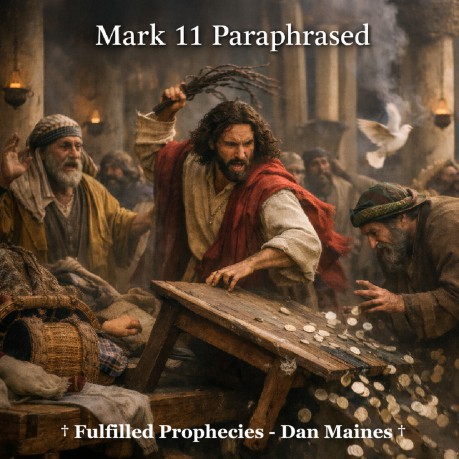
They came to Jerusalem and He
entered the temple and began driving out those buying and selling
there. He overturned the tables of the money changers and the seats
of those selling doves.
† The temple had
become corrupted by profit and exploitation.
†
Jesus cleanses the temple as a sign that judgment is coming upon the
entire system.
He wouldn't allow anyone to carry
merchandise through the temple courts.
†
Christ asserts His authority over the temple.
†
The temple was meant to be holy ground, not a marketplace.
He taught them saying isn't it
written my house shall be called a house of prayer for all nations
but you've made it a den of robbers.
† Jesus
combines two Old Testament passages showing the temple was meant for
the nations (Isaiah 56:7, Jeremiah 7:11).
†
The corruption of the temple leadership turned worship into
exploitation.
The chief priests and scribes
heard this and began looking for a way to destroy Him because they
feared Him since the whole crowd was amazed at His teaching.
†
The religious leaders' response reveals their hardened hearts.
†
Their desire to kill Him fulfills the pattern of rejecting God's
messengers (Matthew 23:37).
When evening came they left the
city.
† Jesus withdraws temporarily as the
tension grows.
† The conflict between Christ
and the leaders is rapidly escalating.
In the morning as they passed by
they saw the fig tree withered from the roots.
†
The complete withering represents total judgment.
†
This mirrors the coming destruction of Jerusalem and the temple
system.
Peter remembered and said to Him
Rabbi look the fig tree you cursed has withered.
†
The disciples recognize the power of Christ's word.
†
The event confirms the prophetic sign Jesus performed.
Jesus answered them have faith in
God.
† Jesus redirects their attention from
the miracle to the power of faith.
† Faith
becomes the defining characteristic of the new covenant community.
Truly I tell you whoever says to
this mountain be taken up and thrown into the sea and doesn't doubt
in his heart but believes what he says will happen it will be done
for him.
† The mountain likely refers to the
temple mount itself, symbolizing the removal of the corrupt system.
†
Faith in God would bring about the fulfillment of His purposes.
Therefore I tell you whatever you
ask in prayer believe you've received it and it will be yours.
†
Prayer is connected to faith and trust in God's promises.
†
Christ emphasizes reliance on God rather than religious systems.
Whenever you stand praying
forgive if you have anything against anyone so that your Father in
heaven will also forgive your sins.
†
Forgiveness becomes a central principle of the new covenant life.
†
Christ connects prayer, forgiveness, and reconciliation.
They came again to Jerusalem and
while He was walking in the temple courts the chief priests scribes
and elders came to Him.
† The religious
leaders now confront Jesus directly.
† Their
authority is threatened by His teaching.
They asked Him by what authority
are you doing these things and who gave you this authority.
†
The leaders question His authority because they refuse to accept His
identity.
† Their question exposes their
rejection of God's messenger.
Jesus said I'll ask you one
question answer Me and I'll tell you by what authority I do these
things.
† Jesus responds with wisdom exposing
their hypocrisy.
† His method forces them to
reveal their true motives.
John's baptism was it from heaven
or from men answer Me.
† John the Baptist
prepared the way for Christ (Malachi 4:5-6).
†
Accepting John would require acknowledging Jesus.
They discussed it among
themselves saying if we say from heaven He'll say why didn't you
believe him.
† Their discussion reveals
political calculation rather than truth.
†
Their concern is public opinion, not obedience to God.
But if we say from men they
feared the people because everyone believed John was truly a
prophet.
† The leaders feared losing their
influence.
† Their refusal to answer shows
their spiritual blindness.
So they answered Jesus we don't
know and Jesus said neither will I tell you by what authority I do
these things.
† Their unwillingness to
recognize truth results in Christ withholding further explanation.
†
This moment exposes the failure of Israel's leadership.
†
Josephus described the corruption of the priestly leadership in the
first century and how the temple system had become deeply
compromised.
† Eusebius wrote that the
rejection of Christ by Jerusalem's leaders led to the judgment that
later fell upon the city.
† Irenaeus recorded
that the prophets and apostles warned Israel repeatedly before the
final destruction of Jerusalem.
†
Mark 11 reminds us that outward religion without true faith produces
no fruit.
† Christ looks for genuine
obedience and faith rather than empty traditions.
†
The judgment that came upon Jerusalem warns every generation not to
reject the truth of Christ.
† Faith in God
must be accompanied by forgiveness and humility.
†
The kingdom Christ established isn't built on temples or institutions
but on faith in Him.
A:
To fulfill the prophecy of the humble King entering Zion (Zechariah
9:9).
A:
It symbolized Israel's leadership that appeared religious but
produced no spiritual fruit (Hosea 9:10).
A:
The temple had become corrupt and was no longer fulfilling its
purpose as a house of prayer for all nations (Isaiah 56:7).
A: It points to the coming
judgment upon Jerusalem and the temple system in that generation
(Matthew 21:43).
A: Because accepting John would
require them to acknowledge Jesus as the Messiah (Malachi 4:5-6).
© Fulfilled Prophecies - Dan
Maines.
† Mark 11
†
Josephus, Antiquities of the Jews
† Irenaeus,
Against Heresies
† Eusebius, Ecclesiastical
History
† Clement of Alexandria, Stromata
Links