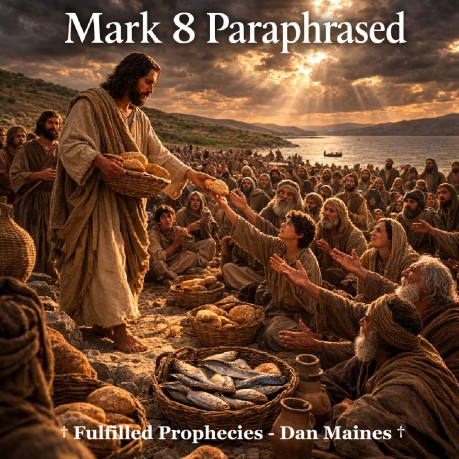
Mark 8
Paraphrased
By Dan Maines
Introduction
†
Mark 8 continues the public ministry of Jesus as large crowds
followed him across Galilee and the surrounding regions.
†
The chapter shows both the compassion of Christ and the spiritual
blindness of Israel's leaders and even his own disciples.
†
Early Christian writers often pointed to these events as proof that
the Messiah came to reveal truth to that generation before the
judgment that would fall on Jerusalem.
Mark 8:1
During
those days a very large crowd gathered again, and they had nothing
left to eat. Jesus called his disciples and said the people needed
help.
† Huge crowds constantly followed Jesus
because his teaching and miracles were spreading throughout the
region (Matthew 4:24).
† Christ's concern
wasn't only about teaching, he cared deeply about the physical needs
of people.
† Irenaeus wrote that the
compassion of Christ revealed the goodness of God toward
humanity.
Mark 8:2
I feel deep compassion
for these people. They've stayed with me three days now and have
nothing left to eat.
† The crowd remained
with Jesus for several days because they were eager to hear his
teaching.
† Compassion was a defining
characteristic of Christ's ministry (Psalm 145:8).
†
Clement of Alexandria wrote that Christ revealed the mercy of God
through acts like these.
Mark 8:3
If I
send them away hungry they'll collapse along the road, because some
of them came from far away.
† Jesus
recognized the hardship faced by people who traveled long distances
to hear him.
† This moment reveals the
practical concern Jesus had for ordinary people.
†
Eusebius noted that many who witnessed these miracles spread the news
throughout the Roman world.
Mark 8:4
His
disciples answered, Where could anyone find enough bread out here in
this deserted place to feed all these people?
†
Even after witnessing previous miracles the disciples still struggled
to fully grasp Christ's power.
† Their
question shows how human reasoning often overlooks what God can do.
†
Early Christian commentators said this honesty in the Gospel accounts
shows their authenticity.
Mark 8:5
He
asked them, How many loaves do you have? They said, Seven.
†
Jesus often involved his disciples so they could personally witness
the miracles.
† God frequently begins with
what little people already have.
† Tertullian
wrote that these miracles demonstrated the creative authority of
Christ.
Mark 8:6
He told the crowd to sit
on the ground. Then he took the seven loaves, gave thanks, broke
them, and handed them to the disciples to distribute to the people.
†
Giving thanks before eating reflected common Jewish prayer
traditions.
† The disciples distributing the
bread symbolized their future role in spreading the gospel.
†
Early Christians saw this moment as a picture of Christ providing
through his followers.
Mark 8:7
They also
had a few small fish. After blessing them he told the disciples to
serve those as well.
† Even small resources
became part of the miracle once placed in Christ's hands.
†
This demonstrated that God's provision often exceeds expectations.
†
Justin Martyr pointed to these miracles as evidence of divine power
working through Jesus.
Mark 8:8
Everyone
ate until they were satisfied, and afterward they gathered seven
large baskets full of leftover pieces.
† The
abundance of leftovers emphasized the overwhelming provision of
Christ.
† The miracle confirmed that Jesus
had authority over creation.
† Irenaeus wrote
that the abundance symbolized the generosity of God's kingdom.
Mark
8:9
About four thousand people were there, and after
they finished eating Jesus sent them away.
†
The size of the crowd shows how widely Jesus' ministry had spread.
†
Many people came from surrounding regions to hear him teach.
†
Eusebius recorded that these reports spread across the Roman
provinces.
Mark 8:10
Immediately he got
into a boat with his disciples and went to the region of
Dalmanutha.
† Jesus frequently traveled
across the Sea of Galilee during his ministry.
†
Moving from place to place allowed him to continue teaching new
crowds.
† Archaeological evidence confirms
heavy travel and fishing activity in this area.
Mark
8:11
The Pharisees came and began arguing with him.
They demanded a sign from heaven to test him.
†
The religious leaders often demanded signs while ignoring the
miracles happening before them.
† Their
request wasn't sincere, it was meant to challenge his authority.
†
Tertullian wrote that unbelief often refuses evidence even when it is
obvious.
Mark 8:12
Jesus sighed deeply and
said, Why does this generation keep demanding a sign? I tell you, no
sign will be given to this generation.
†
Jesus directly addressed the people living during that time.
†
The phrase this generation appears repeatedly in the Gospels
referring to the first century audience (Matthew 23:36).
†
Early Christian writers connected these warnings to the events that
led to the destruction of Jerusalem.
Mark 8:13
Then
he left them, got back into the boat, and crossed to the other
side.
† Jesus often walked away from those
who approached him with hardened hearts.
†
Israel's leadership repeatedly rejected the truth being revealed.
†
Josephus later described the devastating consequences that
followed.
Mark 8:14
The disciples had
forgotten to bring bread, and they only had one loaf with them in the
boat.
† The disciples were still focused on
physical concerns.
† This moment leads into
Jesus warning about spiritual corruption.
†
Clement of Alexandria wrote that understanding often grows
gradually.
Mark 8:15
Jesus warned them,
Watch out, be careful of the yeast of the Pharisees and the yeast of
Herod.
† Yeast was commonly used as a symbol
of corrupt influence spreading through a group (1 Corinthians 5:6).
†
The Pharisees represented religious hypocrisy.
†
Herod represented corrupt political power.
Mark
8:16
They began discussing among themselves that he
said this because they had no bread.
† The
disciples misunderstood the warning and thought he meant literal
bread.
† This reveals how easily people miss
spiritual meaning.
† Irenaeus noted that
Christ patiently corrected their misunderstandings.
Mark
8:17
Jesus knew what they were discussing and said, Why
are you talking about having no bread? Do you still not see or
understand? Are your hearts still hardened?
†
Jesus rebuked them for failing to recognize the deeper lesson.
†
Spiritual blindness was a repeated problem throughout Israel's
history.
† Early Christian writers noted that
discipleship requires growing understanding.
Mark
8:18
You have eyes but you don't see, and ears but you
don't hear. Don't you remember?
† Jesus
echoed the words of the prophets about Israel's blindness (Isaiah
6:9-10).
† The disciples had seen miracles
yet still struggled to grasp their meaning.
†
Eusebius wrote that the prophets warned about this condition
centuries earlier.
Mark 8:19
When I broke
the five loaves for the five thousand, how many baskets full of
pieces did you collect? They said, Twelve.
†
Jesus reminded them of the miracle they personally witnessed.
†
Their own experience should have strengthened their faith.
†
Early commentators emphasized how clearly these events revealed
Christ's power.
Mark 8:20
And when I broke
the seven loaves for the four thousand, how many baskets full of
pieces did you collect? They said, Seven.
†
Jesus pointed to another recent miracle.
†
The disciples themselves gathered the leftover baskets.
†
Tertullian wrote that these reminders revealed the patience of
Christ.
Mark 8:21
Then he said to them, Do
you still not understand?
† The disciples
were still learning who Jesus truly was.
†
Understanding would come more clearly later in their ministry.
†
Early church teachers often pointed out how Christ patiently trained
his followers.
Mark 8:22
They came to
Bethsaida, and people brought a blind man to Jesus and begged him to
touch him.
† Many people believed that even a
touch from Jesus could heal disease.
†
Healing miracles were widely known throughout the region.
†
Eusebius recorded traditions about the widespread reputation of
Jesus' healings.
Mark 8:23
He took the
blind man by the hand and led him outside the village. Then he put
saliva on the man's eyes and laid his hands on him.
†
Jesus sometimes healed privately rather than publicly.
†
The power came from Christ himself rather than a ritual.
†
Early commentators saw this as a personal act of compassion.
Mark
8:24
The man looked up and said, I see people, but they
look like trees walking around.
† This
miracle occurred in stages which was unusual among Jesus' healings.
†
It illustrated the gradual restoration of sight.
†
Clement of Alexandria suggested it symbolized growing spiritual
understanding.
Mark 8:25
Jesus placed his
hands on the man's eyes again, and his sight was fully restored, and
he could see everything clearly.
† The
healing was completed by the authority of Christ.
†
Physical sight returned completely.
†
Irenaeus connected this miracle to the spiritual enlightenment
brought by Christ.
Mark 8:26
Jesus sent
him home saying, Don't even go into the village.
†
Jesus sometimes limited publicity surrounding his miracles.
†
Many people expected a political Messiah.
†
Early Christian writers noted that Jesus avoided unnecessary
attention.
Mark 8:27
Jesus and his
disciples went on to the villages of Caesarea Philippi. Along the way
he asked them, Who do people say that I am?
†
This question prepared the disciples for an important moment.
†
Caesarea Philippi was known for pagan worship.
†
Eusebius described the region as a center of pagan temples.
Mark
8:28
They answered, Some say John the Baptist, others
say Elijah, and others say one of the prophets.
†
Many people recognized Jesus as a powerful prophet.
†
Yet most didn't understand that he was the Messiah.
†
Early Christian writers noted the confusion surrounding his
identity.
Mark 8:29
Then he asked them,
But who do you say that I am? Peter answered, You are the Christ.
†
Peter declared that Jesus was the Messiah.
†
This moment marked a major step in the disciples' understanding.
†
Irenaeus said this confession revealed the growing faith of the
apostles.
Mark 8:30
Jesus warned them not
to tell anyone about him.
† Jesus carefully
controlled when his identity would be publicly revealed.
†
Premature announcements could have triggered political rebellion.
†
Early historians noted that messianic movements often caused unrest
under Rome.
Mark 8:31
He began teaching
them that the Son of Man must suffer many things, be rejected by the
elders, chief priests, and scribes, be killed, and rise again after
three days.
† Jesus predicted his death and
resurrection clearly.
† The rejection by
Israel's leaders fulfilled prophecy about the suffering Messiah
(Isaiah 53).
† Early Christians often pointed
to this verse as proof of divine foreknowledge.
Mark
8:32
He spoke about this openly. Peter took him aside
and began to rebuke him.
† Peter still
expected a conquering Messiah rather than a suffering one.
†
Many Jews held the same expectation.
†
Clement of Alexandria wrote that Peter spoke from loyalty but lacked
understanding.
Mark 8:33
But Jesus turned
and rebuked Peter in front of the disciples, saying, Get behind me,
Satan. You aren't setting your mind on God's concerns, but on human
concerns.
† Jesus recognized that Peter's
thinking reflected human expectations rather than God's plan.
†
The rebuke emphasized that the mission of Christ couldn't be
changed.
† Early church teachers warned
against elevating human reasoning above God's purpose.
Mark
8:34
He called the crowd and his disciples together and
said, If anyone wants to follow me, he must deny himself, take up his
cross, and follow me.
† Following Christ
requires personal sacrifice.
† Taking up the
cross symbolized willingness to suffer for truth.
†
Early Christians facing persecution often repeated this
teaching.
Mark 8:35
Whoever wants to save
his life will lose it, but whoever loses his life for my sake and for
the gospel will save it.
† True life is found
through surrender to God.
† Many believers
throughout history have faced persecution for their faith.
†
Tertullian wrote that the blood of martyrs became the seed of the
church.
Mark 8:36
What good is it for
someone to gain the whole world but lose his soul?
†
Earthly success can't compare with eternal life.
†
Jesus warned against valuing worldly power above truth.
†
Clement of Alexandria emphasized the eternal value of the soul.
Mark
8:37
What could anyone give in exchange for his soul?
†
Nothing in the world equals the value of a human soul.
†
Wealth or power cannot restore what is spiritually lost.
†
Early Christian teachers frequently repeated this warning.
Mark
8:38
If anyone is ashamed of me and my words in this
adulterous and sinful generation, the Son of Man will also be ashamed
of him when he comes in the glory of his Father with the holy
angels.
† Jesus again spoke about the
generation living at that time.
† His coming
in judgment would occur within their lifetime (Matthew 16:27-28).
†
Early Christian historians connected these warnings to the events
leading to the fall of Jerusalem.
Historical
References
† Josephus described the
destruction of Jerusalem in AD 70 and the devastation that
followed.
† Eusebius recorded that Christians
fled Jerusalem before the Roman siege remembering Jesus' warnings.
†
Irenaeus and Clement of Alexandria wrote extensively about the
teachings of Christ and the blindness of that generation.
How
It Applies To Us Today
† Christ
still calls people to recognize who he truly is.
†
Spiritual blindness remains a danger when people ignore the truth of
scripture.
† Following Christ requires
humility and willingness to live according to his teaching.
Q
& A Appendix
Q: Why did Jesus
perform the feeding miracle again?
A: It showed
the compassion of Christ and confirmed his authority to provide for
the people of God (Matthew 6:33).
Q: Why did
the Pharisees demand signs?
A: Their hearts
were hardened and they rejected the evidence already given (John
12:37).
Q: What does the yeast of the Pharisees
represent?
A: It represents hypocrisy and
corrupt teaching spreading among the people (Luke 12:1).
Q:
Why did Jesus rebuke Peter so strongly?
A:
Peter unknowingly opposed God's plan for the Messiah to suffer and
redeem humanity (Isaiah 53:5).
Q: What does
taking up the cross mean?
A: It means following
Christ with willingness to endure hardship for the sake of the gospel
(Luke 9:23).
† This is the fulfilled perspective we
proclaim at Fulfilled Prophecies †
© Fulfilled
Prophecies - Dan Maines.
Source Index
†
Mark 8
† Josephus, Wars of the Jews
†
Irenaeus, Against Heresies
† Eusebius,
Ecclesiastical History
† Clement of
Alexandria, Stromata
† Tertullian, Apology
Links