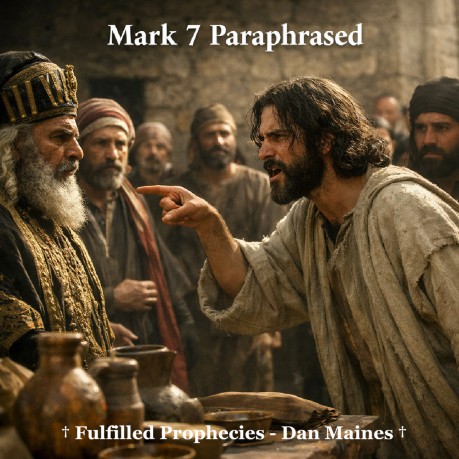
Mark 7
Paraphrased
By Dan Maines
Introduction
†
Mark chapter 7 records a confrontation between Jesus and the
religious leaders of Israel over their traditions and the authority
of God's commandments.
† The Pharisees had
elevated human traditions to the same level as scripture, and Jesus
exposed that error openly.
† This chapter
also reveals that true defilement doesn't come from external rituals
but from the sinful heart of man.
† The final
part of the chapter shows God's mercy reaching beyond Israel through
the faith of a Gentile woman and the healing of the deaf man.
Mark
7:1
Some Pharisees and some scribes gathered around
Jesus after coming from Jerusalem.
†
Religious authorities from Jerusalem often traveled to observe and
challenge Jesus' ministry (John 1:19).
†
Their goal was examination and accusation rather than genuine faith
(Matthew 12:14).
† Josephus describes how
Pharisaic leaders actively monitored religious teaching among the
people.
Mark 7:2
They noticed that some of
His disciples were eating bread with unclean hands, meaning they had
not performed the ritual washing.
† This
washing was part of rabbinic tradition rather than a command given in
the law of Moses (Matthew 15:2).
† The issue
was ceremonial purity, not physical cleanliness.
†
Jesus allowed the situation to expose the misuse of religious
tradition.
Mark 7:3
The Pharisees and all
the Jews do not eat unless they carefully wash their hands, holding
firmly to the traditions passed down by the elders.
†
The traditions of the elders were interpretations developed by later
teachers.
† Over time these traditions became
treated as binding law.
† This created a
religious system built more on tradition than scripture.
Mark
7:4
When they return from the marketplace they don't
eat unless they wash themselves, and there are many other traditions
they observe, such as washing cups, pitchers, and copper vessels.
†
Ritual purification expanded far beyond the requirements of the
Mosaic law (Leviticus 11:32).
† These
traditions shaped daily life for many Jews in the first century.
†
Eusebius later wrote about the strict observance of such customs
among religious leaders.
Mark 7:5
The
Pharisees and scribes asked Him, why do Your disciples not walk
according to the traditions of the elders but eat their bread with
unclean hands?
† Their accusation assumes
their traditions carry divine authority.
†
Jesus answers by exposing the deeper hypocrisy behind their
question.
† The issue wasn't washing hands
but whether human tradition overrides God's word.
Mark
7:6
Jesus answered them, Isaiah was right when he
prophesied about you hypocrites, as it is written, this people honors
Me with their lips, but their heart is far from Me.
†
Jesus quotes Isaiah 29:13 to show that this hypocrisy had long been
condemned by God.
† Outward religion can
exist without a true heart devoted to God.
†
Their behavior matched the same spiritual problem described by the
prophet.
Mark 7:7
In vain they worship Me,
teaching as doctrines the commandments of men.
†
Worship becomes empty when human rules replace God's truth.
†
Jesus identified their teachings as commandments of men.
†
This statement directly challenges the authority of their
traditions.
Mark 7:8
You neglect the
commandment of God and hold to the tradition of men.
†
The leaders had abandoned God's law while preserving their
traditions.
† This reveals how easily
religion can drift away from scripture.
† The
warning remains relevant whenever tradition replaces truth.
Mark
7:9
He was also saying to them, you are experts at
setting aside the commandment of God in order to keep your
tradition.
† Jesus points out that they had
become skilled at manipulating the law.
†
Their authority depended on maintaining their tradition system.
†
This criticism exposes deliberate corruption of God's commands.
Mark
7:10
For Moses said, honor your father and your mother,
and whoever speaks evil of father or mother must be put to death.
†
Jesus cites the law directly from Exodus 20:12 and Exodus 21:17.
†
Honoring parents included caring for them materially.
†
The law emphasized the seriousness of family responsibility.
Mark
7:11
But you say, if a man says to his father or
mother, whatever I have that would help you is Corban, meaning given
to God.
† Corban referred to a vow dedicating
property to the temple.
† This practice
allowed people to avoid supporting their parents.
†
Jesus reveals how religion was used to justify selfishness.
Mark
7:12
You no longer allow him to do anything for his
father or his mother.
† The tradition
effectively canceled the commandment of God.
†
This shows how human systems can override divine instruction.
†
The leaders enforced this corrupt interpretation.
Mark
7:13
You invalidate the word of God by your tradition
which you have handed down, and you do many things such as this.
†
Their traditions nullified scripture.
† Jesus
indicates that many similar practices existed.
†
The authority of God's word had been replaced by religious
tradition.
Mark 7:14
After calling the
crowd again, He said to them, listen to Me all of you and
understand.
† Jesus turns from rebuking
leaders to instructing the people.
† He calls
them to understand the deeper truth about defilement.
†
The teaching challenges the foundation of ritual purity laws.
Mark
7:15
There is nothing outside the person which can
defile him if it goes into him, but the things which come out of the
person are what defile him.
† True defilement
comes from the inner condition of the heart.
†
This teaching challenged the traditional interpretation of purity
laws.
† It anticipates the coming transition
away from ceremonial restrictions (Acts 10:15).
Mark
7:18
And He said to them, are you also so lacking in
understanding? Do you not understand that whatever goes into the
person from outside cannot defile him.
† Even
the disciples struggled with the meaning of His teaching.
†
Jesus explains the difference between ritual and moral impurity.
†
The focus moves from external actions to internal
transformation.
Mark 7:20
And He was
saying, that which comes out of the person, that is what defiles the
person.
† Sin originates from within the
human heart.
† External rituals cannot
correct internal corruption.
† Only God's
transforming work can cleanse the heart.
Mark 7:21
For
from within, out of the heart of people, come evil thoughts, sexual
immorality, theft, murder.
† Jesus identifies
the heart as the source of sinful behavior.
†
The prophets had already described the heart as deeply corrupted
(Jeremiah 17:9).
† Moral transformation must
occur within.
Mark 7:22
Adultery, greed,
wickedness, deceit, sensuality, envy, slander, pride, and
foolishness.
† These sins represent the
natural fruit of a fallen heart.
† Ritual
religion cannot remove these internal problems.
†
The need for spiritual renewal becomes clear.
Mark
7:23
All these evil things come from within and defile
the person.
† The root problem of sin is
internal corruption.
† Jesus exposes the
weakness of the Pharisaic purity system.
†
True cleansing must come from God.
Mark 7:24
Jesus
left there and went away to the region of Tyre and Sidon, and when He
entered a house He wanted no one to know about it, but He couldn't
escape notice.
† Tyre and Sidon were Gentile
territories.
† News of Jesus had spread far
beyond Israel.
† This movement foreshadows
the later expansion of the gospel to the nations.
Mark
7:25
But after hearing about Him, a woman whose little
daughter had an unclean spirit immediately came and fell at His
feet.
† Her desperation drove her to seek
help from Jesus.
† Demon possession was
widely recognized as a serious affliction.
†
Her humility stands in contrast to the pride of the Pharisees.
Mark
7:26
The woman was a Gentile, a Syrophoenician by
birth, and she kept asking Him to cast the demon out of her
daughter.
† Mark emphasizes her Gentile
identity.
† Her persistence demonstrates
genuine faith.
† This moment anticipates the
opening of salvation to the nations.
Mark 7:27
And
He was saying to her, let the children be satisfied first, for it
isn't good to take the children's bread and throw it to the dogs.
†
The children represent Israel's covenant priority (Romans 1:16).
†
Jesus uses the statement to test her faith.
†
The scene illustrates the historical order of redemption.
Mark
7:28
But she answered and said to Him, yes Lord, but
even the dogs under the table eat the children's crumbs.
†
Her reply demonstrates humility and trust.
†
She accepts Israel's priority but still seeks mercy.
†
Her faith becomes the turning point in the story.
Mark
7:29
And He said to her, because of this answer go, the
demon has gone out of your daughter.
† Jesus
responds to her faith by granting the miracle.
†
The healing occurs instantly without His presence.
†
His authority extends over distance and spiritual powers.
Mark
7:30
And after going back to her home she found the
child lying on the bed, the demon having left.
†
The miracle confirms Jesus' authority over demons.
†
It also highlights the power of persistent faith.
†
The story demonstrates God's mercy reaching beyond Israel.
Mark
7:31
Again He left the region of Tyre and came through
Sidon to the Sea of Galilee, within the region of the Decapolis.
†
The Decapolis was a group of largely Gentile cities.
†
This journey shows the geographic spread of His ministry.
†
Archaeological evidence confirms the Greek cultural influence in
these cities.
Mark 7:32
They brought to
Him a man who was deaf and had difficulty speaking, and they pleaded
with Him to lay His hand on him.
† The crowd
believed in Jesus' ability to heal.
† The
laying on of hands symbolized blessing and restoration.
†
Physical healing often pointed to deeper spiritual truth.
Mark
7:33
Jesus took him aside from the crowd privately, put
His fingers into his ears, and after spitting touched his tongue.
†
Jesus sometimes used physical gestures during healing.
†
The private setting focused attention on the miracle itself.
†
These actions helped communicate the healing to the deaf man.
Mark
7:34
Looking up to heaven, He sighed and said to him
Ephphatha, that is, be opened.
† The sigh
reflects Jesus' compassion for human suffering.
†
Ephphatha is an Aramaic command preserved in the text.
†
The word demonstrates His authority over physical infirmity.
Mark
7:35
And his ears were opened, and the impediment of
his tongue was removed, and he began speaking plainly.
†
The healing was immediate and complete.
†
This miracle fulfilled the expectations of messianic prophecy (Isaiah
35:5-6).
† It confirmed Jesus as the promised
deliverer.
Mark 7:36
And He ordered them
not to tell anyone, but the more He ordered them, the more widely
they continued to proclaim it.
† Jesus often
attempted to limit publicity surrounding miracles.
†
Many people misunderstood His mission as political.
†
The miracle still spread widely through the region.
Mark
7:37
They were utterly astonished, saying, He has done
all things well, He makes even the deaf hear and the mute speak.
†
The crowd recognized the extraordinary nature of His works.
†
Their words echo the prophecy of Isaiah about the Messiah (Isaiah
35:5).
† The miracles pointed to the arrival
of God's kingdom.
Historical References
†
Josephus describes the powerful influence of Pharisaic traditions in
first century Judaism.
† Irenaeus wrote that
Jesus exposed traditions that corrupted God's commandments.
†
Eusebius recorded that early Christians understood these miracles as
fulfillment of prophetic promises.
How It Applies To Us
Today
† God's word must always stand
above human traditions.
† True purity begins
with a transformed heart rather than external rituals.
†
Faith and humility open the door to God's mercy.
†
Jesus' authority over sickness and evil shows His power to restore
life.
Q & A Appendix
Q:
Why did Jesus condemn the Pharisees' traditions?
A:
Because their traditions replaced God's commandments and created
hypocrisy (Isaiah 29:13; Matthew 15:3-9).
Q:
What did Jesus teach about defilement?
A:
Defilement comes from the sinful heart rather than external rituals
(Mark 7:15; Jeremiah 17:9).
Q: Why is the
Syrophoenician woman's faith significant?
A: It
demonstrates that faith brings access to God's mercy even beyond
Israel (Romans 1:16; Acts 10:34-35).
Q: What do
the miracles in this chapter prove?
A: They
confirm Jesus as the Messiah fulfilling prophetic promises (Isaiah
35:5-6).
Q: What lesson does this chapter teach
believers today?
A: We must guard against
replacing God's word with religious tradition (Colossians 2:8).
†
This is the fulfilled perspective we proclaim at Fulfilled Prophecies
†
© Fulfilled Prophecies - Dan Maines.
Source
Index
† Mark 7
†
Josephus, Antiquities of the Jews
† Irenaeus,
Against Heresies
† Eusebius, Ecclesiastical
History
Links