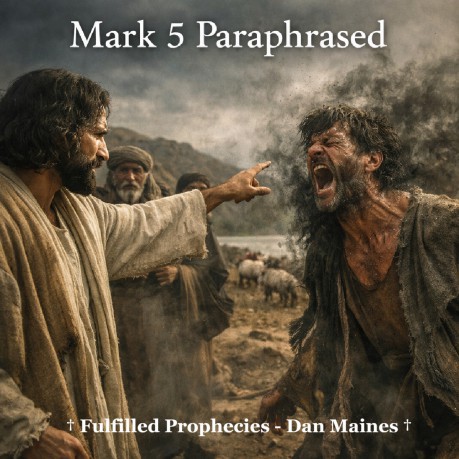
Mark 5
Paraphrased
By Dan Maines
Introduction
†
Mark 5 reveals Christ's authority over demons, sickness, and death.
†
These events happened during the final covenant age when Israel was
under judgment and the kingdom was being revealed through Jesus.
†
The chapter shows that nothing can resist the authority of the Son of
God.
Mark 5:1
They came to the other side
of the sea, into the region of the Gerasenes.
†
This area was largely Gentile territory, showing Christ's authority
extended beyond Israel (Isaiah 49:6).
†
Crossing the sea echoes earlier moments when God showed His power
over the nations (Psalm 65:7).
† Jesus
intentionally entered this region to confront spiritual
darkness.
Mark 5:2
As soon as Jesus
stepped out of the boat, a man with an unclean spirit came out of the
tombs and met Him.
† Living among tombs
symbolized uncleanness and separation under the Law (Numbers
19:16).
† The man's condition shows the
destructive bondage of demonic oppression (Luke 11:20).
†
Christ immediately confronts the power controlling him.
Mark
5:3
The man lived among the tombs, and no one could
restrain him anymore, not even with chains.
†
Human strength was powerless against the spiritual forces tormenting
him.
† This shows how helpless people are
without God's intervention (Romans 7:24).
†
The scene emphasizes the severity of the man's condition.
Mark
5:4
He had often been bound with shackles and chains,
but he tore the chains apart and broke the shackles into pieces, and
no one was strong enough to subdue him.
†
Demonic influence gave him unnatural strength.
†
Evil always brings destruction and chaos (John 10:10).
†
No one in the region had the power to restore him.
Mark
5:5
Night and day he cried out among the tombs and on
the mountains and cut himself with stones.
†
The torment shows the misery of spiritual bondage.
†
Self destruction often accompanies demonic oppression.
†
The man was completely isolated from society.
Mark
5:6
When he saw Jesus from a distance, he ran and bowed
down before Him.
† Even demons recognize
Christ's authority (James 2:19).
† The
spiritual realm knows exactly who Jesus is.
†
His authority is immediately acknowledged.
Mark 5:7
He
shouted with a loud voice and said what do You want with me, Jesus,
Son of the Most High God, I beg You by God do not torment me.
†
The demons openly confess Jesus' identity.
†
They fear the coming judgment (Matthew 8:29).
†
Their plea shows they are subject to His authority.
Mark
5:8
Jesus had already said to him come out of the man,
you unclean spirit.
† Christ speaks with
absolute authority over the spirit world.
†
No ritual or struggle was needed.
† His word
alone has power (Hebrews 4:12).
Mark 5:9
Jesus
asked him what is your name, he replied my name is Legion, because
many demons are inside me.
† A Roman legion
could contain thousands of soldiers.
† The
name shows the extent of the man's torment.
†
It also reflects the oppressive environment of the Roman world.
Mark
5:10
The demons begged Him repeatedly not to send them
out of the region.
† Demons appear to operate
within certain territories.
† Their begging
shows they cannot act without permission.
†
Christ holds full authority over their fate.
Mark 5:11
A
large herd of pigs was feeding there on the hillside.
†
Pigs were considered unclean animals under the Law (Leviticus
11:7).
† Their presence confirms the Gentile
setting.
† This becomes the setting for the
next event.
Mark 5:12
The demons begged
Him saying send us into the pigs so we may enter them.
†
Demons seek a host to inhabit.
† Even in this
request they acknowledge Christ's authority.
†
They cannot move without His permission.
Mark 5:13
Jesus
allowed them, and the unclean spirits came out and entered the pigs,
and the herd rushed down the steep bank into the sea, about two
thousand of them, and they drowned.
† The
destruction of the pigs shows the destructive nature of demonic
influence.
† Christ's authority forced the
spirits to leave the man.
† The event
demonstrated visible power over the spiritual realm.
Mark
5:14
Those feeding the pigs ran away and reported it in
the city and countryside, and people came to see what had happened.
†
News about Jesus spread quickly through the region.
†
His actions forced people to confront His authority.
†
Crowds often gathered after such miracles.
Mark
5:15
They came to Jesus and saw the man who had been
possessed sitting there, clothed and in his right mind, and they
became afraid.
† Christ not only removes evil
but restores the person completely.
† The
transformation was undeniable.
† The people
were overwhelmed by the power they witnessed.
Mark
5:16
Those who had seen it explained what happened to
the demon possessed man and about the pigs.
†
Witnesses confirmed the miracle.
† This
testimony spread throughout the region.
†
Events like this built Christ's reputation.
Mark
5:17
The people began begging Jesus to leave their
region.
† Instead of celebrating the miracle
they feared His power.
† People often reject
truth when it disrupts their lives (John 3:19).
†
Fear can lead people to push away God's presence.
Mark
5:18
As Jesus was getting into the boat, the man who
had been possessed begged to go with Him.
†
Deliverance produced gratitude and loyalty.
†
The healed man wanted to remain with Christ.
†
His life had been completely changed.
Mark 5:19
Jesus
did not allow him but said go home to your people and tell them what
the Lord has done for you and how He had mercy on you.
†
Jesus sent him as a witness to his own community.
†
Personal testimony is powerful.
† The man's
story would spread throughout the region.
Mark 5:20
He
went away and began telling in the Decapolis what Jesus had done for
him, and everyone was amazed.
† The Decapolis
was a group of Gentile cities.
† This shows
the message spreading beyond Israel.
†
Christ's work reached many people through this testimony.
Historical
References
† Josephus recorded
accounts of demonic possession and exorcism in the first century,
showing such events were widely recognized, Antiquities of the Jews
Book 8.
† Irenaeus wrote that Christ
demonstrated authority over demons and sickness as proof He was the
promised Messiah, Against Heresies 2.32.
†
Eusebius recorded early testimonies that Christ's miracles were
widely known in Judea, Ecclesiastical History 3.39.
†
Clement of Alexandria described Christ's miracles as demonstrations
of divine authority and compassion, Stromata Book 6.
How
It Applies To Us Today
† Christ's
authority over demons reminds us that evil is not equal to God and
cannot overcome Him (Luke 10:19).
† The
healing of the woman shows that faith in Christ brings restoration
beyond what human systems can provide (Hebrews 11:6).
†
The raising of Jairus' daughter reminds us that Jesus holds power
even over death (John 11:25).
† These events
confirm that Jesus is the promised Messiah who brings life and
freedom.
Q & A Appendix
Q
Why did the demons recognize Jesus immediately?
A
The spiritual realm knew His identity even when many people did not
(James 2:19).
Q Why did Jesus allow the demons
to enter the pigs?
A The event revealed the
destructive nature of demons and Christ's authority over them (Luke
8:32).
Q Why did the people ask Jesus to leave
their region?
A Fear and disruption of their
lives caused them to reject His presence (John 3:19).
Q
Why did Jesus say the girl was asleep?
A He
used the language of sleep to describe death when resurrection was
about to occur (John 11:11).
Q Why did Jesus
sometimes tell people not to spread news of miracles?
A
He controlled the timing of public recognition to fulfill God's plan
(Matthew 16:20).
† This is the fulfilled perspective
we proclaim at Fulfilled Prophecies †
© Fulfilled
Prophecies - Dan Maines.
Source Index
†
Mark 5
† Josephus, Antiquities of the Jews
†
Irenaeus, Against Heresies
† Eusebius,
Ecclesiastical History
† Clement of
Alexandria, Stromata
Links