Mark 3
Paraphrased
By Dan Maines
Introduction
†
Mark 3 continues the record of growing conflict between Jesus and the
religious leaders of Israel while also showing His authority over
sickness, demons, and the covenant community.
†
The leaders of Israel were becoming hardened while the crowds were
recognizing the authority of Christ.
† These
events took place in the generation leading to the judgment that
later came upon Jerusalem in AD 70 (Matthew 23:36; Matthew
24:34).
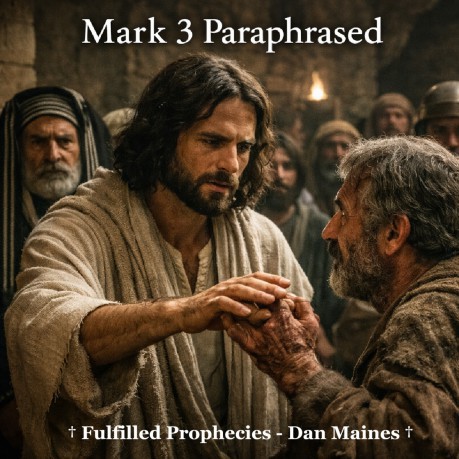
Mark 3:1
Jesus entered the
synagogue again, and a man was there whose hand was shriveled and
useless.
† The synagogue setting shows this
confrontation happening in the center of Jewish religious life.
†
The man's condition shows the suffering among the people while the
leaders were focused on rule keeping rather than mercy (Hosea 6:6).
†
Irenaeus later wrote that Christ healed on the Sabbath to expose the
hypocrisy of those who claimed to guard the law while ignoring its
purpose (Irenaeus, Against Heresies).
Mark 3:2
Some
were watching Him carefully to see if He would heal on the Sabbath so
they could accuse Him.
† The leaders were not
interested in the man's healing, they were searching for a charge.
†
Their observation was motivated by hostility rather than truth.
†
This reveals the spiritual blindness that was spreading among the
leadership of Israel.
Mark 3:3
Jesus said
to the man with the shriveled hand, stand up here in front of
everyone.
† Jesus deliberately brought the
moment into public view so the hypocrisy would be visible.
†
Truth often exposes corruption openly rather than hiding from it
(John 3:20-21).
† Clement of Alexandria noted
that Christ frequently used public acts to reveal spiritual blindness
(Clement of Alexandria, Stromata).
Mark 3:4
He
said to them, is it lawful on the Sabbath to do good or to do harm,
to save life or to destroy it? But they remained silent.
†
The law was never intended to block mercy.
†
Their silence showed they understood the truth but refused to admit
it.
† The same refusal appears repeatedly
throughout the Gospels as leaders resisted clear evidence.
Mark
3:5
He looked around at them with anger and grief
because of the hardness of their hearts, and He said to the man,
stretch out your hand. The man stretched it out, and his hand was
restored.
† Jesus responded to injustice with
righteous anger and compassion.
† The miracle
demonstrated divine authority openly in front of them.
†
Their hardened hearts reflected the spiritual condition that
eventually led to national judgment (Matthew 23:37-38).
Mark
3:6
The Pharisees went out immediately and began
plotting with the Herodians about how they might destroy Him.
†
This alliance between religious and political groups reveals the
intensity of their opposition.
† Their
concern was protecting power rather than protecting truth.
†
Josephus described how religious and political factions in Judea
often united when authority was threatened (Josephus, Antiquities of
the Jews).
Mark 3:7
Jesus withdrew with
His disciples toward the sea, and a large crowd followed Him from
Galilee.
† The crowds continued growing as
people heard about His authority and compassion.
†
News of His works was spreading across the region.
†
The ministry was expanding beyond the control of the religious
authorities.
Mark 3:8
People came from
Judea, Jerusalem, Idumea, beyond the Jordan, and the region around
Tyre and Sidon when they heard everything He was doing.
†
People from many territories were drawn to Him.
†
This reflects the beginning of the promise that the nations would be
drawn to the Messiah (Isaiah 49:6).
†
Eusebius later recorded that the movement around Jesus quickly spread
across regions (Eusebius, Ecclesiastical History).
Mark
3:9
He told His disciples to keep a small boat ready
because of the crowd so they would not crush Him.
†
The crowds were so large that practical measures were needed.
†
This detail shows how intense the public response had become.
†
Even under pressure, Jesus continued serving the people.
Mark
3:10
He had healed many people, so everyone who had
diseases pushed forward trying to touch Him.
†
People believed even contact with Him could bring healing.
†
The suffering among the population was widespread.
†
These miracles confirmed that the promised kingdom was arriving
(Isaiah 35:5-6).
Mark 3:11
Whenever
unclean spirits saw Him, they fell down before Him and cried out
saying He is the Son of God.
† Even the
demonic realm recognized His authority.
†
Their reaction showed that Christ's power extended over spiritual
forces.
† The spiritual battle surrounding
His ministry was visible even to the crowds.
Mark
3:12
But He strongly warned them not to reveal who He
was.
† Jesus controlled the timing of how His
identity would be revealed.
† Demonic
testimony was not the witness He intended.
†
His identity would be confirmed through His works and mission.
Mark
3:13
Jesus went up on a mountain and called those He
wanted, and they came to Him.
† Mountains
often appear in Scripture during moments of divine purpose.
†
Jesus was preparing the leadership for the coming mission.
†
The calling of disciples marks the beginning of organized ministry
expansion.
Mark 3:14
He appointed twelve
so they could be with Him and so He could send them out to preach.
†
The number twelve symbolized the restoration of Israel's twelve
tribes.
† These men would become witnesses of
His teaching and miracles.
† Their mission
would eventually extend throughout the Roman world.
Mark
3:15
He gave them authority to cast out demons.
†
This authority confirmed their role as representatives of Christ.
†
Miracles during the apostolic period validated the message they
carried.
† Their authority demonstrated the
defeat of the kingdom of darkness.
Mark 3:16
These
are the twelve He appointed: Simon, whom He named Peter.
†
Peter later became a leading voice among the apostles.
†
His new name symbolized a new mission and identity.
†
Early Christian writings often highlight Peter's leadership
role.
Mark 3:17
James the son of Zebedee
and John the brother of James, to whom He gave the name Boanerges,
meaning sons of thunder.
† Their nickname
reflected their strong personalities.
† These
brothers became key witnesses of Christ's ministry.
†
John later wrote one of the Gospel accounts and letters to the
church.
Mark 3:18
Andrew, Philip,
Bartholomew, Matthew, Thomas, James the son of Alphaeus, Thaddaeus,
Simon the Zealot.
† These men came from very
different backgrounds.
† Christ's kingdom was
not limited to one social group.
† God used
ordinary people to carry an extraordinary message.
Mark
3:19
And Judas Iscariot, who later betrayed Him.
†
Judas's betrayal fulfilled prophecy about the rejection of the
Messiah (Psalm 41:9).
† His presence among
the twelve shows that proximity to truth does not guarantee
faithfulness.
† Even betrayal became part of
the unfolding plan of redemption.
Mark 3:20
He
entered a house, and the crowd gathered again so they could not even
eat.
† The constant crowds show the
overwhelming demand for His ministry.
† Jesus
and the disciples were under continuous pressure from the needs of
the people.
† This reveals the intense pace
of the ministry during this time.
Mark 3:21
When
His family heard about this, they went to take hold of Him because
they were saying He is out of His mind.
†
Even those close to Him struggled to understand His mission.
†
His actions appeared extreme to those who did not yet see the full
purpose.
† Faith often requires seeing beyond
what others initially understand.
Mark 3:22
The
scribes who came down from Jerusalem said He is possessed by
Beelzebul, and by the ruler of demons He drives out demons.
†
The leaders attempted to discredit the miracles by attributing them
to evil power.
† This accusation revealed
deep spiritual blindness.
† Their hostility
was growing as His influence expanded.
Mark 3:23
Jesus
called them and spoke in parables, how can Satan cast out Satan?
†
Jesus responded with clear logic to expose their accusation.
†
A divided kingdom cannot stand.
† His
reasoning dismantled their claim publicly.
Mark 3:24
If
a kingdom is divided against itself, that kingdom cannot stand.
†
Unity is essential for any kingdom to survive.
†
Jesus applied this truth to reveal the weakness of their
accusation.
† The principle also reflected
the internal divisions already present in Israel.
Mark
3:25
If a house is divided against itself, that house
cannot stand.
† The image of a divided house
emphasized instability.
† Israel itself was
becoming divided spiritually and politically.
†
These divisions would later contribute to the destruction of
Jerusalem.
Mark 3:26
If Satan has risen
against himself and is divided, he cannot stand but is finished.
†
Jesus showed that their argument contradicted itself.
†
If Satan were destroying his own kingdom, it would collapse.
†
Their accusation exposed their desperation rather than truth.
Mark
3:27
No one can enter a strong man's house and plunder
his possessions unless he first ties up the strong man, then he can
plunder his house.
† Jesus described His
authority over the kingdom of darkness.
† He
was binding the strong man and freeing those under oppression.
†
His ministry demonstrated the defeat of Satan's power.
Mark
3:28
Truly I say to you, all sins will be forgiven the
sons of men and whatever blasphemies they speak.
†
The mercy of God was still available even to those who had spoken
against Him.
† Forgiveness remained open
through repentance.
† This statement reveals
the depth of divine grace.
Mark 3:29
But
whoever blasphemes against the Holy Spirit never has forgiveness but
is guilty of an eternal sin.
† This referred
to the deliberate rejection of the Spirit's clear testimony.
†
The leaders had seen undeniable evidence yet called it evil.
†
Their hardened rejection placed them under severe judgment.
Mark
3:30
He said this because they were saying He had an
unclean spirit.
† Their accusation was
deliberate and persistent.
† They rejected
the truth even when it stood clearly before them.
†
Such rejection would contribute to the coming judgment on that
generation.
Mark 3:31
His mother and
brothers arrived and stood outside, sending someone to call Him.
†
This moment introduces a teaching about spiritual family.
†
Physical relationship was not the defining factor in the kingdom.
†
Faith and obedience were the true markers of belonging.
Mark
3:32
The crowd sitting around Him said your mother and
brothers are outside looking for you.
† The
crowd expected family ties to take priority.
†
Jesus used this moment to redefine belonging in the kingdom.
†
Spiritual loyalty would be greater than biological connection.
Mark
3:33
He answered them, who are My mother and My
brothers?
† Jesus was expanding the
definition of family.
† The kingdom of God
forms a new community.
† Faithful obedience
becomes the defining bond.
Mark 3:34
Looking
at those seated around Him He said here are My mother and My
brothers.
† The gathered believers
represented the true covenant family.
† The
kingdom community was based on obedience to God.
†
This spiritual family would become the foundation of the church.
Mark
3:35
Whoever does the will of God is My brother and
sister and mother.
† Obedience to God defines
membership in Christ's family.
† The new
covenant community is built on faith and obedience.
†
This teaching reveals the unity that exists among
believers.
Historical References
†
Josephus describes the intense political and religious tensions
present in Judea during the time of Jesus (Josephus, Antiquities of
the Jews).
† Irenaeus wrote about Christ
confronting the hypocrisy of religious leaders while revealing the
true purpose of the law (Irenaeus, Against Heresies).
†
Eusebius recorded how the message of Christ spread rapidly across
regions during the first century (Eusebius, Ecclesiastical
History).
† Clement of Alexandria described
Christ exposing spiritual blindness while forming a new covenant
community (Clement of Alexandria, Stromata).
How it
applies to us today
† Christ still
exposes hardened religion that values tradition over mercy.
†
True faith is shown through obedience rather than outward
appearance.
† Believers today belong to the
same spiritual family defined by doing the will of God.
†
The kingdom Christ established continues to unite people across every
nation.
Q & A Appendix
Q
Why did Jesus heal on the Sabbath?
A Because
the law was meant to serve mercy and life rather than restrict
compassion (Matthew 12:7).
Q Why were the
religious leaders hostile toward Jesus?
A His
authority exposed their hypocrisy and threatened their influence
(John 11:48).
Q What does the strong man
parable mean?
A It shows Christ overpowering
the kingdom of Satan and freeing those under oppression (Luke
11:20-22).
Q What is the blasphemy against the
Holy Spirit?
A It was the deliberate rejection
of the Spirit's testimony about Christ (Matthew 12:31-32).
Q
Who belongs to the true family of Christ?
A
Those who do the will of God and follow Him in faith (Luke 8:21).
†
This is the fulfilled perspective we proclaim at Fulfilled Prophecies
†
© Fulfilled Prophecies - Dan Maines.
Source
Index
† Mark 3
†
Josephus, Antiquities of the Jews
† Irenaeus,
Against Heresies
† Eusebius, Ecclesiastical
History
† Clement of Alexandria, Stromata
Links