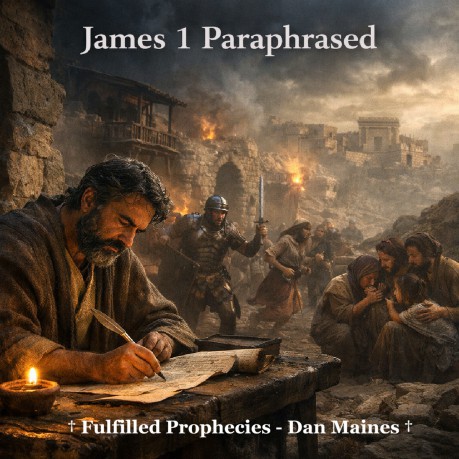
James 1 Paraphrased Introduction † James writes to believers who were scattered
among the nations during the first century. These were Jewish
Christians living outside Judea because persecution had forced many
of them to leave their homes (Acts 8:1). † The chapter focuses on endurance, wisdom, and
faithful obedience. These believers were facing real pressure,
rejection from their communities, and hardship as the Old Covenant
world was reaching its end (Hebrews 10:36-37). † From the fulfilled perspective, this letter
fits directly within the historical setting leading up to the
destruction of Jerusalem in AD 70, when believers needed
encouragement to remain faithful through trials (Luke 21:20-22). James 1:1 † James identifies himself as a servant rather
than appealing to authority or family connection to Jesus. This
reflects the humility expected of those who follow Christ (Matthew
20:26-27). † The twelve tribes scattered among the nations
refers to Israelites living outside Judea who had come to believe
that Jesus is the Messiah (Acts 8:1). † Irenaeus wrote that the
apostles continued to teach scattered Jewish believers who had
accepted Christ, confirming the early church understood the audience
of this letter. James 1:2 † James calls believers to see trials
differently. Hardship wasn't meaningless suffering but a process God
used to strengthen their faith (Romans 5:3-4). † These trials included persecution, rejection
from synagogue communities, and social pressure for following Christ
(John 16:2). † Clement of Alexandria
explained that early Christians saw trials as training that prepared
believers for spiritual maturity. James 1:3 † Faith becomes stronger when it is tested.
Just as metal is refined by fire, faith grows stronger through
difficulty (1 Peter 1:6-7). † The early believers needed endurance as they
lived through a turbulent time leading up to the fall of Jerusalem
(Hebrews 10:36). † Eusebius recorded that many
Christians endured persecution during this period but remained
faithful to Christ. James 1:4 † The purpose of endurance is spiritual
maturity. God was forming believers into stable, faithful followers
of Christ (Colossians 1:28). † Maturity meant they wouldn't be easily shaken
by persecution or false teaching (Ephesians 4:14). † Early Christian leaders taught that
perseverance was a sign of genuine faith. James 1:5 † Wisdom here refers to understanding how to
live faithfully during difficult circumstances (Proverbs 2:6). † God gives wisdom freely to those who ask Him
in faith (Matthew 7:7). † Clement of Alexandria taught
that divine wisdom guides believers in both understanding truth and
living it out. James 1:6 † Doubt in this context refers to instability
in trusting God (Hebrews 11:6). † James compares this instability to waves
tossed by wind, illustrating a life without firm trust. † Early Christian teachers warned that unstable
faith left believers vulnerable to deception. James 1:7 † Faith must be genuine and consistent, not
divided between trusting God and relying on worldly solutions
(Matthew 6:24). † A divided heart prevents believers from fully
receiving God's guidance. † Early Christian instruction repeatedly warned
against spiritual inconsistency. James 1:8 † Double minded means trying to serve God while
still clinging to worldly trust and security (Luke 16:13). † This divided loyalty causes instability in
every area of life. † Irenaeus warned that divided
loyalty weakens faith and leads to spiritual confusion. James 1:9 † Even believers who were poor or socially
insignificant had honor in God's kingdom (Luke 6:20). † In Christ, true status is defined by faith,
not by wealth or social standing. † Early Christian communities often included
many poor believers who found hope in this truth. James 1:10 † James reminds wealthy believers that earthly
riches are temporary (Matthew 6:19-21). † Wealth cannot secure eternal life or
spiritual standing before God. † Early Christian teaching consistently warned
against trusting in riches. James 1:11 † James uses the imagery of grass and flowers
to illustrate the temporary nature of wealth and human status (Isaiah
40:6-8). † This reminds believers to focus on what is
eternal rather than temporary. † Early Christian writers frequently used this
imagery to emphasize humility. James 1:12 † The crown of life symbolizes victory and
reward for faithful endurance (Revelation 2:10). † This promise encouraged believers facing
persecution in the first century. † Early Christian martyrs often referred to
this promise when enduring suffering for Christ. Historical References † Irenaeus taught that
perseverance under trial proved genuine faith and devotion to Christ. † Eusebius recorded that many
early believers remained faithful even during intense persecution. † Clement of Alexandria
explained that endurance and wisdom were key marks of mature
Christian faith. How it applies to us today † Trials still test our faith. Hard times
reveal whether our trust in God is genuine. † We must ask God for wisdom when facing
difficult decisions and challenges. † True faith remains steady even when
circumstances are unstable. Q & A Appendix Q: Who was James writing to in this letter? Q: Why should believers consider trials as
joy? Q: What kind of wisdom does James encourage
believers to ask for? Q: What does double minded mean? Q: What is the crown of life? † This is the fulfilled perspective we proclaim at
Fulfilled Prophecies † Source Index † James 1
By Dan Maines
James, a servant of God and of the
Lord Jesus Christ, sends greetings to the twelve tribes scattered
among the nations.
Consider it a reason for joy, my
brothers, whenever you encounter various trials.
Because you know that the testing
of your faith produces endurance.
Let endurance complete its work so
that you may become mature and complete, lacking nothing.
If any of you lacks wisdom, ask
God, who generously gives to all without finding fault, and it will
be given to him.
But ask in faith without doubting,
because the one who doubts is like a wave of the sea driven and
tossed by the wind.
That person should not expect to
receive anything from the Lord.
He is a double minded man,
unstable in all his ways.
The humble brother should take
pride in his high position.
But the rich should take pride in
their humiliation, because they will pass away like a flower of the
field.
The sun rises with scorching heat
and withers the grass, its flower falls and its beauty disappears. In
the same way the rich man will fade away even while he goes about his
business.
Blessed is the man who perseveres
under trial, because once he has been approved he will receive the
crown of life which God promised to those who love Him.
A:
The twelve tribes scattered among the nations, referring to Jewish
believers living outside Judea (Acts 8:1).
A: Because trials strengthen faith and
produce endurance (Romans 5:3-4).
A: Wisdom for living
faithfully and making godly decisions (Proverbs 2:6).
A:
A divided heart that tries to trust God while also relying on worldly
security (Luke 16:13).
A:
A reward promised to those who remain faithful through trials
(Revelation 2:10).
© Fulfilled Prophecies - Dan
Maines.
† Irenaeus,
Against Heresies
† Eusebius, Ecclesiastical
History
† Clement of Alexandria, Stromata
Links