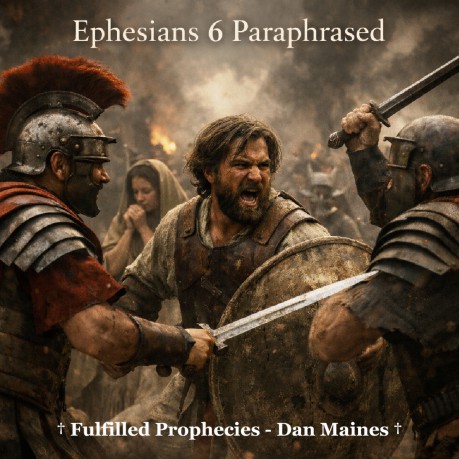
Ephesians 6 Paraphrased Introduction Ephesians 6:1 Ephesians 6:2 Ephesians 6:3 Ephesians 6:4 Ephesians 6:5 Ephesians 6:6 Ephesians 6:7 Ephesians 6:8 Ephesians 6:9 Ephesians 6:10 Ephesians 6:11 Ephesians 6:12 Ephesians 6:13 Ephesians 6:14 Ephesians 6:15 Ephesians 6:16 Ephesians 6:17 Ephesians 6:18 Ephesians 6:19 Ephesians 6:20 Ephesians 6:21 Ephesians 6:22 Ephesians 6:23 Ephesians 6:24 Historical References How It Applies To Us Today Q and A Appendix Q What is the main message of Ephesians 6? Q What does the armor of God represent? Q Why does Paul talk about servants and
masters? Q Why does Paul emphasize prayer at the end of
the chapter? Q Why does Paul ask for prayer for his
ministry? † This is the fulfilled perspective we proclaim at
Fulfilled Prophecies † Source Index
By Dan Maines
† Paul
closes the letter to the Ephesians by applying the gospel to everyday
life, families, work, and spiritual struggle.
†
The instructions show how believers were to live during the final
years of the Old Covenant age before the judgment that came upon
Jerusalem in AD 70.
† Early Christians
understood these commands as practical guidance for living faithfully
while the old world of the Mosaic system was passing away.
Children, listen to your
parents and follow their guidance in the Lord, because this is the
right and proper thing to do.
† The family
order Paul describes reflects the moral structure God established
long before the Law of Moses (Proverbs 1:8).
†
In the first century church, obedience within the household showed
that the gospel restored order rather than creating rebellion in
society.
† Clement of Alexandria explained
that Christian households were to reflect harmony and discipline
shaped by Christ.
Honor your father and your
mother, this is the first commandment that carries a promise with
it.
† Paul reminds them of the command
originally given in the Law, but now fulfilled through life in Christ
(Exodus 20:12).
† Respect for parents
remained a universal moral principle even as the covenant
administration changed.
† Irenaeus noted that
Christ did not abolish righteous conduct but confirmed it through the
teaching of the apostles.
When you honor them, it will
go well for you and you'll enjoy a long life on the earth.
†
The promise originally referred to life in the land of Israel, but
Paul applies the principle more broadly to a life blessed by
wisdom.
† The idea reflects a general truth
about stability and peace within a society that respects family
order.
† Eusebius wrote that Christian
conduct strengthened communities and displayed the moral
transformation brought by Christ.
Fathers, don't provoke your
children to anger, instead raise them with discipline and instruction
that comes from the Lord.
† Fathers were
responsible for shaping the spiritual direction of the household.
†
Paul warns against harsh or unjust authority, which was common in the
Roman world.
† Early Christian writers taught
that parents should guide their children with patience and
instruction rooted in Christ's teaching.
Servants, obey your earthly
masters with respect and sincerity, serving them as if you were
serving Christ himself.
† Many believers in
the first century were slaves or servants within Roman households.
†
Paul instructs them to live faithfully within their situation while
remembering that Christ is their true Lord (Colossians 3:22-24).
†
Early Christians understood this as a call to integrity, not a
defense of the institution itself.
Don't work only when someone
is watching you just to impress people, but serve as servants of
Christ, doing God's will from the heart.
†
Paul contrasts outward performance with sincere devotion.
†
The focus is on inner transformation produced by the gospel.
†
Clement of Alexandria emphasized that believers should live
consistently whether seen or unseen.
Serve willingly and with a
good attitude, as if your service is offered to the Lord rather than
to men.
† The Christian life was meant to be
lived with a heart of devotion in every task.
†
Even ordinary work became an act of service to Christ.
†
This teaching helped early believers endure difficult circumstances
with hope and purpose.
Remember that whatever good
anyone does, the Lord will reward it, whether that person is a
servant or free.
† God sees every act of
faithfulness, even those ignored by society.
†
Paul emphasizes that earthly status does not change a person's
standing before God.
† Irenaeus taught that
God judges the heart and rewards righteousness.
Masters, treat your servants
in the same way, without threats, knowing that both you and they
share the same Master in heaven, and he shows no favoritism.
†
Paul places moral responsibility on masters as well as servants.
†
The gospel undermined social arrogance by reminding everyone that
Christ is the true authority.
† Early
Christian communities were known for treating servants and masters as
equal members in the body of Christ.
Finally, be strong in the
Lord and rely on the power of his strength.
†
The strength Paul describes is not human determination but dependence
on God's power.
† Believers in the first
century faced persecution and opposition from both Roman and Jewish
authorities.
† Eusebius recorded how early
Christians relied on faith and courage during those trials.
Put on the full armor that
God provides so you can stand firm against the schemes of the
adversary.
† The armor imagery comes from
Isaiah where God himself is pictured as a warrior defending
righteousness (Isaiah 59:17).
† Paul adapts
the imagery to show how believers stand firm through truth and
faith.
† Early Christians often described the
Christian life as spiritual warfare against deception.
Our struggle is not against
ordinary human enemies but against unseen powers and authorities,
against the dark forces ruling this present world.
†
Paul explains that the conflict behind persecution and deception had
a spiritual dimension.
† These powers
represented systems of corruption, false religion, and spiritual
opposition.
† Early writers understood this
language as referring to demonic influence operating through earthly
structures.
Because of this, take up the
full armor God gives so that when the day of evil comes you'll be
able to stand your ground and remain standing after the battle.
†
The day of evil refers to times of testing and pressure facing the
early church.
† Paul urges believers to
remain faithful during the approaching upheaval of their
generation.
† The destruction of Jerusalem
soon after these writings confirmed that the old order truly was
passing away.
Stand firm with truth wrapped
around you like a belt, and righteousness protecting you like a
breastplate.
† Truth and righteousness
represent the moral foundation of the believer's life.
†
These qualities guard the heart and guide the mind.
†
Early Christian teachers emphasized honesty and integrity as the
armor that protects believers.
Let your feet be ready with
the message of peace that comes from the good news.
†
The gospel of peace was spreading rapidly across the Roman world
during the first century.
† Paul himself had
traveled through many regions preaching that message.
†
Irenaeus later wrote that the gospel reached the nations through the
apostles and their companions.
In every situation take up
faith like a shield, which can extinguish all the flaming arrows of
the evil one.
† Faith acts as a defense
against fear, doubt, and deception.
† The
imagery reflects Roman military shields that protected soldiers from
burning projectiles.
† Early believers
understood faith as trusting God's promises even during persecution.
Receive salvation like a
helmet protecting your mind, and take the sword of the Spirit, which
is the word of God.
† The helmet represents
confidence in the salvation God has provided.
†
The sword represents God's truth spoken and proclaimed.
†
Early Christian preaching relied heavily on the Scriptures to defend
the faith and refute error.
Pray at all times with every
kind of prayer and request, staying alert and continually praying for
all believers.
† Prayer was central to the
life of the early church (Acts 2:42).
†
Through prayer believers remained united across different cities and
regions.
† Clement of Alexandria described
prayer as the constant communication between the believer and God.
Pray also for me so that when
I speak the message I'll have boldness to reveal the mystery of the
good news.
† Paul often requested prayer
because preaching the gospel carried real danger.
†
The mystery he refers to is the revelation that Jews and Gentiles
were now united in Christ.
† Early Christians
recognized Paul's ministry as foundational to spreading the gospel to
the nations.
I am serving as a messenger
of that good news even though I'm in chains, so pray that I'll speak
boldly as I should.
† Paul wrote this letter
while imprisoned under Roman authority.
† His
chains showed the cost of proclaiming Christ in the Roman Empire.
†
Eusebius recorded that many early believers suffered imprisonment for
their faith.
Tychicus, our beloved brother
and faithful servant in the Lord, will tell you everything so you'll
know how I'm doing and what is happening here.
†
Tychicus was a trusted companion who delivered Paul's letters to
various churches.
† The early church relied
on messengers like him to maintain communication between
congregations.
† Historical records confirm
the importance of these traveling coworkers in the apostolic mission.
I'm sending him to you for
this very purpose so you'll know about us and so he can encourage
your hearts.
† Encouragement and unity were
essential for churches facing pressure and persecution.
†
Letters and messengers strengthened the connection between believers
across the empire.
† Irenaeus later testified
that the apostolic writings were preserved and shared among the
churches.
Peace to the brothers and
sisters, along with love and faith from God the Father and the Lord
Jesus Christ.
† Paul closes the letter with a
blessing reflecting the unity of the Father and the Son.
†
Peace and faith were central themes throughout the epistle.
†
Early Christians often ended their letters with similar blessings.
Grace be with all who love
our Lord Jesus Christ with sincere and undying devotion.
†
Grace summarizes the entire message of the gospel Paul preached.
†
The blessing extends to all believers who remain faithful to
Christ.
† Early church leaders repeated this
emphasis on grace as the foundation of the Christian life.
†
Irenaeus wrote that the apostles established churches throughout the
world and preserved the teaching handed down from Christ.
†
Eusebius documented the spread of the gospel through the Roman Empire
during the first centuries of the church.
†
Clement of Alexandria emphasized the importance of disciplined
Christian living within the household and community.
†
Ephesians 6 reminds us that the Christian life involves faithfulness
in everyday responsibilities.
† Families,
workplaces, and communities are places where our faith becomes
visible.
† Spiritual strength comes from
truth, righteousness, faith, and prayer.
†
Just as believers in the first century stood firm during difficult
times, we also remain strong through trust in Christ.
†
The gospel continues to shape how we live, serve others, and remain
faithful to God.
A
The chapter teaches believers how to live faithfully in families,
workplaces, and spiritual struggles while relying on God's strength
(Ephesians 6:10-11).
A
It represents spiritual qualities like truth, righteousness, faith,
and salvation that protect believers against deception (Ephesians
6:14-17).
A Because many early Christians lived
within Roman household structures, and Paul was teaching them how to
live faithfully in those circumstances (Ephesians 6:5-9).
A Prayer connects believers with
God's strength and unites the church during times of trial (Ephesians
6:18).
A Because preaching the gospel
brought persecution and imprisonment, and he needed courage to
continue speaking boldly (Ephesians 6:19-20).
© Fulfilled Prophecies - Dan
Maines.
† Ephesians
6
† Irenaeus, Against Heresies
†
Eusebius, Ecclesiastical History
† Clement of
Alexandria, Stromata
Links