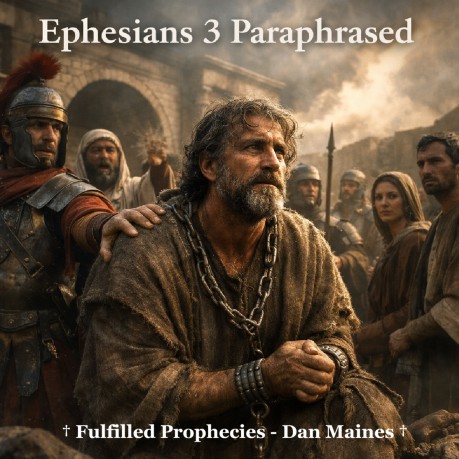
Ephesians 3
Paraphrased
By Dan Maines
Introduction
†
Paul explains that what God once kept hidden has now been openly
revealed through Christ, that both Jews and Gentiles are united in
the same covenant family (Colossians 1:26-27).
†
The mystery wasn't that Gentiles would be blessed, the prophets
already spoke of that, the mystery was that they would share the same
body in Christ (Isaiah 49:6).
† Early
Christian writers such as Irenaeus explained that the church revealed
God's long hidden plan for the nations through Christ (Irenaeus,
Against Heresies 3.16.6).
Ephesians 3:1
Because
of this truth, I Paul am a prisoner because I serve Christ Jesus for
the sake of you Gentiles.
† Paul's
imprisonment happened because he preached that Gentiles were equal
heirs in Christ, which angered many Jewish leaders (Acts 21:28-33).
†
His chains were evidence that the gospel had moved beyond Israel and
into the nations (Philippians 1:12-13).
†
Eusebius recorded that Paul suffered imprisonment because he
faithfully proclaimed the gospel among the Gentiles (Eusebius,
Ecclesiastical History 2.22).
Ephesians 3:2
You
have certainly heard about the responsibility God gave me to share
His grace with you.
† Paul was specifically
chosen to carry the message of Christ to the Gentile world (Acts
9:15).
† This mission was entrusted to him
directly by Christ and not received from men (Galatians 1:11-12).
†
Clement of Alexandria wrote that Paul was appointed as a teacher to
the nations so they could know the truth of Christ (Clement of
Alexandria, Stromata 4.21).
Ephesians 3:3
God
made the mystery known to me by revelation, just as I wrote briefly
before.
† The gospel message wasn't invented
by Paul but revealed by God Himself (Galatians 1:12).
†
This revelation explained how the promises to Abraham would reach the
nations (Genesis 12:3).
† Irenaeus taught
that the apostles received divine revelation to make known God's
hidden plan in Christ (Irenaeus, Against Heresies 3.1.1).
Ephesians
3:4
When you read this, you can understand my insight
into the mystery of Christ.
† Paul's writings
helped believers understand truths that had previously been hidden.
†
The mystery centered on Christ bringing Jews and Gentiles together in
one body (Ephesians 2:14-16).
† Early
Christians preserved the apostolic writings because they explained
the revealed truth of the gospel (Eusebius, Ecclesiastical History
3.24).
Ephesians 3:5
This mystery wasn't
made known to people in earlier generations the way it has now been
revealed by the Spirit to His holy apostles and prophets.
†
The prophets spoke about Gentile blessing but didn't see the full
picture of the united body of Christ (Isaiah 60:3).
†
The Spirit revealed this fuller understanding to the apostles during
the first century.
† Clement of Alexandria
wrote that the apostles received illumination from the Spirit to
proclaim the deeper meaning of the gospel (Clement of Alexandria,
Stromata 6.7).
Ephesians 3:6
The mystery
is this, the Gentiles are fellow heirs, members of the same body, and
sharers in the promise in Christ Jesus through the gospel.
†
Gentiles were no longer outsiders but equal participants in the
covenant blessings (Ephesians 2:19).
† The
dividing wall between Jew and Gentile had been removed through Christ
(Ephesians 2:14).
† Irenaeus explained that
Christ gathered all nations into one people through faith (Irenaeus,
Against Heresies 4.34.1).
Ephesians 3:7
I
became a servant of this gospel by God's grace given to me through
His power at work.
† Paul's ministry was not
based on personal ability but on God's grace working through him (1
Corinthians 15:10).
† The gospel ministry was
empowered by God's strength, not human wisdom.
†
Eusebius recorded that Paul tirelessly served the gospel despite
persecution and suffering (Eusebius, Ecclesiastical History
2.22).
Ephesians 3:8
Even though I am the
least of all the saints, this grace was given to me to preach to the
Gentiles the endless riches found in Christ.
†
Paul humbly acknowledged his past persecution of the church (1
Timothy 1:13).
† Yet God chose him to reveal
the riches of Christ to the nations.
†
Clement of Alexandria wrote that God's grace often works through
those who once opposed the truth (Clement of Alexandria, Stromata
2.9).
Ephesians 3:9
My task is to make
clear to everyone the plan of the mystery hidden for ages in God who
created all things.
† The gospel reveals
God's long hidden purpose now fulfilled in Christ.
†
What was hidden through the ages became fully revealed in the
apostolic message.
† Irenaeus wrote that the
incarnation of Christ revealed God's plan that had been hidden since
the beginning (Irenaeus, Against Heresies 3.11.8).
Ephesians
3:10
God's purpose is that now through the church His
wisdom would be displayed to the rulers and authorities in the
heavenly places.
† The church reveals God's
wisdom to both earthly and spiritual authorities.
†
The unity of Jews and Gentiles demonstrates the power of God's
redemptive plan.
† Early writers taught that
the spread of the church showed the victory of Christ over spiritual
powers (Irenaeus, Against Heresies 5.21.1).
Ephesians
3:11
This was according to the eternal purpose He
accomplished in Christ Jesus our Lord.
†
God's plan wasn't accidental but established before the ages (2
Timothy 1:9).
† Christ fulfilled the purpose
God planned from the beginning.
† Clement of
Alexandria taught that Christ revealed the eternal purpose of God to
humanity (Clement of Alexandria, Stromata 5.1).
Ephesians
3:12
Through Him we have boldness and confident access
to God through faith in Him.
† Christ opened
direct access to God for believers (Hebrews 4:16).
†
This access wasn't limited to Israel but extended to all who
believe.
† Early Christians taught that
prayer and access to God were made possible through Christ alone
(Eusebius, Ecclesiastical History 1.2).
Ephesians
3:13
So I ask you not to lose heart over my suffering
for you, because it is for your glory.
†
Paul's suffering advanced the gospel and strengthened believers.
†
Persecution was often the cost of proclaiming the truth.
†
Irenaeus wrote that suffering for the faith was considered an honor
among early Christians (Irenaeus, Against Heresies 4.33.9).
Ephesians
3:14
Because of this, I kneel before the Father.
†
Paul expresses humility and reverence in prayer.
†
Prayer was central to the early Christian life and ministry.
†
Clement of Alexandria emphasized prayer as the believer's continual
connection with God (Clement of Alexandria, Stromata 7.7).
Ephesians
3:15
From whom every family in heaven and on earth
receives its name.
† God is the ultimate
source of all life and authority.
† Every
group of people ultimately traces its existence back to Him.
†
Early Christian teachers saw this as evidence of God's universal
authority over creation (Irenaeus, Against Heresies 2.2.4).
Ephesians
3:16
I pray that according to the riches of His glory
He will strengthen you with power through His Spirit in your inner
being.
† Spiritual strength comes from the
work of the Spirit within believers.
† This
inner transformation empowers believers to live faithfully.
†
Early Christian teachers often emphasized the Spirit's role in
strengthening believers for faithful living (Clement of Alexandria,
Stromata 6.12).
Ephesians 3:17
So that
Christ may dwell in your hearts through faith, and that you, being
rooted and grounded in love.
† Faith allows
Christ's presence to shape the believer's life.
†
Love becomes the foundation of the Christian life.
†
Irenaeus taught that love toward God and others was the central mark
of true believers (Irenaeus, Against Heresies 4.12.2).
Ephesians
3:18
May you have the strength to understand with all
the saints what is the width, length, height, and depth.
†
The love and wisdom of Christ cannot be measured by human limits.
†
Believers grow in understanding through fellowship and spiritual
maturity.
† Clement of Alexandria wrote that
the depth of God's truth unfolds as believers grow in faith (Clement
of Alexandria, Stromata 5.12).
Ephesians 3:19
And
to know the love of Christ that surpasses knowledge so that you may
be filled with all the fullness of God.
†
Christ's love goes beyond human understanding.
†
The goal of faith is spiritual fullness in relationship with God.
†
Early Christian teachers often described this fullness as the
maturity of believers in Christ (Irenaeus, Against Heresies
4.38.3).
Ephesians 3:20
Now to Him who is
able to do far more than we ask or imagine according to the power
working within us.
† God's power working in
believers accomplishes far more than human expectations.
†
This power is the same power that raised Christ from the dead
(Ephesians 1:19-20).
† Eusebius wrote that
the spread of Christianity across the world demonstrated the
extraordinary power of God (Eusebius, Ecclesiastical History
2.3).
Ephesians 3:21
To Him be glory in
the church and in Christ Jesus throughout all generations forever and
ever. Amen.
† All glory ultimately belongs to
God through Christ.
† The church exists to
reflect that glory across generations.
†
Early Christians consistently ended prayers with praise to God
through Christ (Clement of Alexandria, Stromata 7.10).
Historical
References
† Irenaeus explained that
Christ united the nations into one people through the gospel
(Irenaeus, Against Heresies 4.34).
† Eusebius
documented the spread of the gospel through the apostles into the
nations (Eusebius, Ecclesiastical History 2.22).
†
Clement of Alexandria wrote extensively about the apostolic teaching
that revealed God's hidden wisdom (Clement of Alexandria,
Stromata).
How It Applies To Us Today
†
The gospel reminds us that God's plan has always included people from
every nation.
† Believers today are part of
the same body that Paul described in the first century.
†
Understanding this unity helps us see the fulfillment of God's
promises in Christ.
Q and A Appendix
Q
What is the mystery Paul describes in this chapter?
A
The mystery is that Gentiles are fellow heirs and members of the same
body in Christ (Ephesians 3:6).
Q Why was Paul
imprisoned?
A Paul was imprisoned because he
preached that Gentiles were included in the covenant blessings
through Christ (Acts 21:28-33).
Q How was the
mystery revealed?
A The mystery was revealed by
the Spirit to the apostles and prophets (Ephesians 3:5).
Q
What role does the church play in God's plan?
A
The church displays the wisdom of God to the rulers and authorities
(Ephesians 3:10).
Q What is the ultimate goal
of believers according to this chapter?
A
Believers are to be filled with the fullness of God through the love
of Christ (Ephesians 3:19).
† This is the fulfilled
perspective we proclaim at Fulfilled Prophecies †
©
Fulfilled Prophecies - Dan Maines.
Source Index
†
Ephesians 3
† Irenaeus, Against Heresies
†
Eusebius, Ecclesiastical History
† Clement of
Alexandria, Stromata
Links