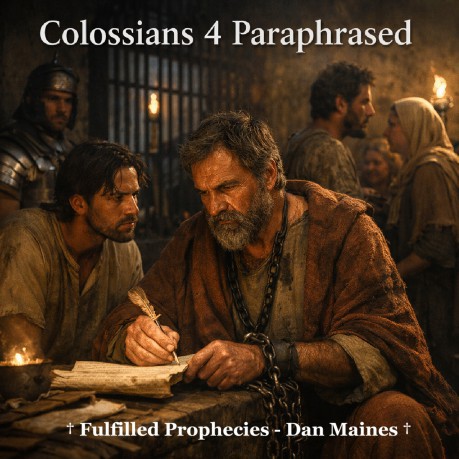
Colossians 4 Paraphrased Introduction Colossians 4:1 Colossians 4:2 Colossians 4:3 Colossians 4:4 Colossians 4:5 Colossians 4:6 Colossians 4:7 Colossians 4:8 Colossians 4:9 Colossians 4:10 Colossians 4:11 Colossians 4:12 Colossians 4:13 Colossians 4:14 Colossians 4:15 Colossians 4:16 Colossians 4:17 Colossians 4:18 Historical References How It Applies To Us Today Q & A Appendix Q: Why did Paul emphasize fair treatment of
servants? Q: Why was prayer so important to the early
church? Q: What does the mystery of Christ refer to? Q: Why were house churches common in the first
century? Q: Why did Paul mention his chains at the end of
the letter? † This is the fulfilled perspective we proclaim at
Fulfilled Prophecies † Source Index
By Dan Maines
† Paul
closes his letter to the Colossian believers by focusing on how faith
shows up in daily life, relationships, and speech.
†
This chapter reminds believers that the gospel was spreading in the
first century and that faithful conduct strengthened the witness of
the church (Matthew 5:16).
† It also shows
the strong network of early Christians who worked together to spread
the message of Christ throughout the Roman world.
Masters, treat your servants
fairly and justly, remembering that you also have a Master in
heaven.
† Paul reminds earthly masters that
authority doesn't belong to them alone, because they are accountable
to Christ who judges all people fairly (Ephesians 6:9).
†
The early church lived within the Roman social system, but Paul
planted the seeds of justice by teaching that all believers stand
equal before God (Galatians 3:28).
† Clement
of Alexandria wrote that Christian masters were to treat servants as
brothers because they share the same Lord.
Continue steadily in prayer,
staying alert and giving thanks as you pray.
†
Prayer kept the early church spiritually awake and focused during
persecution and hardship (1 Thessalonians 5:17-18).
†
Thanksgiving in prayer reminded believers that God was working even
during trials.
† Tertullian wrote that
Christians prayed frequently throughout the day, showing how central
prayer was to early Christian life.
At the same time pray for us
also, that God will open a door for the message so we can speak about
the mystery of Christ, which is the reason I am in chains.
†
Paul was imprisoned for preaching Christ, yet his focus remained on
spreading the gospel (Philippians 1:12-13).
†
The mystery of Christ refers to the revealed truth that salvation was
now openly proclaimed to both Jews and Gentiles (Ephesians 3:6).
†
Eusebius records that many early Christian leaders were imprisoned
but continued preaching boldly despite opposition.
Pray that I may make this
message clear, speaking it as I should.
†
Paul didn't ask for comfort or release, but for clarity and boldness
in preaching the truth (Acts 4:29).
† The
gospel message had to be explained plainly so people could understand
God's plan through Christ.
† Irenaeus wrote
that the apostles faithfully passed down the message in clear
teaching so the churches would not be misled.
Walk in wisdom toward
outsiders, making the most of every opportunity.
†
Believers were called to live carefully among those who didn't yet
follow Christ so their conduct would reflect the truth (1 Peter
2:12).
† Every moment was seen as an
opportunity to demonstrate the transforming power of the gospel.
†
The Didache encouraged believers to live honorable lives before
unbelievers so the name of God would not be dishonored.
Let your speech always be
gracious, seasoned with wisdom, so you'll know how to answer each
person.
† Christian speech was meant to build
others up and communicate truth with kindness (Ephesians 4:29).
†
Wise and gracious speech helped open hearts to the gospel.
†
Justin Martyr wrote that Christians were known for their calm and
thoughtful responses when questioned about their faith.
Tychicus will tell you
everything about my situation. He's a beloved brother, a faithful
servant, and a fellow worker in the Lord.
†
Tychicus was one of Paul's trusted companions who helped deliver
letters and strengthen churches (Ephesians 6:21).
†
The early church depended on faithful messengers to carry apostolic
teaching across the Roman Empire.
† Early
Christian writers noted that these traveling servants of Christ
helped keep the churches united in doctrine.
I'm sending him to you for
this very purpose, so you'll know how we are doing and so he can
encourage your hearts.
† Encouragement was a
major part of early Christian ministry, strengthening believers
during trials (Hebrews 10:24-25).
† Letters
and messengers connected distant churches and helped maintain unity
in faith and practice.
† Eusebius recorded
that early Christian communities frequently sent letters and
representatives to support one another.
He's coming with Onesimus,
our faithful and beloved brother, who is one of you. They'll tell you
everything happening here.
† Onesimus had
once been a runaway servant but was transformed through the gospel
and became a beloved brother (Philemon 1:10-16).
†
This shows the radical change Christ brought, turning broken
relationships into restored fellowship.
†
Ignatius later wrote that Onesimus served faithfully in the church,
showing how the gospel restored lives.
Aristarchus my fellow
prisoner greets you, along with Mark the cousin of Barnabas. You've
received instructions about him, welcome him if he comes to you.
†
Aristarchus had traveled with Paul and even shared imprisonment with
him for the sake of the gospel (Acts 19:29).
†
Mark had previously separated from Paul but was later restored and
welcomed again in ministry (2 Timothy 4:11).
†
Early Christian tradition records that Mark later served in major
leadership roles in spreading the gospel.
Jesus who is called Justus
also sends greetings. These are the only Jewish coworkers for the
kingdom of God among my companions, and they've been a great comfort
to me.
† Jewish believers like these helped
bridge the message of Christ to the wider world.
†
Their partnership with Paul shows the unity of Jewish and Gentile
believers in the early church (Ephesians 2:14-16).
†
Irenaeus noted that the apostles gathered faithful workers from many
backgrounds to serve the churches.
Epaphras, who is one of you
and a servant of Christ Jesus, greets you. He's always struggling in
prayer for you so you'll stand mature and fully confident in all
God's will.
† Epaphras had likely helped
establish the church in Colossae and deeply cared for its spiritual
growth (Colossians 1:7).
† His constant
prayers show the importance of intercession for the strength of
believers.
† Early Christian leaders
frequently prayed for churches under pressure from false teachings
and persecution.
I testify for him that he
works hard for you and for those in Laodicea and Hierapolis.
†
Epaphras served multiple congregations in the region, showing the
connected nature of early Christian communities.
†
The gospel spread city to city through the labor of dedicated
servants like him.
† Eusebius records that
regional leaders often cared for several nearby congregations.
Luke the beloved physician
greets you, and so does Demas.
† Luke, the
writer of the Gospel of Luke and Acts, was a close companion of Paul
(2 Timothy 4:11).
† His presence shows how
educated believers also played key roles in preserving the history of
the early church.
† Early tradition
consistently identifies Luke as the historian who carefully
documented the events of the apostolic age.
Greet the brothers in
Laodicea, and greet Nympha and the church that meets in her house.
†
Many early Christian gatherings took place in homes before dedicated
church buildings existed (Romans 16:5).
†
House churches allowed believers to gather in smaller communities
while the gospel spread.
† Archaeological and
historical evidence confirms that early Christian worship often
occurred in private homes.
After this letter is read
among you, have it read also in the church of the Laodiceans, and
make sure you read the letter from Laodicea as well.
†
Apostolic letters circulated between churches so believers could
learn the same teachings.
† This sharing
helped maintain unity of doctrine across different congregations.
†
Early church leaders preserved these writings, which later became
part of the New Testament canon.
Tell Archippus to be sure he
completes the ministry he received in the Lord.
†
Archippus was likely a leader in the Colossian church and was being
encouraged to remain faithful in his calling.
†
Ministry often required perseverance despite hardship or
discouragement.
† Early church writers
frequently urged pastors and leaders to remain steadfast in their
service to Christ.
I, Paul, write this greeting
with my own hand. Remember my chains. Grace be with you.
†
Paul often dictated letters but added a final greeting in his own
handwriting as a mark of authenticity (2 Thessalonians 3:17).
†
His chains remind readers that the gospel advanced even through
imprisonment.
† Early Christian writers
honored Paul's endurance as an example of faithful suffering for
Christ.
†
Clement of Alexandria taught that Christian conduct toward servants
and others must reflect the justice and mercy of Christ.
†
Irenaeus recorded that the apostles worked with many faithful
coworkers who carried the message across the Roman world.
†
Eusebius documented the imprisonment and suffering of early Christian
leaders who continued preaching the gospel.
†
Believers today are still called to treat others with fairness and
compassion because Christ is our true Master.
†
Prayer remains the foundation of spiritual strength and guidance for
the church.
† Our speech should reflect
wisdom and grace so others can see the truth of Christ in how we live
and speak.
† Faithfulness in ministry
matters, because every believer has a role in God's work.
†
Just as the early church supported one another, believers today are
called to strengthen and encourage each other in faith.
A: Because all believers answer to
the same Lord in heaven (Ephesians 6:9).
A: Prayer kept believers spiritually
alert and thankful (1 Thessalonians 5:17-18).
A:
The revealed truth that salvation is offered to both Jews and
Gentiles (Ephesians 3:6).
A: Early believers gathered in homes
because formal church buildings did not yet exist (Romans 16:5).
A: His imprisonment showed the cost
of preaching the gospel and reminded believers to remain faithful
(Philippians 1:12-13).
© Fulfilled Prophecies - Dan
Maines.
† Colossians
4
† Josephus, Antiquities of the Jews
†
Irenaeus, Against Heresies
† Eusebius,
Ecclesiastical History
† Clement of
Alexandria, Stromata
Links