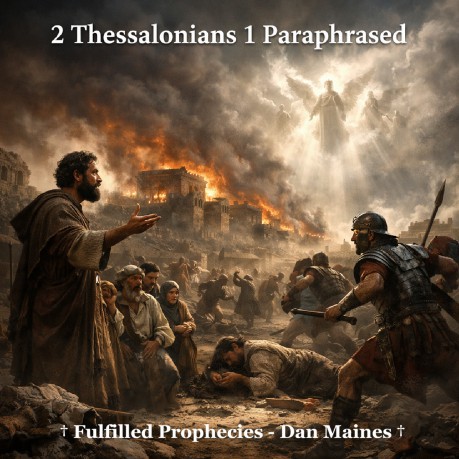
2 Thessalonians 1 Paraphrased Introduction 2 Thessalonians 1:1 2 Thessalonians 1:2 2 Thessalonians 1:3 2 Thessalonians 1:4 2 Thessalonians 1:5 2 Thessalonians 1:6 2 Thessalonians 1:7 2 Thessalonians 1:8 2 Thessalonians 1:9 2 Thessalonians 1:10 2 Thessalonians 1:11 2 Thessalonians 1:12 Historical References How it applies to us today Q & A Appendix Q When did the judgment described in this chapter
happen? Q Who were the persecutors Paul referred to? Q What does the revealing of Jesus from heaven
mean? Q What destruction was Paul speaking about? Q Why were the Thessalonian believers encouraged
by this message? † This is the fulfilled perspective we proclaim at
Fulfilled Prophecies † Source Index
By Dan Maines
† Paul wrote
this letter to believers who were already suffering persecution.
†
Their faith was being tested, but Paul reminded them that God sees
every injustice and will bring righteous judgment.
†
The chapter shows that the suffering of the saints and the coming
judgment on their persecutors belonged to the same approaching day
that Jesus had already warned about (Matthew 16:27-28).
†
Early Christians also understood these words in connection with the
judgment that came upon Jerusalem in that generation.
Paul, Silvanus, and
Timothy write to the congregation of believers in Thessalonica who
belong to God our Father and to the Lord Jesus Christ.
†
Paul identifies the believers as belonging to God and to Christ
together, showing the unity between the Father and the Son (John
10:30).
† This greeting establishes that the
church was God's people, not the earthly system that opposed them
(Hebrews 12:22-23).
† Ignatius of Antioch
also wrote about believers belonging to Christ as God's true
assembly.
Grace and peace to you
from God our Father and from the Lord Jesus Christ.
†
Grace and peace describe the covenant blessings believers receive
through Christ (Romans 5:1-2).
† Paul reminds
them that even while persecution surrounds them, they stand in God's
favor.
† Clement of Alexandria taught that
true peace comes through reconciliation with God through Christ.
We always thank God for
you, brothers and sisters, because it's only right, since your faith
keeps growing stronger and the love each of you has for one another
continues to increase.
† Paul praises their
growing faith even while they were under pressure.
†
True faith matures through hardship, not comfort (James 1:2-4).
†
Irenaeus wrote that the church often grows strongest when persecution
tries to silence it.
Because of this, we
ourselves proudly speak about you among the congregations of God,
telling them about your perseverance and faith through all the
persecution and suffering you are enduring.
†
Their endurance became an example to other churches (1 Peter 5:9).
†
Perseverance was a sign that they truly belonged to Christ.
†
Tertullian famously observed that the blood of the martyrs became the
seed of the church.
This is clear evidence
that God's judgment is righteous, and it shows that you will be
counted worthy of the kingdom of God for which you are suffering.
†
Their suffering wasn't meaningless, it proved God's righteous
judgment was unfolding.
† Jesus taught that
persecution would accompany the coming of the kingdom in their
generation (Matthew 5:10-12).
† Eusebius
recorded how early believers saw persecution as confirmation of
Christ's warnings.
Since it's just for God
to repay with trouble those who are troubling you,
†
Paul assures them that God would repay their persecutors with
justice.
† Jesus promised judgment on those
who persecuted His followers (Matthew 23:34-36).
†
Josephus recorded the terrible judgment that later fell on Jerusalem
and those who opposed the believers.
and to give relief to
you who are suffering, and to us as well, when the Lord Jesus is
revealed from heaven with His powerful angels.
†
The relief promised here was tied to the revealing of Christ in
judgment.
† Jesus said His coming in judgment
would happen before that generation passed away (Matthew 24:34).
†
Early Christian writers connected Christ's coming with the
destruction that came upon Jerusalem in AD 70.
He will bring blazing
judgment on those who refuse to acknowledge God and who do not obey
the good news of our Lord Jesus.
† Fire often
symbolized divine judgment in Scripture (Isaiah 66:15-16).
†
The judgment especially targeted those who rejected Christ's message
(John 3:18-19).
† Josephus described
Jerusalem burning during the Roman destruction of the city.
They will face the
penalty of lasting destruction, separated from the presence of the
Lord and from the glory of His power.
† This
destruction refers to covenant judgment on the system that rejected
Christ (Hebrews 8:13).
† The temple system
that once represented God's presence was permanently removed.
†
Eusebius wrote that Jerusalem's destruction fulfilled Christ's
warnings about the city's coming ruin.
This will happen on the
day when He comes to be honored among His people and to be admired by
all who have believed, because you believed our testimony.
†
The same event that judged the wicked also vindicated the
believers.
† Christ's followers were shown to
be the true people of God when the old covenant order passed away
(Hebrews 12:26-28).
† Early Christians saw
the fall of Jerusalem as proof that Christ's words had been
fulfilled.
For this reason we keep
praying for you, asking that our God will make you worthy of the
calling you have received and that by His power He will bring to
completion every good purpose and work of faith.
†
Paul prayed that their faith would continue producing fruit.
†
God completes the work He begins in His people (Philippians 1:6).
†
Clement of Rome encouraged believers to remain faithful knowing that
God strengthens those who trust Him.
Then the name of our
Lord Jesus will be honored in you, and you in Him, according to the
grace of our God and the Lord Jesus Christ.
†
Believers glorify Christ through faithful lives.
†
Christ also honors His people by sharing His glory with them (John
17:22).
† Early Christian writers repeatedly
emphasized that faithful endurance brings honor to Christ's name.
†
Josephus described the destruction of Jerusalem and the temple in AD
70 in The Jewish War.
† Irenaeus wrote about
the perseverance of believers under persecution in Against
Heresies.
† Eusebius recorded the flight of
Christians from Jerusalem before the city's destruction in
Ecclesiastical History.
† Tertullian wrote
that persecution strengthened the church in Apologeticus.
†
This chapter reminds us that God sees injustice even when it seems
like evil is winning.
† Believers are called
to remain faithful through trials just like the Thessalonian church
did.
† Christ has already proven that His
promises come true exactly when He said they would.
†
Our confidence today rests in the finished work of Christ and the
fulfilled judgment He already carried out.
A Jesus placed the timing in the
lifetime of His listeners. Matthew 16:27-28 says some standing there
would see the Son of Man coming in His kingdom.
A
The same hostile leaders and systems that rejected Christ and
persecuted the early church (Acts 8:1; Matthew 23:34-36).
A It refers to His coming in judgment,
the same event Jesus described in Matthew 24:30-34.
A
The destruction of the old covenant system centered in Jerusalem and
its temple (Hebrews 8:13; Luke 21:20-22).
A Because it assured them that
their suffering would end and their persecutors would face God's
justice (Luke 18:7-8).
© Fulfilled Prophecies - Dan
Maines.
† 2
Thessalonians 1
† Josephus, The Jewish War
†
Irenaeus, Against Heresies
† Eusebius,
Ecclesiastical History
† Tertullian,
Apologeticus
Links