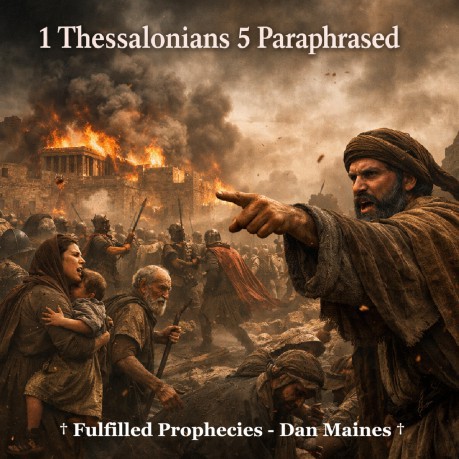
1 Thessalonians 5 Paraphrased Introduction 1 Thessalonians 5:1 1 Thessalonians 5:2 1 Thessalonians 5:3 1 Thessalonians 5:4 1 Thessalonians 5:5 1 Thessalonians 5:6 1 Thessalonians 5:7 1 Thessalonians 5:8 1 Thessalonians 5:9 1 Thessalonians 5:10 1 Thessalonians 5:11 1 Thessalonians 5:12 1 Thessalonians 5:13 1 Thessalonians 5:14 1 Thessalonians 5:15 1 Thessalonians 5:16 1 Thessalonians 5:17 1 Thessalonians 5:18 1 Thessalonians 5:19 1 Thessalonians 5:20 1 Thessalonians 5:21 1 Thessalonians 5:22 1 Thessalonians 5:23 1 Thessalonians 5:24 1 Thessalonians 5:25 1 Thessalonians 5:26 1 Thessalonians 5:27 1 Thessalonians 5:28 Historical References How It Applies To Us Today Q & A Appendix Q: What does the day of the Lord refer to in this
chapter? Q: Why does Paul say the day comes like a
thief? Q: What does it mean to stay awake and sober? Q: Why were believers told to encourage one
another? Q: What are the key attitudes believers should
have according to this chapter? † This is the fulfilled perspective we proclaim at
Fulfilled Prophecies † Source Index
By Dan Maines
† Paul
closes this letter by reminding believers that the coming judgment
that Jesus warned about would arrive suddenly for those who were not
watching.
† The Thessalonian church already
understood the timing Jesus taught, that these events were
approaching in their generation (Matthew 24:34).
†
This chapter encourages believers to stay alert, live upright lives,
and strengthen one another as the old covenant age was coming to its
end.
Now about the times and
seasons of these events, brothers and sisters, you don't need me to
write anything more to you about it.
† Paul
had already explained the timing in person, and the Thessalonians
understood it clearly (Acts 17:1-4).
† Jesus
had already revealed that the generation living then would see these
things happen (Matthew 24:32-34).
† The
church was not waiting for a distant future, they were living in the
final days of that covenant age (Hebrews 1:1-2).
You yourselves know very
well that the day of the Lord will come suddenly, like a thief in the
night.
† Jesus used the same language about
the coming destruction that would fall on Jerusalem (Matthew
24:42-44).
† The point is suddenness, not
secrecy, the judgment would arrive quickly and unexpectedly for the
unprepared (Luke 21:34-36).
† Peter later
described the same day of covenant judgment that was approaching
their world (2 Peter 3:10).
While people are saying
everything is peaceful and secure, sudden destruction will fall on
them like labor pains on a pregnant woman, and they won't escape
it.
† Jerusalem believed it was secure even
while rebellion and corruption filled the city (Josephus, Wars of the
Jews, Book 6).
† Jesus warned that people
would be living normally right up until the judgment came (Matthew
24:37-39).
† The imagery of labor pains shows
that the coming crisis could not be stopped once it began (Isaiah
13:6-8).
But you, brothers and
sisters, aren't living in darkness so that this day would surprise
you like a thief.
† Believers were warned
ahead of time so they could recognize the signs (Luke 21:28-31).
†
The church had prophetic instruction from Christ and the apostles so
they wouldn't be caught unaware (John 16:13).
†
The light of the gospel revealed what was happening in their
generation (Ephesians 5:8).
You are all children of
the light and children of the day, we don't belong to the night or to
darkness.
† Light represents truth and
revelation through Christ (John 8:12).
†
Those who followed Christ were walking in the light of the new
covenant (1 John 1:7).
† The contrast shows
the difference between the faithful church and those still in
spiritual blindness.
So then let's not sleep
like others do, but let's stay awake and keep our minds clear.
†
Jesus repeatedly commanded His followers to stay alert because the
crisis was approaching quickly (Mark 13:33-37).
†
Spiritual sleep represents indifference and unpreparedness (Romans
13:11).
† The church was to remain sober and
attentive to what God was doing in that time.
Those who sleep do it at
night, and those who get drunk do it at night.
†
Paul uses everyday imagery to show how darkness hides careless
living.
† Night represents spiritual
ignorance and moral compromise (John 3:19).
†
The church was called to live differently from the surrounding world.
But since we belong to
the day, let's keep our minds clear, putting on faith and love as a
breastplate, and the hope of salvation as a helmet.
†
Paul uses the imagery of spiritual armor to describe a faithful life
(Ephesians 6:11-17).
† Faith, love, and hope
were the defining marks of the early church (1 Thessalonians 1:3).
†
These virtues protected believers as they endured persecution and
hardship.
God didn't appoint us
for wrath but to receive salvation through our Lord Jesus Christ.
†
The wrath being discussed is the judgment that fell on the
unbelieving generation (Matthew 23:36).
†
Believers were rescued from that coming judgment through Christ (Luke
21:20-22).
† Paul already told them they were
delivered from the coming wrath (1 Thessalonians 1:10).
He died for us so that
whether we're awake or asleep we may live together with Him.
†
Christ's death united believers with Him both in life and in death
(Romans 14:8-9).
† The point is that
believers remain secure in Christ regardless of circumstance.
†
Life with Christ is the hope that sustains the church.
So encourage one
another and build each other up, just as you're already doing.
†
The early church depended heavily on mutual encouragement during
times of persecution (Hebrews 10:24-25).
†
Spiritual growth happens when believers strengthen one another in
faith.
† Paul commends them because they were
already practicing this.
Now we ask you,
brothers and sisters, to respect those who work hard among you, who
lead you in the Lord and instruct you.
†
Church leaders were responsible for guiding believers through
difficult times (Acts 20:28).
† Teaching and
shepherding were essential roles in the early congregations.
†
Respect for faithful leadership helped maintain unity in the church.
Show them great respect
and love because of their work. Live in peace with one another.
†
Unity was critical as believers faced external pressure and
persecution (John 17:21).
† Love within the
church testified to the truth of the gospel (John 13:34-35).
†
Peaceful relationships reflect the character of Christ.
We urge you, brothers
and sisters, warn those who are idle, encourage those who are
discouraged, help the weak, and be patient with everyone.
†
The church was responsible for caring for its members spiritually and
practically (Galatians 6:1-2).
† Patience
reflects God's own character toward His people (2 Peter 3:9).
†
These instructions show the everyday life of a healthy congregation.
Make sure no one repays
evil for evil, but always pursue what is good for one another and for
everyone.
† Jesus taught that believers
should respond to wrongdoing with grace rather than revenge (Matthew
5:38-44).
† Doing good even toward enemies
demonstrates the power of Christ's teaching.
†
The church was to model a completely different way of living.
Always rejoice.
†
Joy was rooted in the believer's relationship with Christ, not
circumstances (Philippians 4:4).
† Even
persecution could not take away the hope the church possessed.
†
Rejoicing expresses confidence in God's promises.
Pray continually.
†
Prayer kept believers connected to God during difficult times (Luke
18:1).
† The early church relied on prayer
for guidance and strength (Acts 2:42).
†
Constant prayer reflects a life centered on God.
Give thanks in
everything, because this is God's will for you in Christ Jesus.
†
Gratitude acknowledges God's sovereignty in every circumstance.
†
Thanksgiving was a consistent practice in apostolic teaching
(Colossians 3:17).
† A thankful heart
reflects trust in God's purposes.
Don't suppress the work
of the Spirit.
† The Spirit guided the early
church in truth and direction (John 16:13).
†
Ignoring the Spirit's work would hinder the church's growth.
†
Believers were called to remain receptive to God's leading.
Don't treat prophecies
with contempt.
† Prophetic messages helped
guide the church before the New Testament writings were complete.
†
These messages were to be respected but also tested carefully.
†
God used prophecy to strengthen and warn the early church.
Examine everything
carefully and hold on to what is good.
†
Discernment was essential because false teachings also circulated (1
John 4:1).
† Believers were expected to
evaluate teachings carefully.
† Truth must be
preserved and protected.
Stay away from every
form of evil.
† The church was called to live
holy lives that reflected Christ's character (1 Peter 1:15-16).
†
Avoiding evil protected the witness of the gospel.
†
Holiness distinguished believers from the surrounding culture.
Now may the God of
peace Himself make you completely holy, and may your whole spirit,
soul, and body be kept blameless at the coming of our Lord Jesus
Christ.
† Paul's prayer shows that
sanctification is God's work in believers (Philippians 1:6).
†
The coming of Christ referenced here connects with the same
approaching judgment spoken of throughout the letter.
†
Believers trusted God to complete His work in them.
The One who calls you
is faithful, and He will do it.
† God's
faithfulness guarantees the fulfillment of His promises (Numbers
23:19).
† The confidence of the church rests
in God's character.
† What God begins He
completes.
Brothers and sisters,
pray for us.
† Even apostles asked the church
for prayer support (Ephesians 6:19).
† This
shows the humility and dependence of the early leaders.
†
Prayer united the entire church.
Greet all the brothers
and sisters with a holy kiss.
† This was a
common greeting expressing unity and affection in the early church
(Romans 16:16).
† It symbolized fellowship
and mutual love.
† The church functioned as a
close spiritual family.
I charge you before the
Lord that this letter be read to all the brothers and sisters.
†
Apostolic letters were intended to be shared among all believers
(Colossians 4:16).
† Public reading ensured
everyone received the same instruction.
†
These writings became foundational teaching for the church.
May the grace of our
Lord Jesus Christ be with you.
† Paul
commonly ended his letters with a blessing centered on grace.
†
Grace summarizes the entire message of the gospel.
†
The church lived daily under the grace of Christ.
†
Josephus describes the sudden destruction that fell upon Jerusalem in
AD 70 and how the people were caught off guard even while claiming
peace and security (Josephus, Wars of the Jews, Book 6).
†
Irenaeus wrote that the apostles warned the early churches about the
approaching trials and the end of the old order (Irenaeus, Against
Heresies).
† Eusebius recorded that
Christians in Judea fled Jerusalem before the Roman siege because
they recognized the warnings Jesus had given (Eusebius,
Ecclesiastical History).
† Clement of
Alexandria emphasized the moral instructions of the apostles as
guidance for believers living through difficult times (Clement of
Alexandria, Stromata).
†
This chapter reminds us that believers are called to live alert and
faithful lives, not spiritually asleep.
†
Encouraging one another remains essential for the health of the
church.
† Faith, love, and hope are still the
foundation of Christian living.
† Prayer,
gratitude, and discernment continue to guide believers today.
†
The church must pursue holiness and reject evil in every form.
A: It refers to the covenant judgment
that fell on Jerusalem in that generation (Matthew 24:34; Luke
21:20-22).
A: Because it would arrive suddenly and
unexpectedly for those who ignored the warnings (Matthew 24:42-44).
A:
It means living spiritually alert and morally disciplined while
watching for the fulfillment of Christ's warnings (Romans 13:11-12).
A: Because they were living through
persecution and approaching upheaval, and the church needed constant
support (Hebrews 10:24-25).
A: Joy, prayer,
gratitude, discernment, and holiness (Philippians 4:4; Colossians
3:17; 1 Peter 1:15-16).
© Fulfilled Prophecies - Dan
Maines.
† 1
Thessalonians 5
† Josephus, Wars of the
Jews
† Irenaeus, Against Heresies
†
Eusebius, Ecclesiastical History
† Clement of
Alexandria, Stromata
Links