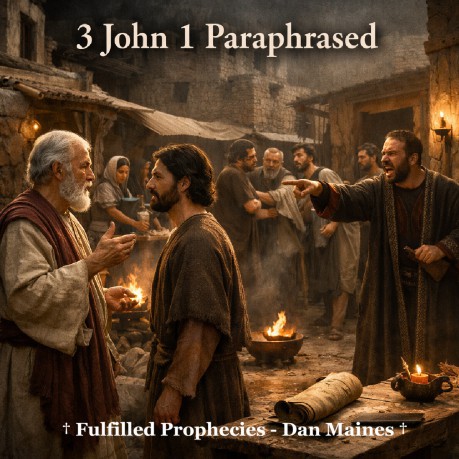
3 John 1 Paraphrased Introduction † This short letter from John gives us a clear
look at how believers were supporting one another while the gospel
was spreading in the first century. The church wasn't just about
belief, it was about walking in truth and helping those who carried
the message of Christ to others. † John writes to Gaius, a faithful believer who
was known for supporting traveling teachers and missionaries. In
contrast to him, another man named Diotrephes was creating division
and refusing to welcome those sent in the name of Christ. † The message of this letter is simple but
powerful, truth must be lived out, not just believed. Hospitality,
faithfulness, and loyalty to the gospel were marks of those walking
in the truth (John 13:34-35). 3 John 1:1 † John identifies himself simply as the elder,
showing his pastoral authority in the early church. This kind of
leadership was recognized among believers as those who guarded sound
teaching and shepherded the flock (1 Peter 5:1-3). † The phrase love in the truth shows that
Christian love isn't separated from doctrine. Love and truth always
walk together in the gospel (Ephesians 4:15). † Early Christian writer Irenaeus wrote that
the apostles appointed faithful men to lead the churches so the truth
would be preserved among believers. 3 John 1:2 † John's prayer shows the balance between
spiritual life and daily life. The condition of Gaius's soul was
already strong, and John desired that his physical life would reflect
that same blessing (Psalm 1:3). † This verse reminds us that the early church
cared deeply for one another's well-being, not just spiritually but
personally. † Clement of Alexandria wrote that the apostles
taught believers to care for both the soul and the needs of the body. 3 John 1:3 † The phrase walking in the truth means living
according to the teaching of Christ, not merely agreeing with it
(James 1:22). † Reports of Gaius's faithfulness were being
shared among traveling believers. This shows how connected the early
churches were as the gospel spread. † Eusebius records that messengers often
carried letters and reports between churches to strengthen unity
among believers. 3 John 1:4 † John refers to believers as his children
because he helped lead many of them to faith and maturity (1
Corinthians 4:15). † The greatest joy for spiritual leaders is
seeing believers remain faithful to the truth of Christ. † Early Christian writings repeatedly emphasize
that perseverance in truth was the mark of genuine discipleship. 3 John 1:5 † Gaius was showing hospitality to traveling
teachers who carried the gospel. This was essential in the early
church because believers often depended on fellow Christians for
support while traveling (Hebrews 13:2). † Hospitality was considered a direct
expression of faith in Christ. † The Didache, an early Christian document,
also instructed believers to receive traveling teachers who came in
the name of the Lord. 3 John 1:6 † Supporting those who preached the gospel
allowed believers to participate in the work even if they weren't the
ones traveling. † This partnership in the gospel is also taught
by Paul when he speaks of believers sharing in ministry through
support (Philippians 4:15-16). † Eusebius records that early Christians
regularly provided for missionaries as they traveled between cities. 3 John 1:7 † The Name refers to the authority and message
of Jesus Christ. † These teachers relied on believers rather
than unbelievers for support so the gospel would never appear to be
motivated by money (Acts 20:33-35). † Early Christian communities took this
seriously, ensuring that gospel workers were supported by the church. 3 John 1:8 † Supporting gospel workers makes believers
partners in the spread of truth. † The work of the gospel was never meant to be
done alone. It has always been a shared mission among the people of
God. † Irenaeus wrote that the churches across the
world were united through the same faith and message handed down from
the apostles. 3 John 1:9 † Diotrephes represents the danger of pride and
control within the church. † Instead of submitting to apostolic teaching,
he wanted to elevate himself above others. † Church history shows that false leadership
often begins when individuals seek personal authority rather than
faithfulness to the truth. 3 John 1:10 † Diotrephes wasn't just rejecting John, he was
actively opposing the work of the gospel. † Refusing fellowship to faithful believers was
a serious issue because it divided the church. † Early Christian writers warned repeatedly
against leaders who sought power rather than truth. 3 John 1:11 † John's instruction is simple, believers must
imitate what reflects the character of God. † This echoes the teaching of Jesus that a tree
is known by its fruit (Matthew 7:16-20). † Genuine faith reveals itself through
righteous actions. 3 John 1:12 † Demetrius is presented as the opposite of
Diotrephes, a man with a faithful reputation. † A good reputation among believers was
evidence of a life shaped by the truth (1 Timothy 3:7). † Early Christian communities valued
trustworthy witnesses who reflected Christ in their conduct. 3 John 1:13 † Letters in the early church often prepared
the way for personal visits where deeper instruction could take
place. † This reminds us that fellowship among
believers has always involved personal connection. 3 John 1:14 † John looked forward to personal fellowship
because truth and encouragement grow stronger when believers gather
together. † The phrase face to face shows the value
placed on personal teaching and unity in the early church. 3 John 1:15 † The closing greeting shows the close
relationships that existed among believers. † Early Christian communities were often small
and deeply connected, knowing one another personally. † Eusebius wrote that the strength of the early
church was found in their unity and shared devotion to Christ. Historical References † Irenaeus wrote that the apostles established
faithful leaders in the churches to guard the truth that had been
delivered to them. † Clement of Alexandria taught that believers
were called not only to believe the truth but to live it through
love, hospitality, and faithfulness. † Eusebius recorded how the early church
remained connected through letters, traveling teachers, and shared
support for the spread of the gospel. How It Applies To Us Today † 3 John reminds us that walking in the truth
isn't just about doctrine, it is about how we treat others and how we
support the work of the gospel. † Faithfulness is seen through actions,
hospitality, generosity, and standing with those who proclaim the
truth. † Just as Gaius supported those spreading the
gospel, believers today continue to participate in God's work by
supporting faithful teaching and living in the truth. Q & A Appendix Q Why did John write this letter to Gaius? Q What does it mean to walk in the truth? Q Why was Diotrephes condemned by John? Q What example does Demetrius provide? Q Why was hospitality important in the early
church? † This is the fulfilled perspective we proclaim at
Fulfilled Prophecies † Source Index † 3 John 1
By Dan Maines
The elder, to the beloved Gaius,
whom I truly love because we stand together in the truth.
Beloved, I pray that everything
goes well for you and that your health is strong, just as your soul
is already doing well.
I was very glad when brothers
came and testified about how you are living in the truth and
continuing to walk in it.
Nothing brings me greater joy
than hearing that my children are living according to the truth.
Beloved, you are acting
faithfully in everything you do for the brothers, especially when
they are strangers.
They have testified before the
church about your love. You will do well to help them continue their
journey in a way that honors God.
They went out for the sake of the
Name, accepting nothing from those who do not believe.
Because of this, we should
support people like them so we can work together for the truth.
I wrote something to the church,
but Diotrephes, who loves to be first among them, does not accept our
authority.
If I come, I will call attention
to what he is doing, spreading false accusations against us. Not
satisfied with that, he refuses to welcome the brothers and even
stops those who want to help them, putting them out of the church.
Beloved, do not imitate what is
evil but what is good. The one who does good belongs to God, but the
one who does evil has not seen God.
Everyone speaks well of
Demetrius, and the truth itself testifies about him. We also testify
about him, and you know our testimony is true.
I had many things to write to
you, but I do not want to write them with pen and ink.
I hope to see you soon, and we
will speak face to face.
Peace be to you. The friends
greet you. Greet the friends there, each one by name.
A
John wrote to encourage Gaius for his faithfulness and hospitality
toward traveling teachers of the gospel (3 John 1:3-6).
A
Walking in the truth means living according to the teachings of
Christ, not just believing them (3 John 1:3; James 1:22).
A
Diotrephes rejected apostolic authority, spread false accusations,
and refused fellowship to faithful believers (3 John 1:9-10).
A
Demetrius is an example of a believer whose life and reputation
confirmed his faithfulness to the truth (3 John 1:12).
A Hospitality supported the spread of
the gospel by helping traveling teachers and missionaries continue
their work (3 John 1:5-8; Hebrews 13:2).
© Fulfilled Prophecies - Dan
Maines.
† Irenaeus,
Against Heresies
† Eusebius, Ecclesiastical
History
† Clement of Alexandria, Stromata
Links