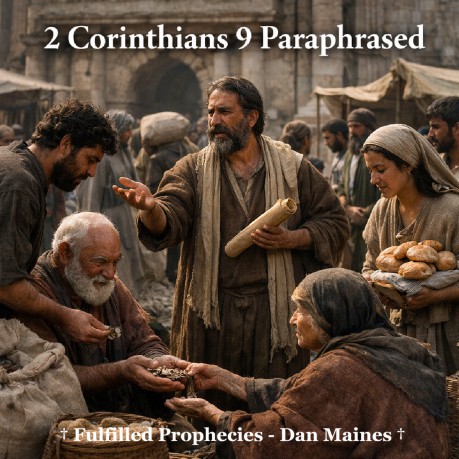
2 Corinthians 9 Paraphrased Introduction 2 Corinthians 9:1 2 Corinthians 9:2 2 Corinthians 9:3 2 Corinthians 9:4 2 Corinthians 9:5 2 Corinthians 9:6 2 Corinthians 9:7 2 Corinthians 9:8 2 Corinthians 9:9 2 Corinthians 9:10 2 Corinthians 9:11 2 Corinthians 9:12 2 Corinthians 9:13 2 Corinthians 9:14 2 Corinthians 9:15 Historical References How It Applies To Us Today Q & A Appendix Q: Why did Paul encourage the Corinthians to give
to believers in Judea? Q: Why does Paul compare generosity to sowing
seed? Q: What kind of giver does God love? Q: What result comes from generous giving? Q: What is the greatest gift Paul refers to at
the end of the chapter? † This is the fulfilled perspective we proclaim at
Fulfilled Prophecies † Source Index
By Dan Maines
† Paul
continues encouraging generosity toward the believers in Judea who
were suffering hardship.
† The message shows
how giving wasn't forced but came from willing hearts that trusted
God to provide.
† This chapter also shows how
generosity becomes a testimony that spreads thanksgiving to God among
many people.
I really don't need to
keep writing to you about helping the believers who are in need.
†
Paul knew the Corinthians were already willing to participate in the
relief collection for the saints in Judea (Acts 11:29-30).
†
The early church practiced shared care for suffering believers across
regions, showing unity in Christ (Galatians 2:10).
†
This also reflects the covenant community caring for one another as a
family of faith.
I know how eager you are
to help, and I've been telling the believers in Macedonia that the
people in Achaia were ready to give since last year, and your
enthusiasm stirred many of them to act as well.
†
Their readiness became an example that motivated other congregations
to give generously (Hebrews 10:24).
† Paul
often used the faithfulness of one church to encourage another toward
good works.
† Generosity spreads when people
see others acting in faith.
But I'm sending these
brothers so the confidence I've had in you about this won't turn out
to be empty, and so you'll be ready just as I said you would be.
†
Paul sent trusted representatives to organize the collection so
everything would be done properly and honestly (2 Corinthians
8:18-21).
† The goal wasn't pressure but
preparation.
† Integrity in handling gifts
was essential in the early church.
Otherwise, if some
Macedonians come with me and find that you aren't ready, we would be
embarrassed, and so would you after the confidence we expressed about
you.
† Paul wanted their generosity to match
the reputation he had shared with other believers.
†
The concern here is about maintaining integrity and trust within the
body of Christ.
† Faithful action confirms
faithful words.
So I thought it was
necessary to urge these brothers to visit you ahead of time and
arrange the gift you promised earlier, so it will be ready as a
generous gift and not something given reluctantly.
†
Giving was meant to come from willingness, not pressure or
obligation.
† Paul carefully protected the
spirit behind the gift so that it would truly be an offering of
love.
† True generosity is planned from the
heart.
Remember this, the one who
sows sparingly will also reap sparingly, but the one who sows
generously will reap generously.
† Paul uses
the picture of farming to show that generosity produces spiritual
fruit (Proverbs 11:24-25).
† God designed
giving and blessing to work like seed and harvest.
†
The principle isn't about wealth but about the abundance of God's
provision and spiritual reward.
Each person should give
what he has decided in his heart, not reluctantly or under pressure,
because God loves a cheerful giver.
† The
heart behind the gift matters more than the amount given.
†
Forced giving isn't what God desires.
† The
joy of giving reflects trust in God's provision.
And God is able to bless
you abundantly so that in everything, at all times, having all that
you need, you'll have plenty for every good work.
†
God's provision enables believers to continue doing good works
(Ephesians 2:10).
† The focus isn't riches
but sufficiency for serving others.
† When
believers trust God, their resources become tools for ministry.
As it is written:
He
scattered his gifts to the poor; his righteousness continues
forever.
† Paul quotes Psalm 112:9 to show
that generosity has always been a mark of righteous living.
†
The righteous person freely shares with the needy.
†
This demonstrates how Old Testament teaching aligns with the life of
the church.
Now the one who supplies
seed to the sower and bread for food will also supply and multiply
your seed for planting and increase the harvest of your
righteousness.
† God is the ultimate source
of both provision and increase (Isaiah 55:10).
†
The harvest here refers to the fruit of righteousness produced
through generosity.
† Faithful giving becomes
part of God's work in the world.
You will be enriched in
every way for all generosity, which through us produces thanksgiving
to God.
† The outcome of generosity isn't
just relief for the needy but praise rising to God.
†
Giving connects believers and spreads gratitude across the body of
Christ.
† God's glory increases when His
people care for one another.
Because the ministry of
this service isn't only meeting the needs of the saints but is also
overflowing in many thanksgivings to God.
†
Acts of generosity create a chain reaction of gratitude.
†
The church becomes a living testimony of God's love through practical
care.
† Meeting needs becomes an act of
worship.
Because of the proof
given by this ministry, they will glorify God for your obedience to
the confession of the gospel of Christ and for your generosity in
sharing with them and with everyone.
† Their
giving proved the sincerity of their faith.
†
True faith produces visible love for others (James 2:14-17).
†
Generosity becomes evidence of obedience to the gospel.
And they will pray for
you with deep affection because of the surpassing grace of God that
is at work in you.
† Generosity builds strong
bonds between believers across regions.
†
Those who receive help respond with prayer and gratitude.
†
God's grace working in one church strengthens another.
Thanks be to God for his
indescribable gift.
† Paul ends by pointing
to the greatest gift of all, God's gift of salvation through Christ
(John 3:16).
† Every act of generosity flows
from the grace believers have already received.
†
Christ Himself is the ultimate gift that inspires all giving.
†
Clement of Alexandria wrote that generosity toward the poor was a
visible expression of true Christian faith.
†
Irenaeus explained that believers shared their resources freely
because they understood everything ultimately belonged to God.
†
Eusebius recorded that the early church was known throughout the
Roman world for caring for widows, orphans, and the poor.
†
Generosity is still one of the clearest signs that someone
understands God's grace.
† When believers
give freely, it shows trust in God's provision rather than fear of
loss.
† Our willingness to help others can
bring thanksgiving to God from people we may never meet.
†
The church becomes strongest when believers care for one another the
way the early church did.
† Every act of
generosity reflects the greatest gift God has already given through
Christ.
A: Because the early
church shared responsibility to care for suffering believers across
regions (Acts 11:29-30).
A: Because giving produces spiritual
fruit just like seed produces a harvest (Proverbs 11:24-25).
A:
God loves a cheerful giver who gives willingly from the heart (2
Corinthians 9:7).
A:
It meets needs and produces thanksgiving to God among many people (2
Corinthians 9:12).
A: God's indescribable
gift is salvation through Jesus Christ (John 3:16).
© Fulfilled Prophecies - Dan
Maines.
† 2
Corinthians 9
† Clement of Alexandria,
Stromata
† Irenaeus, Against Heresies
†
Eusebius, Ecclesiastical History
Links