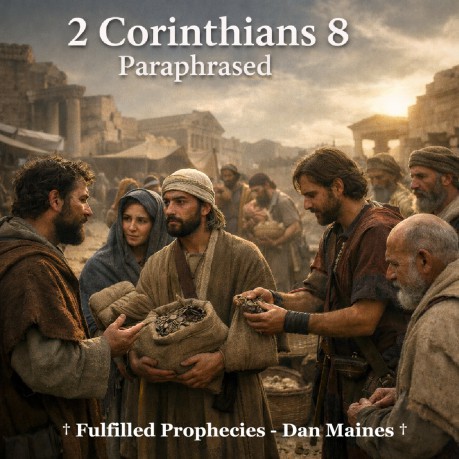
2 Corinthians 8 Paraphrased Introduction 2 Corinthians 8:1 2 Corinthians 8:2 2 Corinthians 8:3 2 Corinthians 8:4 2 Corinthians 8:5 2 Corinthians 8:6 2 Corinthians 8:7 2 Corinthians 8:8 2 Corinthians 8:9 2 Corinthians 8:10 2 Corinthians 8:11 2 Corinthians 8:12 2 Corinthians 8:13 2 Corinthians 8:14 2 Corinthians 8:15 2 Corinthians 8:16 2 Corinthians 8:17 2 Corinthians 8:18 2 Corinthians 8:19 2 Corinthians 8:20 2 Corinthians 8:21 2 Corinthians 8:22 2 Corinthians 8:23 2 Corinthians 8:24 Historical References How It Applies To Us Today Q & A Appendix Q: Why did Paul organize a collection among the
churches? Q: Why did Paul emphasize willingness in
giving? Q: What example does Paul use to encourage
generosity? Q: Why were multiple people involved in
delivering the offering? Q: What principle of equality does Paul teach? † This is the fulfilled perspective we proclaim at
Fulfilled Prophecies † Source Index
By Dan Maines
† Paul wrote
this section to encourage generosity among believers, especially
regarding the collection for the struggling saints in Judea.
†
The early churches understood that the body of Christ supports one
another, sharing resources so that none are left in need (Acts
4:34-35).
† This chapter shows that giving
was not forced, it flowed from willing hearts that understood God's
grace.
Brothers and sisters, we
want you to understand the grace God has given to the churches in
Macedonia.
† Paul begins by pointing to God's
grace working among the Macedonian believers, generosity was the
evidence of that grace in action.
† The
giving of these believers wasn't about wealth, it was about hearts
transformed by God (Acts 20:35).
† Early
Christian writers noted that charity marked the identity of the
church in the first century.
Even though they were
going through severe trials and deep poverty, their joy overflowed
and resulted in rich generosity.
† Their
circumstances didn't stop their generosity, their joy in Christ
overcame their hardship.
† This shows that
Christian giving is not measured by abundance but by willingness
(Mark 12:43-44).
† The Macedonian believers
demonstrated that faith produces compassion for others.
I can testify that they
gave according to their ability, and even beyond their ability,
freely and willingly.
† Paul emphasizes that
their giving was voluntary, not commanded.
†
The heart behind giving matters more than the amount given (2
Corinthians 9:7).
† This generosity reflected
the unity believers shared across different regions.
They urgently pleaded with
us for the privilege of sharing in the support of the saints.
†
These believers didn't need persuasion, they desired to participate
in helping others.
† Giving was viewed as a
privilege, not a burden.
† Their eagerness
shows how the early church saw itself as one family.
And they went beyond what
we expected, first giving themselves to the Lord and then to us by
God's will.
† True generosity begins with
dedication to God first.
† When believers
surrender themselves to the Lord, their resources follow naturally.
†
This pattern reflects the teaching of Christ about seeking God's
kingdom first (Matthew 6:33).
So we encouraged Titus
that as he had begun this work, he should also complete this gracious
act among you.
† Titus had already started
organizing the collection among the Corinthians.
†
Paul encourages them to finish what they had previously committed to
do.
† Follow through in faith matters in
Christian service.
But just as you excel in
everything, in faith, speech, knowledge, complete earnestness, and in
the love we inspired in you, see that you also excel in this act of
grace.
† Paul reminds them that generosity is
another expression of spiritual maturity.
†
Christian growth includes compassion and care for fellow believers.
†
Faith that produces love will also produce generosity.
I'm not commanding you,
but I'm testing the sincerity of your love by comparing it with the
eagerness of others.
† Paul clarifies that
giving should never be forced.
† Instead,
generosity reveals the authenticity of love within the church.
†
Christian giving flows from willing hearts.
You know the grace of our
Lord Jesus Christ, that though he was rich, yet for your sake he
became poor, so that through his poverty you might become rich.
†
Christ is the ultimate example of sacrificial giving.
†
His incarnation and sacrifice brought spiritual riches to
believers.
† Paul's point is simple, if
Christ gave everything for us, we should be willing to help others.
In this matter I'm giving
my opinion, which benefits you, because last year you were the first
not only to give but also to desire to do so.
†
The Corinthians had already shown willingness in the previous year.
†
Paul encourages them to finish the commitment they began.
†
Faithful intentions should lead to faithful action.
Now finish the work, so
that your eagerness to do it may be matched by completing it
according to your means.
† Good intentions
must result in real action.
† Paul stresses
that giving should match each person's ability.
†
The focus remains willingness, not pressure.
If the willingness is
there, the gift is acceptable according to what a person has, not
according to what he doesn't have.
† God
evaluates generosity based on the heart and ability.
†
The amount given is secondary to the sincerity of the giver.
†
This principle protects believers from guilt or manipulation.
Our desire isn't that
others might be relieved while you are burdened, but that there might
be equality.
† Paul's goal is balance within
the church community.
† Believers help one
another so that needs are met across the body.
†
This reflects the unity Christ established among his people.
At the present time your
abundance can supply their need, so that their abundance may also
supply your need in the future, resulting in equality.
†
The church operates through mutual care and shared support.
†
Times of abundance and need shift among believers.
†
God's design ensures that no member of the body is abandoned.
As it is written, The one
who gathered much didn't have too much, and the one who gathered
little didn't have too little.
† Paul
references the principle seen when Israel gathered manna in the
wilderness (Exodus 16:18).
† God's provision
ensured that every person had what was necessary.
†
The same principle applies within the church.
But thanks be to God, who
put the same earnest care for you into the heart of Titus.
†
Titus shared Paul's concern for the Corinthian believers.
†
God works through faithful servants to organize and care for the
church.
† Leadership in the early church
involved responsibility and trust.
He not only welcomed our
appeal, but he's coming to you with much enthusiasm on his own
initiative.
† Titus wasn't forced to go, he
volunteered eagerly.
† His willingness
reflects the same spirit of service Paul encourages in others.
†
Faithful ministry grows out of genuine concern for believers.
We're sending along with
him the brother who is praised by all the churches for his work in
the gospel.
† Paul ensured accountability by
sending trusted companions.
† Financial
matters in the church required transparency and integrity.
†
This helped protect the reputation of the ministry.
Not only that, but he was
chosen by the churches to travel with us as we carry this offering,
which we administer to honor the Lord and show our willingness to
help.
† Representatives from the churches
helped oversee the offering.
† This protected
the collection from suspicion or misuse.
†
The goal was to honor the Lord through honest stewardship.
We want to avoid any
criticism regarding the way we administer this generous gift.
†
Paul understood the importance of accountability in ministry.
†
Proper handling of resources protects the church's witness.
†
Integrity builds trust among believers.
We're careful to do
what's right not only before the Lord but also before people.
†
Christian leadership must maintain integrity both spiritually and
publicly.
† The church's reputation matters
because it reflects Christ.
† Faithful
stewardship strengthens the credibility of the gospel.
We're also sending with
them our brother whom we've often tested and found diligent in many
matters, and now even more eager because of his great confidence in
you.
† Multiple trusted witnesses ensured the
proper handling of the offering.
† This
structure protected both the donors and those managing the funds.
†
Early church leadership valued transparency.
As for Titus, he's my
partner and fellow worker among you, and our brothers are
representatives of the churches and an honor to Christ.
†
Paul describes these men as partners in the ministry.
†
They represent the churches and serve Christ's mission.
†
Their work reflects the unity of the early Christian movement.
Therefore openly show
them the proof of your love and the reason for our pride in you
before the churches.
† Paul urges the
Corinthians to demonstrate their generosity publicly through
action.
† Their giving would confirm their
sincerity before the wider church community.
†
Love expressed through generosity strengthens unity among believers.
†
Josephus wrote that Jewish believers in the first century often
relied on support from other communities because persecution and
famine created hardship in Judea.
† Clement
of Alexandria described Christian generosity as a defining mark of
the church, believers saw wealth as something to share for the good
of others.
† Eusebius recorded that early
Christians frequently organized collections to care for those
suffering in other regions.
†
Christian generosity still reflects the grace of God working in the
heart.
† Believers are called to help one
another so that no one in the body of Christ is left in need.
†
Giving should always come from willingness, not pressure or
manipulation.
† The example of Christ reminds
us that sacrificial love defines the life of a believer.
A: The collection was intended to
help believers in Judea who were facing hardship and famine (Acts
11:27-30).
A: Because Christian giving must come
from the heart, not from compulsion (2 Corinthians 9:7).
A: He points to Jesus Christ, who
gave himself so believers could receive spiritual riches (Philippians
2:5-8).
A: To ensure
accountability and integrity in handling the gift (1 Corinthians
16:3-4).
A:
Those with abundance help those in need so that the body of Christ
functions together in unity (Galatians 6:10).
© Fulfilled Prophecies - Dan
Maines.
† 2
Corinthians 8
† Josephus, Antiquities of the
Jews
† Clement of Alexandria, Stromata
†
Eusebius, Ecclesiastical History
Links