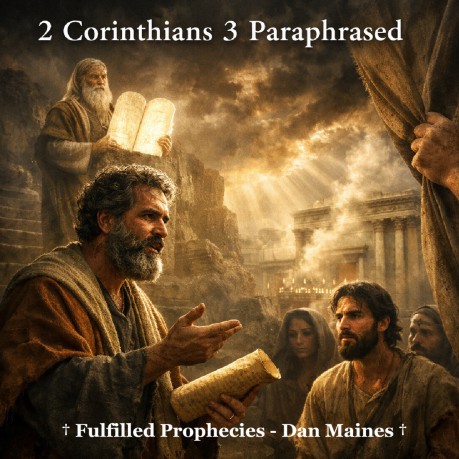
2 Corinthians 3 Paraphrased Introduction 2 Corinthians 3:1 2 Corinthians 3:2 2 Corinthians 3:3 2 Corinthians 3:4 2 Corinthians 3:5 2 Corinthians 3:6 2 Corinthians 3:7 2 Corinthians 3:8 2 Corinthians 3:9 2 Corinthians 3:10 2 Corinthians 3:11 2 Corinthians 3:12 2 Corinthians 3:13 2 Corinthians 3:14 2 Corinthians 3:15 2 Corinthians 3:16 2 Corinthians 3:17 2 Corinthians 3:18 Historical References How It Applies To Us Today Q & A Appendix Q: Why does Paul call the Law the ministry of
death? Q: What does the veil represent? Q: What removes the veil? Q: What is the ministry of the Spirit? Q: Why does Paul compare Moses' glory with the
new covenant? † This is the fulfilled perspective we proclaim at
Fulfilled Prophecies † Source Index
By Dan Maines
† In this
chapter Paul explains the difference between the old covenant written
on stone and the new covenant written on hearts.
†
He's not attacking the Law itself, he's explaining its purpose and
its fulfillment through Christ.
† The Law
revealed sin and brought condemnation, but the Spirit brings life and
righteousness through the completed work of Jesus (Romans 7:7;
Galatians 3:24).
† Paul also shows that the
fading glory of the old covenant pointed forward to the lasting glory
of the new covenant age.
† From the fulfilled
perspective, the fading glory reached its end in the first century
when the temple system passed away and the new covenant stood fully
revealed.
Are we starting again to
recommend ourselves? Or do we need letters of approval for you or
from you like some people do?
† Paul answers
critics who questioned his authority. His ministry didn't depend on
letters of recommendation.
† The Corinthians
themselves were the proof of his work because their lives had been
changed by the gospel (1 Corinthians 9:2).
†
Tertullian wrote that the transformed lives of believers were the
strongest testimony of the church's truth.
You yourselves are our
letter, written on our hearts, known and read by everyone.
†
Instead of written endorsements, Paul says the believers themselves
are the visible evidence of his ministry.
†
Their lives were like a living letter that the world could read.
†
Clement of Alexandria explained that the conduct of believers reveals
the teaching of Christ more clearly than written documents.
It's clear that you're a
letter from Christ delivered through us, written not with ink but
with the Spirit of the living God, not on tablets of stone but on
tablets of human hearts.
† Paul contrasts two
covenants here, stone tablets from Sinai and hearts transformed by
the Spirit.
† This echoes Jeremiah's prophecy
that God's law would be written on hearts (Jeremiah 31:33).
†
The new covenant isn't about external commandments but internal
transformation.
This is the confidence we
have toward God through Christ.
† Paul's
confidence wasn't in himself but in the authority given through
Christ.
† The gospel itself was the source of
his boldness.
† Irenaeus taught that the
apostles spoke with confidence because Christ had fulfilled the
promises of the prophets.
Not that we're capable in
ourselves to claim anything as coming from us, but our ability comes
from God.
† Paul reminds us that spiritual
work is never produced by human strength.
†
Ministry power comes from God alone.
† This
removes pride and keeps the focus on God's work.
He made us capable
servants of a new covenant, not of the letter but of the Spirit, for
the letter kills but the Spirit gives life.
†
The letter refers to the Law written externally, which exposed sin
but couldn't give life.
† The Spirit brings
life because the work of redemption has been completed through
Christ.
† Early writer Barnabas explained
that the new covenant brings life because forgiveness and
transformation come through Christ.
Now if the ministry of
death, carved in letters on stone, came with glory so that the sons
of Israel couldn't look steadily at Moses' face because of its glory,
fading though it was,
† The Law had glory
because it came from God, but it was temporary.
†
The shining face of Moses showed the glory of that covenant.
†
Yet even that glory was already fading, showing it wasn't the final
covenant.
how much greater will the
ministry of the Spirit be in glory?
† If the
old covenant had glory, the new covenant must have far greater
glory.
† The Spirit reveals the completed
work of Christ and the righteousness now available to believers.
†
The contrast shows movement from temporary glory to lasting glory.
If the ministry that
brought condemnation had glory, the ministry that brings
righteousness overflows with even greater glory.
†
The Law condemned because it exposed sin but couldn't remove it.
†
The gospel brings righteousness because Christ fulfilled the Law and
removed sin.
† This righteousness is given
through faith in Christ.
What once had glory has
now lost its glory because of the greater glory that has appeared.
†
Compared to the glory of Christ and the new covenant, the old
covenant glory fades away.
† This doesn't
mean the Law was bad, it means its role was temporary.
†
The greater glory of Christ fulfilled what the Law pointed toward.
If what was fading away
came with glory, how much greater is the glory of what remains.
†
Paul emphasizes permanence.
† The old
covenant faded, but the new covenant remains.
†
The destruction of the temple in AD 70 marked the final removal of
that fading system.
Since we have such a
hope, we speak with great boldness.
† Because
the new covenant is secure, Paul speaks openly and confidently.
†
The hope he's referring to is the full unveiling of the new covenant
age.
† This hope strengthened the early
church during persecution.
We aren't like Moses, who
covered his face with a veil so the Israelites wouldn't see the
fading glory.
† Moses' veil symbolized that
the old covenant glory was temporary.
† The
people couldn't fully see what was fading away.
†
The veil represents spiritual blindness under the old covenant
system.
But their minds were
hardened. Even today when the old covenant is read, the same veil
remains because it can only be removed through Christ.
†
Paul explains that many still couldn't understand the Law's
purpose.
† The veil remains whenever people
read the Law without seeing Christ as its fulfillment.
†
Only Christ removes the veil and reveals the true meaning of the
scriptures.
Even now whenever Moses
is read, a veil lies over their hearts.
†
This describes spiritual blindness when the Law is read without
recognizing Christ.
† The problem wasn't the
scripture but the hardened heart.
† The
gospel reveals what the Law was pointing toward.
But whenever someone
turns to the Lord, the veil is removed.
†
Turning to the Lord brings understanding.
†
The gospel opens the scriptures and reveals Christ throughout the Law
and prophets (Luke 24:27).
† Faith removes
the blindness caused by relying on the old system.
Now the Lord is the
Spirit, and where the Spirit of the Lord is, there is freedom.
†
The Spirit brings freedom from the condemnation of the Law.
†
This freedom isn't lawlessness but freedom from the old covenant
system.
† Believers now live under the
completed work of Christ.
But we all, with unveiled
faces, seeing the Lord's glory as in a mirror, are being transformed
into the same image from glory to glory, just as from the Lord, the
Spirit.
† Believers now see clearly what
earlier generations could only see dimly.
†
Transformation happens through the Spirit as we understand Christ's
finished work.
† Eusebius wrote that the
gospel reveals the full light that earlier ages only anticipated.
†
Josephus recorded the destruction of Jerusalem and the temple in AD
70, marking the end of the old covenant system.
†
Irenaeus explained that Christ fulfilled the Law and brought the new
covenant reality.
† Clement of Alexandria
taught that the law prepared the world for the coming of Christ.
†
Eusebius described the fall of Jerusalem as the closing of the old
covenant age.
†
We don't live under a fading covenant system but under the completed
new covenant through Christ.
† The Spirit now
writes God's truth on our hearts instead of stone tablets.
†
The veil has been removed, so we can understand the scriptures
through Christ.
† Our confidence comes from
God's work, not our own ability.
† We live in
the full light of the covenant that earlier generations were waiting
to see.
A: Because the Law revealed sin and
brought condemnation but couldn't remove sin (Romans 7:10).
A:
Spiritual blindness when people read the Law without seeing Christ as
its fulfillment (2 Corinthians 3:14).
A:
Turning to the Lord removes the veil and reveals the true meaning of
scripture (2 Corinthians 3:16).
A:
The ministry of the Spirit brings life and righteousness through
Christ (2 Corinthians 3:6).
A: To show that the old covenant
glory was temporary but the new covenant glory remains (2 Corinthians
3:11).
© Fulfilled Prophecies - Dan
Maines.
† 2
Corinthians 3
† Josephus, Wars of the Jews
†
Irenaeus, Against Heresies
† Clement of
Alexandria, Stromata
† Eusebius,
Ecclesiastical History
Links