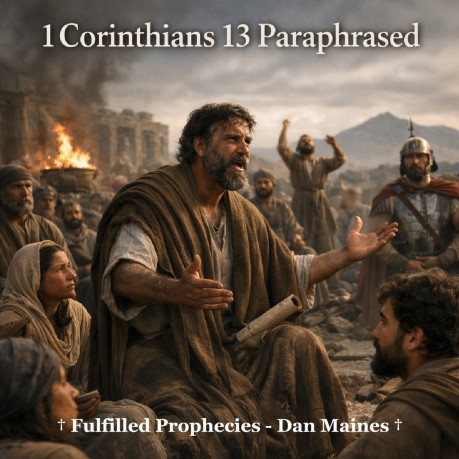
1 Corinthians 13 Paraphrased Introduction Scripture 1 Corinthians 13:1 1 Corinthians 13:2 1 Corinthians 13:3 1 Corinthians 13:4 1 Corinthians 13:5 1 Corinthians 13:6 1 Corinthians 13:7 1 Corinthians 13:8 1 Corinthians 13:9 1 Corinthians 13:10 1 Corinthians 13:11 1 Corinthians 13:12 1 Corinthians 13:13 Historical References How it applies to us today Q & A Appendix Q: Why does Paul place love above spiritual
abilities? Q: What does Paul mean when he says love never
fails? Q: What were the temporary things Paul
mentioned? Q: Why does Paul compare maturity to growing from
childhood? Q: Why is love greater than faith and hope? † This is the fulfilled perspective we proclaim at
Fulfilled Prophecies † Source Index
By Dan Maines
† Paul now
explains the foundation that must guide every believer's life, love.
Without love, even the greatest spiritual actions are empty.
†
This chapter sits directly between Paul's discussion of gifts in 1
Corinthians 12 and their proper use in 1 Corinthians 14, showing that
love must govern everything.
† Clement of
Alexandria taught that true Christian maturity is measured by love,
not by knowledge or outward ability (Clement of Alexandria,
Stromata).
If I could speak in every
human language and even the language of angels, but I don't have
love, my words are nothing more than empty noise like a clanging
instrument.
† Paul begins by showing that
even the most impressive abilities mean nothing without love (1
Corinthians 8:1).
† Love is the motive that
gives value to every act of service in the kingdom (John 13:34-35).
†
Tertullian wrote that outsiders recognized Christians by their love
for one another, not by their speech or knowledge (Tertullian,
Apology).
If I had the gift of
prophecy, understood every mystery, and possessed all knowledge, and
if I had faith strong enough to move mountains, but I don't have
love, then I am nothing.
† Paul shows that
knowledge, prophecy, and faith still fall short if love isn't present
(Matthew 17:20).
† The Corinthians valued
spiritual abilities, but Paul redirects them to what truly matters.
†
Irenaeus emphasized that knowledge without love only produces pride
(Irenaeus, Against Heresies).
Even if I gave away
everything I owned and even allowed my body to suffer for others, but
I don't have love, it gains me nothing.
†
Outward sacrifice alone doesn't prove true devotion if love isn't the
motive (Matthew 6:1-2).
† Love is what
transforms sacrifice into genuine obedience.
†
Early Christian writers often warned that outward acts of religion
without love become empty rituals (Barnabas, Epistle of Barnabas).
Love is patient and kind.
Love isn't jealous, it doesn't brag, and it isn't proud.
†
Paul now defines what real love looks like in daily life (Colossians
3:12).
† Patience and kindness reflect the
character of God Himself.
† Clement of
Alexandria taught that love imitates the character of Christ in every
relationship (Clement of Alexandria, Stromata).
Love doesn't act rudely,
it doesn't seek its own advantage, it isn't easily angered, and it
doesn't keep a record of wrongs.
† Love
refuses to live in constant offense or resentment (Ephesians
4:31-32).
† Forgiveness is one of the
strongest evidences of genuine love.
†
Tertullian noted that Christians were known for forgiving injuries
rather than seeking revenge (Tertullian, Apology).
Love doesn't celebrate
wrongdoing, but it rejoices when truth wins.
†
Love stands firmly with truth rather than compromising with sin
(Psalm 119:163).
† True love never supports
evil, even when culture celebrates it.
†
Irenaeus warned that false teachers claimed knowledge but abandoned
truth and love (Irenaeus, Against Heresies).
Love patiently carries
burdens, keeps trusting, remains hopeful, and endures through every
hardship.
† Love continues even when
circumstances become difficult (Galatians 6:2).
†
This endurance reflects the perseverance Christ showed toward His
people.
† Early Christians endured
persecution while continuing to love both believers and enemies
(Eusebius, Ecclesiastical History).
Love never fails.
Prophecies will eventually stop, languages will cease, and knowledge
will reach its end.
† Temporary spiritual
functions would pass away when their purpose was fulfilled (1
Corinthians 13:10).
† Love alone remains
permanent because it reflects God's eternal nature (1 John 4:8).
†
Clement of Alexandria wrote that love is the eternal mark of the
perfected believer (Clement of Alexandria, Stromata).
Right now our knowledge
is incomplete and our prophecy reveals only part of the whole
picture.
† The early church was still
receiving revelation during the apostolic period (Ephesians 3:5).
†
Paul reminds them that their understanding wasn't yet complete.
†
Eusebius records how the early church recognized the gradual
completion of apostolic teaching (Eusebius, Ecclesiastical History).
But when the complete
comes, what is partial will no longer be needed.
†
Paul contrasts temporary revelation with the coming completion of
God's revealed truth (James 1:25).
† The
church would eventually move from partial understanding to mature
clarity.
† Early writers often connected
maturity with the fullness of Christ's completed work (Irenaeus,
Against Heresies).
When I was a child I
spoke like a child, thought like a child, and reasoned like a child,
but when I became a man I left childish things behind.
†
Paul uses growth as an illustration of moving from partial to mature
understanding (Hebrews 5:13-14).
† The church
was transitioning from the early apostolic stage into maturity.
†
Clement of Alexandria often described spiritual maturity as moving
beyond elementary understanding (Clement of Alexandria, Stromata).
Right now we see things
dimly like a reflection in a mirror, but then we will see clearly.
Right now I understand only in part, but then I will understand fully
just as I have been fully known.
† Ancient
mirrors gave unclear reflections, illustrating incomplete
understanding.
† Paul anticipates a time when
God's plan would be seen clearly.
† Early
Christian writers often spoke of the clarity that came as the gospel
spread and matured throughout the church (Eusebius, Ecclesiastical
History).
Three things remain,
faith, hope, and love. But the greatest of these is love.
†
Faith trusts God, hope expects His promises, but love expresses His
nature.
† Love stands above the others
because it reflects God's character directly (1 John 4:16).
†
Irenaeus wrote that love is the highest expression of life in Christ
(Irenaeus, Against Heresies).
†
Clement of Alexandria taught that the mature Christian life is
defined by love expressed in action (Clement of Alexandria,
Stromata).
† Tertullian recorded that the
Roman world noticed Christians saying, see how they love one another
(Tertullian, Apology).
† Irenaeus emphasized
that knowledge without love leads to pride and division (Irenaeus,
Against Heresies).
† Eusebius described how
early believers endured persecution while continuing to show love and
unity (Eusebius, Ecclesiastical History).
†
Love must remain the foundation of every believer's life, doctrine
without love becomes empty religion.
†
Churches can focus on knowledge, debate, or influence, but love is
still the true measure of spiritual maturity.
†
Our relationships with other believers must reflect patience,
forgiveness, and humility.
† The fulfilled
kingdom Christ established is built on love, not power or status.
†
When believers walk in love, they reflect the character of Christ to
the world.
A: Because spiritual abilities have
value only when motivated by love (1 Corinthians 13:1-3).
A: Love reflects God's eternal nature
and continues even when temporary functions pass away (1 John 4:8).
A: Prophecy, languages, and partial
knowledge were temporary tools used during the early church period (1
Corinthians 13:8-10).
A: He shows that the church was
moving from partial understanding to full maturity (Hebrews 5:13-14).
A:
Because love reflects God's character and continues even when faith
becomes sight and hope is fulfilled (1 John 4:16).
© Fulfilled Prophecies - Dan
Maines.
† 1
Corinthians 13
† Clement of Alexandria,
Stromata
† Irenaeus, Against Heresies
†
Tertullian, Apology
† Eusebius,
Ecclesiastical History
Links