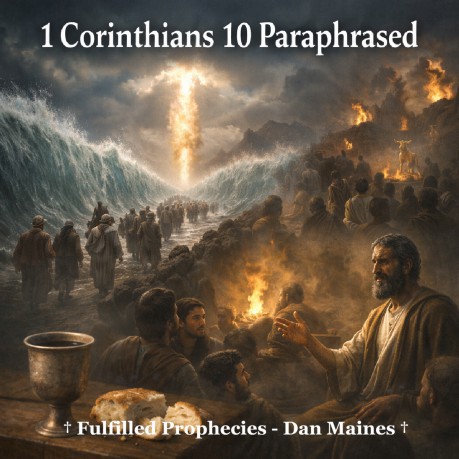
1 Corinthians 10
Paraphrased
By Dan Maines
Introduction
†
Paul reminds believers that Israel's history wasn't written merely as
history but as instruction for the church. The same God who delivered
them also judged them when they turned to idolatry and rebellion
(Romans 15:4).
† The apostle connects the
wilderness generation to the early church to warn that privilege
doesn't equal protection if people abandon faithfulness (Hebrews
3:16-19).
† From the fulfilled perspective,
these warnings were urgent for the first century church living just
before the covenant judgment that culminated in AD 70 (Matthew
24:34).
1 Corinthians 10:1
I want you to
understand, brothers, that our fathers were all under the cloud and
all passed through the sea.
† Paul connects
the Corinthian believers to Israel's story, showing continuity
between God's covenant people (Exodus 13:21-22).
†
The cloud symbolized God's presence guiding His people, just as
Christ now leads His church (Nehemiah 9:12).
†
The crossing of the sea represented deliverance from bondage, a type
pointing forward to redemption through Christ (Isaiah 63:11-14).
1
Corinthians 10:2
All of them were baptized into Moses
in the cloud and in the sea.
† Israel's
passage through the sea functioned like a national baptism,
identifying them with Moses as their covenant leader (Exodus
14:29).
† Paul uses this imagery to show that
outward participation in covenant events doesn't guarantee
faithfulness.
† The warning applies to the
church because people may share in religious experiences yet still
fall away (Hebrews 4:1-2).
1 Corinthians 10:3
All
of them ate the same spiritual food.
† The
manna given in the wilderness was physical bread but also carried
spiritual meaning (Exodus 16:15).
† Jesus
later revealed that the true bread from heaven is Himself (John
6:32-35).
† Israel shared the provision but
many still hardened their hearts.
1 Corinthians 10:4
All
of them drank the same spiritual drink, for they drank from a
spiritual rock that followed them, and that rock was Christ.
†
The water from the rock in the wilderness pointed to Christ as the
true source of life (Exodus 17:6).
† Paul
identifies the sustaining presence of God with Christ Himself working
throughout Israel's history (Psalm 78:15-16).
†
Even with this provision, many still turned to unbelief.
1
Corinthians 10:5
Yet with most of them God wasn't
pleased, and their bodies were scattered in the wilderness.
†
Despite their privileges, the majority of that generation died
because of rebellion (Numbers 14:29).
† This
proves that covenant participation without faith leads to judgment.
†
Paul uses this as a warning to the church living in the last days of
the old covenant age.
1 Corinthians 10:6
These
things happened as examples for us so we wouldn't crave evil things
as they did.
† Israel's history functions as
instruction for believers so the same sins won't be repeated (Psalm
106:13-15).
† The church must learn from the
past rather than repeat the same rebellion.
†
Paul's generation needed this warning as the covenant age was
reaching its climax.
1 Corinthians 10:7
Don't
become idolaters like some of them were, as it is written, The people
sat down to eat and drink and stood up to play.
†
Paul refers to the golden calf incident when Israel turned to
idolatry (Exodus 32:6).
† Idolatry wasn't
only about statues but about turning from God's authority.
†
The early church faced similar temptations in pagan cities like
Corinth.
1 Corinthians 10:8
We must not
commit sexual immorality as some of them did, and twenty three
thousand fell in one day.
† This refers to
the judgment that came when Israel joined the immorality and idolatry
of Moab (Numbers 25:1-9).
† Sexual sin was
tied to pagan worship in the ancient world.
†
Paul warns the church not to repeat those same sins.
1
Corinthians 10:9
We must not test Christ as some of
them did and were destroyed by serpents.
†
Israel tested God by complaining and rejecting His provision (Numbers
21:5-6).
† The bronze serpent later became a
symbol pointing to Christ's saving work (John 3:14).
†
Testing God shows distrust in His promises.
1
Corinthians 10:10
And don't grumble as some of them did
and were destroyed by the destroyer.
†
Complaining against God's leadership brought judgment during Israel's
wilderness journey (Numbers 16:41-49).
†
Grumbling revealed unbelief and rejection of God's authority.
†
The church must guard against the same spirit.
1
Corinthians 10:11
Now these things happened to them as
examples and were written for our instruction, upon whom the ends of
the ages have come.
† Paul clearly states
that his generation was living at the end of the covenant ages.
†
This matches Jesus' statements about the last days of that generation
(Matthew 24:34).
† The coming judgment would
soon fall upon the old covenant system.
1 Corinthians
10:12
Therefore let the one who thinks he stands take
heed so he doesn't fall.
† Confidence without
humility leads to spiritual failure.
† Israel
believed they were secure yet fell because of unbelief.
†
The same warning applies to believers.
1 Corinthians
10:13
No temptation has overtaken you except what is
common to man, and God is faithful, He won't allow you to be tempted
beyond what you are able, but with the temptation will also provide
the way of escape so you'll be able to endure it.
†
God always provides a path of faithfulness even in difficult
trials.
† Temptation isn't an excuse for
sin.
† Faith relies on God's faithfulness.
1
Corinthians 10:14
Therefore my beloved, flee from
idolatry.
† Paul gives a direct command
because idolatry destroys covenant loyalty.
†
The early church had to separate from pagan temple practices common
in Corinth.
† Loyalty to Christ must be
exclusive.
1 Corinthians 10:15
I speak as
to wise people, judge for yourselves what I say.
†
Paul appeals to their spiritual maturity and understanding.
†
Believers are expected to discern truth through the gospel.
†
Wisdom comes through obedience to Christ.
1 Corinthians
10:16
Isn't the cup of blessing which we bless a
sharing in the blood of Christ, and isn't the bread which we break a
sharing in the body of Christ.
† The Lord's
Supper symbolizes participation in Christ's covenant sacrifice (Luke
22:19-20).
† Communion represents unity with
Christ and with His people.
† This sacred
meal cannot be mixed with pagan worship.
1 Corinthians
10:17
Since there is one bread, we who are many are one
body, for we all share in the one bread.
†
The church is united through Christ.
†
Communion expresses the shared life believers have in Him.
†
Division contradicts the meaning of the Lord's table.
1
Corinthians 10:18
Look at Israel according to the
flesh, aren't those who eat the sacrifices sharing in the altar.
†
In Israel's worship, eating sacrifices showed participation in the
covenant system (Leviticus 7:15).
† Paul uses
this example to show that religious meals symbolize allegiance.
†
The same principle applies to pagan temples.
1
Corinthians 10:19
What am I saying then, that food
sacrificed to idols is anything, or that an idol is anything.
†
Paul clarifies that idols themselves have no real power.
†
The danger lies in participating in the worship connected to them.
†
Idolatry is ultimately about spiritual allegiance.
1
Corinthians 10:20
No, but I say that the things the
Gentiles sacrifice they sacrifice to demons and not to God, and I
don't want you to become partners with demons.
†
Behind pagan worship stands spiritual deception.
†
Participation in idol worship aligns a person with false spiritual
powers.
† The church must remain separated
from these practices.
1 Corinthians 10:21
You
can't drink the cup of the Lord and the cup of demons, you can't
share in the table of the Lord and the table of demons.
†
Covenant loyalty cannot be divided.
†
Fellowship with Christ excludes fellowship with idolatry.
†
Spiritual compromise leads to judgment.
1 Corinthians
10:22
Or do we provoke the Lord to jealousy, we're not
stronger than He is, are we.
† God is
described as jealous for His covenant people (Exodus 34:14).
†
Divided loyalty provokes divine judgment.
†
Paul reminds believers that God will not tolerate idolatry.
1
Corinthians 10:23
All things are permitted, but not all
things are beneficial, all things are permitted, but not all things
build up.
† Christian freedom must be guided
by wisdom and love.
† Not everything lawful
is helpful for spiritual growth.
† The goal
is to build up others.
1 Corinthians 10:24
No
one should seek his own good but the good of his neighbor.
†
Love places the well being of others above personal rights.
†
This reflects the law of Christ (Galatians 6:2).
†
The church grows through mutual care.
1 Corinthians
10:25
Eat whatever is sold in the meat market without
asking questions for the sake of conscience.
†
Paul teaches practical wisdom regarding marketplace food.
†
Believers don't need to investigate every detail of its origin.
†
Freedom is allowed unless it causes spiritual harm.
1
Corinthians 10:26
For the earth is the Lord's and
everything in it.
† Paul quotes the Psalms to
show that all creation belongs to God (Psalm 24:1).
†
Food itself isn't defiled.
† The issue is
participation in idol worship.
1 Corinthians 10:27
If
an unbeliever invites you and you want to go, eat whatever is set
before you without raising questions for conscience sake.
†
Believers can interact with unbelievers in normal social settings.
†
The gospel spreads through ordinary relationships.
†
Freedom should be exercised with wisdom.
1 Corinthians
10:28
But if someone says to you, This was offered to
idols, then don't eat it for the sake of the one who informed you and
for conscience sake.
† The concern isn't the
food but the witness.
† Love sometimes limits
freedom for the sake of others.
† Protecting
another person's conscience matters.
1 Corinthians
10:29
I mean not your conscience but the other
person's, for why should my freedom be judged by another
conscience.
† Paul explains that believers
act out of love rather than fear.
† The goal
is to avoid causing someone else to stumble.
†
Christian liberty must be guided by responsibility.
1
Corinthians 10:30
If I partake with thankfulness, why
am I criticized because of something I give thanks for.
†
Gratitude sanctifies ordinary things.
† Yet
love still limits how freedom is expressed.
†
The focus remains on honoring God.
1 Corinthians
10:31
Whether you eat or drink or whatever you do, do
everything for the glory of God.
† Every
action in life should reflect devotion to God.
†
Faith isn't limited to religious settings.
†
The believer's entire life becomes worship.
1
Corinthians 10:32
Give no offense either to Jews or
Greeks or to the church of God.
† Paul
emphasizes unity and peace within the diverse early church.
†
Believers must consider the impact of their actions.
†
The goal is the growth of God's people.
1 Corinthians
10:33
Just as I also try to please everyone in
everything, not seeking my own advantage but the advantage of many so
they may be saved.
† Paul's ministry focused
on the salvation of others.
† Self sacrifice
for the gospel was his guiding principle.
†
The church is called to live with the same purpose.
Historical
References
† Josephus recorded how
first century Jews repeatedly fell into idolatry and rebellion
leading up to the destruction of Jerusalem.
†
Irenaeus wrote that the Old Testament events served as examples so
believers would avoid the same sins.
†
Clement of Alexandria taught that Israel's history revealed the moral
lessons necessary for Christian instruction.
†
Eusebius noted that the early church interpreted these warnings as
applying directly to the generation before Jerusalem's fall.
How
It Applies To Us Today
† We learn
from Israel's failures so we don't repeat the same rebellion.
†
Privilege in God's kingdom doesn't remove the need for
faithfulness.
† Idolatry today can appear in
many forms including power, wealth, or self worship.
†
True freedom in Christ is guided by love and responsibility.
†
Our lives must glorify God in every action.
Q & A
Appendix
Q: Why did Paul use Israel's
wilderness history as a warning?
A: Because
their experiences showed that covenant privilege doesn't guarantee
faithfulness (Hebrews 3:16-19).
Q: What did
Paul mean by the ends of the ages having come?
A:
He was referring to the closing period of the old covenant age that
culminated in the judgment of Jerusalem (Matthew 24:34).
Q:
Why is idolatry such a serious warning in this chapter?
A:
Because idolatry represents divided loyalty and spiritual rebellion
against God (Exodus 34:14).
Q: What principle
guides Christian freedom according to Paul?
A:
Freedom must be guided by love and the spiritual good of others (1
Corinthians 10:23-24).
Q: What is the main
message of this chapter?
A: Believers must
remain faithful, avoid idolatry, and live in a way that glorifies God
in all things (1 Corinthians 10:31).
† This is the
fulfilled perspective we proclaim at Fulfilled Prophecies †
©
Fulfilled Prophecies - Dan Maines.
Source Index
†
1 Corinthians 10
† Josephus, Wars of the
Jews
† Irenaeus, Against Heresies
†
Clement of Alexandria, Stromata
† Eusebius,
Ecclesiastical History
Links