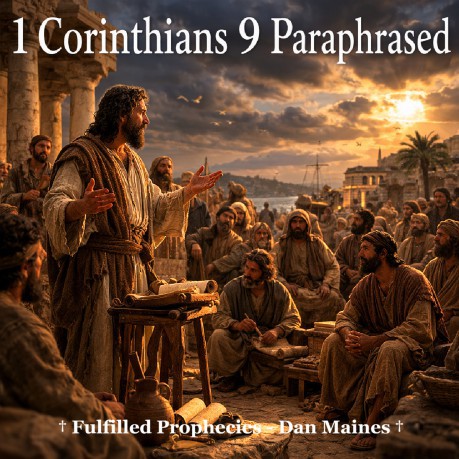
1 Corinthians 9
Paraphrased
By Dan Maines
Introduction
†
In this chapter Paul explains his authority as an apostle and why he
willingly gives up certain rights for the sake of the gospel.
†
His argument shows the balance between freedom and responsibility in
ministry.
† The message also reminds
believers that serving Christ often means laying aside personal
advantage so the truth can reach more people.
1
Corinthians 9:1
Am I not free, am I not an apostle,
haven't I seen Jesus our Lord, and aren't you the result of my work
in the Lord
† Paul reminds them that he
personally saw the risen Christ and was commissioned as an apostle
(Acts 9:3-6).
† The Corinthian church itself
proved his apostleship because they came to faith through his
ministry (1 Corinthians 4:15).
† Irenaeus
explained that the apostles were eyewitnesses of Christ and founders
of the churches.
1 Corinthians 9:2
Even if
others don't recognize me as an apostle, surely you do, because you
are the seal that proves my apostleship in the Lord
†
Their very existence as a church was the evidence of Paul's
authority.
† Their faith confirmed the
success of his mission among the Gentiles (2 Corinthians 3:2-3).
†
Clement of Alexandria wrote that the apostles left behind established
churches as proof of their calling.
1 Corinthians
9:3
This is my defense to those who examine and
question my authority
† Paul is answering
critics who doubted his apostleship.
†
Challenges to Paul's authority appear throughout his letters (2
Corinthians 10:10).
† Tertullian noted that
apostolic authority was often questioned by false teachers.
1
Corinthians 9:4
Don't we have the right to receive food
and drink from those we serve
† Ministers of
the gospel have the right to be supported by those they serve (Luke
10:7).
† Paul is establishing a biblical
principle before explaining why he personally refused it.
†
Early church communities commonly supported traveling teachers and
apostles.
1 Corinthians 9:5
Don't we have
the right to take along a believing wife just like the other
apostles, the brothers of the Lord, and Cephas
†
This verse shows that several apostles were married.
†
Christian ministry in the first century included married leaders
traveling with their wives.
† Clement of
Alexandria wrote that Peter and other apostles had believing wives
who shared in their ministry.
1 Corinthians 9:6
Or
is it only Barnabas and I who must work with our own hands to support
ourselves
† Paul often supported himself
through tentmaking (Acts 18:3).
† This
allowed him to preach without being accused of greed.
†
Early Christian writers praised Paul's willingness to endure hardship
for the gospel.
1 Corinthians 9:7
Who
serves as a soldier at his own expense, who plants a vineyard and
doesn't eat its fruit, or who tends a flock and doesn't drink the
milk
† Paul uses examples from everyday life
to show that workers normally receive benefit from their labor.
†
Soldiers, farmers, and shepherds all receive provision through their
work.
† The same principle applies to
spiritual labor.
1 Corinthians 9:8
I'm not
saying these things from human reasoning alone, the Law also says the
same thing
† Paul now appeals to Scripture to
support his argument.
† Biblical law confirms
the fairness of supporting workers.
† This
shows continuity between God's law and gospel ministry.
1
Corinthians 9:9
Because it is written in the Law of
Moses, you shall not muzzle the ox while it is treading out the
grain, God isn't concerned only about oxen, is He
†
Paul quotes Deuteronomy 25:4.
† The principle
shows that laborers deserve to share in their work.
†
Early Christian interpreters understood this as a moral principle
about fairness.
1 Corinthians 9:10
He said
this for our sake, because the one who plows should plow in hope and
the one who threshes should do so expecting to share in the harvest
†
The instruction ultimately points to human laborers.
†
Those who work should expect reward for their effort.
†
Spiritual workers fall under the same principle.
1
Corinthians 9:11
If we've planted spiritual things
among you, is it too much if we harvest material things from you
†
Paul argues that spiritual labor is even more valuable than physical
labor.
† Therefore material support would be
reasonable.
† Early churches often supported
evangelists and teachers.
1 Corinthians 9:12
If
others share this right over you, don't we even more, yet we didn't
use this right, instead we endured everything so nothing would hinder
the gospel of Christ
† Paul refused financial
support in Corinth to avoid accusations of greed.
†
His sacrifice protected the credibility of the gospel.
†
Eusebius wrote about apostles who endured hardship so their message
would not be questioned.
1 Corinthians 9:13
Don't
you know that those who serve in the temple eat from the temple
offerings and those who attend the altar share in what is offered
there
† Paul refers to the Old Testament
priesthood (Numbers 18:8-12).
† Priests were
supported through the offerings brought by the people.
†
This reinforces the biblical precedent for supporting spiritual
workers.
1 Corinthians 9:14
In the same
way the Lord commanded that those who preach the gospel should live
from the gospel
† Jesus taught this when
sending out His disciples (Luke 10:7).
†
Gospel workers had the right to receive support.
†
The early church followed this instruction in many communities.
1
Corinthians 9:15
But I haven't used any of these
rights, and I'm not writing this so it will happen for me, because
I'd rather die than have anyone take away my reason for boasting
†
Paul's joy was preaching freely without financial obligation.
†
His boasting referred to the privilege of giving the gospel freely.
†
This demonstrated sincerity and devotion.
1 Corinthians
9:16
If I preach the gospel I have nothing to boast
about, because I'm under obligation, and woe to me if I do not preach
the gospel
† Paul viewed preaching as a
divine commission.
† The responsibility was
placed on him by Christ.
† Apostolic ministry
carried a sense of urgency and duty.
1 Corinthians
9:17
If I do this willingly I have a reward, but even
if unwilling I'm still entrusted with a stewardship
†
Paul's mission was a sacred responsibility entrusted to him.
†
The gospel message had to be faithfully delivered.
†
Early Christian leaders often described ministry as stewardship.
1
Corinthians 9:18
What then is my reward, that when I
preach the gospel I may offer it free of charge and not use my full
rights in the gospel
† Paul's reward was the
privilege of giving the message freely.
†
This removed any suspicion of personal gain.
†
His approach strengthened trust in his preaching.
1
Corinthians 9:19
Though I'm free from everyone, I've
made myself a servant to all so I may win more people
†
Paul willingly humbled himself for the sake of others.
†
His focus was reaching as many people as possible.
†
Missionary work in the early church followed this same mindset.
1
Corinthians 9:20
To the Jews I became like a Jew so I
could win Jews, to those under the Law I became like one under the
Law though I'm not under it myself so I could win those under the
Law
† Paul adapted culturally to connect with
Jewish audiences.
† This did not mean
compromising the gospel message.
† It meant
removing unnecessary barriers to hearing the truth.
1
Corinthians 9:21
To those without the Law I became like
one without the Law though I'm not without God's law but under
Christ's law so I could win those without the Law
†
Paul remained obedient to Christ even while adapting to Gentile
culture.
† Flexibility never meant abandoning
righteousness.
† The mission was always
reaching people with the gospel.
1 Corinthians 9:22
To
the weak I became weak so I could win the weak, I've become all
things to all people so that by every possible means I might save
some
† Paul showed compassion toward those
with fragile faith.
† His goal was helping
people grow rather than condemning them.
†
This reflects the heart of pastoral care.
1 Corinthians
9:23
I do all things for the sake of the gospel so that
I may share in its blessings
† Paul's life
revolved around the mission of the gospel.
†
Every sacrifice served that purpose.
†
Participation in God's work was his greatest reward.
1
Corinthians 9:24
Don't you know that in a race all
runners run but only one receives the prize, run in such a way that
you may win
† Paul uses athletic imagery
familiar in Corinth.
† The Christian life
requires discipline and determination.
†
Early Christian teachers frequently used athletic metaphors for
spiritual endurance.
1 Corinthians 9:25
Everyone
who competes exercises self control in all things, they do it to
receive a temporary crown but we pursue an eternal one
†
Athletes trained intensely for a fading reward.
†
Believers strive for something far greater.
†
The eternal reward surpasses any earthly prize.
1
Corinthians 9:26
Therefore I don't run without
direction and I don't fight like someone striking the air
†
Paul's ministry had purpose and focus.
† His
life was not wasted on meaningless effort.
†
Every action aimed at advancing the gospel.
1
Corinthians 9:27
Instead I discipline my body and bring
it under control so after preaching to others I myself will not be
disqualified
† Paul practiced personal
discipline to remain faithful.
† Spiritual
leadership requires integrity and perseverance.
†
Early church writers often pointed to Paul's self control as a model
for believers.
Historical References
†
Irenaeus taught that the apostles established churches as witnesses
of the gospel message.
† Clement of
Alexandria wrote about married apostles and their shared ministry
with their wives.
† Eusebius documented the
hardships and sacrifices endured by the apostles.
†
Tertullian defended apostolic authority against critics and false
teachers.
How It Applies To Us Today
†
Believers should be willing to sacrifice personal rights for the sake
of the gospel.
† Christian freedom should be
used to serve others and help them grow.
†
Discipline and perseverance remain essential in faithful living.
†
Like Paul, we should remove obstacles that might prevent others from
hearing the truth.
Q & A Appendix
Q:
Why did Paul refuse financial support from the Corinthians?
A:
He wanted to remove suspicion that he preached for money and to
protect the credibility of the gospel (1 Corinthians 9:12, 15).
Q:
Did Paul believe ministers could receive support?
A:
Yes, he clearly taught that those who preach the gospel have the
right to live from the gospel (1 Corinthians 9:14).
Q:
What does it mean that Paul became all things to all people?
A:
He adapted culturally to reach different groups without compromising
the truth of Christ (1 Corinthians 9:20-22).
Q:
Why did Paul compare the Christian life to athletic competition?
A:
The comparison shows the need for discipline, focus, and perseverance
in faith (1 Corinthians 9:24-25).
Q: What
warning does Paul give in the final verse?
A:
Even those who preach must remain disciplined and faithful so they
themselves are not disqualified (1 Corinthians 9:27).
†
This is the fulfilled perspective we proclaim at Fulfilled Prophecies
†
© Fulfilled Prophecies - Dan Maines.
Source
Index
† 1 Corinthians 9
†
Irenaeus, Against Heresies
† Clement of
Alexandria, Stromata
† Eusebius,
Ecclesiastical History
† Tertullian, Apology
Links