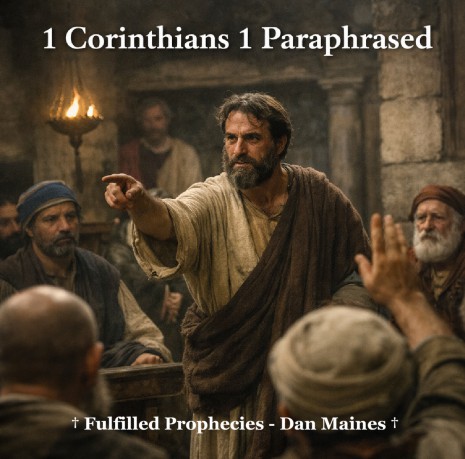
1 Corinthians 1
Paraphrased
By Dan Maines
Introduction
†
Paul opens this letter by grounding everything in God's calling, not
man's approval, because the church in Corinth had started thinking
too highly of men and too lightly of Christ.
†
This chapter exposes division, fleshly pride, and confidence in
worldly wisdom, and it pulls everything back to the cross of
Christ.
† From the fulfilled perspective,
this was written in the last days of the Old Covenant age, when the
church was being established as God's holy people before the full
judgment that was coming upon Jerusalem in that generation (Matthew
16:27-28).
1 Corinthians 1:1
Paul, called
by God's will to be an apostle of Jesus Christ, and Sosthenes our
brother,
† Paul begins by reminding them that
his authority came from God, not from human appointment or personal
ambition.
† That matters because the
Corinthians were already elevating men into parties and factions,
something this chapter corrects.
† The
calling of an apostle was foundational to the church's establishment
in that generation (Ephesians 2:20).
1 Corinthians
1:2
To the assembly of God in Corinth, to those made
holy in Christ Jesus, called to be saints, together with all who in
every place call on the name of our Lord Jesus Christ, their Lord and
ours,
† He calls them sanctified and called
saints before correcting them, showing that covenant identity comes
from Christ, not from perfect performance.
†
The church is God's assembly, not man's institution, and all
believers share one Lord, which destroys sectarian pride.
†
Their holiness was located in Christ, not in temple rituals,
ancestry, or old covenant distinctions (Hebrews 10:10).
1
Corinthians 1:3
Grace to you and peace from God our
Father and the Lord Jesus Christ.
† Grace and
peace summarize the whole gospel, grace from God, peace through
Christ.
† This peace stands in contrast to
the strife and party spirit that had begun to infect Corinth.
†
What the law couldn't produce, Christ now gives freely to His people
(Romans 5:1).
1 Corinthians 1:4
I always
thank my God for you because of the grace of God given to you in
Christ Jesus,
† Paul starts with
thanksgiving, not flattery, because even troubled believers are
recipients of God's grace.
† He points to
what God gave them in Christ, not to what they achieved by
themselves.
† Grace is the ground of all
Christian standing and growth, and that leaves no room for boasting
(Ephesians 2:8-9).
1 Corinthians 1:5
that
in everything you were enriched in Him, in all speech and all
knowledge,
† Corinth valued speech and
knowledge, but Paul says whatever they truly had came from Christ.
†
Spiritual enrichment was real, but gifts were never meant to become
tools of pride.
† Knowledge without humility
leads to division, which is exactly what happened in Corinth (1
Corinthians 8:1).
1 Corinthians 1:6
just
as the testimony about Christ was confirmed in you,
†
The gospel had been truly established among them, and their existence
as a church proved the power of that testimony.
†
This means their later divisions were not caused by a weak gospel,
but by a fleshly response to it.
† Christ's
testimony was being confirmed in living communities all over the
Roman world during that age (Colossians 1:5-6).
1
Corinthians 1:7
so that you aren't lacking in any gift,
as you eagerly wait for the revealing of our Lord Jesus Christ,
†
The church in that time possessed the gifts needed for its transition
period while awaiting Christ's revealing in judgment and
vindication.
† From the fulfilled
perspective, this revealing wasn't a far off event thousands of years
away, but an approaching reality for that generation.
†
The same time frame appears throughout the New Testament, showing
expectation within their own lifetime (James 5:8-9).
1
Corinthians 1:8
who will also strengthen you to the
end, so that you may be blameless in the day of our Lord Jesus
Christ.
† Their endurance depended on
Christ's faithfulness, not their own strength.
†
The end in view is the consummation of that covenantal age, when the
Lord's day of judgment would fully expose and remove the old order.
†
Believers were kept secure through that transition because Christ
Himself was preserving them (1 Thessalonians 5:23-24).
1
Corinthians 1:9
God is faithful, through whom you were
called into fellowship with His Son, Jesus Christ our Lord.
†
God's faithfulness is the anchor of the entire chapter, especially
when men prove unstable and divisive.
†
Fellowship with Christ is the true bond of the church, stronger than
personality, gifts, or leadership preferences.
†
Since God called them into this fellowship, they had no right to
fracture it by exalting men.
1 Corinthians 1:10
Now
I urge you, brothers, by the name of our Lord Jesus Christ, that all
of you agree, and that there be no divisions among you, but that you
be made complete in the same mind and in the same judgment.
†
Paul doesn't ask for shallow uniformity, but for real unity centered
in Christ.
† Divisions in the church deny the
very name they claim to honor.
† A body
joined to one Lord must not tear itself apart over men, methods, or
status (Ephesians 4:4-6).
1 Corinthians 1:11
For
I've been informed about you, my brothers, by Chloe's people, that
there are quarrels among you.
† Paul deals
with real reported sin, not rumor chasing, and he names the issue
plainly.
† Quarreling was evidence that
fleshly thinking had begun to rule them.
†
Churches don't drift into division overnight, it starts with pride,
comparison, and loyalty to human personalities.
1
Corinthians 1:12
What I mean is this, each one of you
says, I belong to Paul, and I to Apollos, and I to Cephas, and I to
Christ.
† Even using Christ's name can be
twisted into a party slogan when the heart is proud.
†
They were acting like disciples of men instead of one body under one
Lord.
† The problem wasn't appreciating
teachers, it was turning teachers into banners of division.
1
Corinthians 1:13
Has Christ been divided? Paul wasn't
crucified for you, was he? Or were you baptized in Paul's name?
†
Paul's questions destroy sectarianism at the root, Christ is one, and
salvation belongs to Him alone.
† No preacher
died for the church, so no preacher has the right to own the
church.
† Baptism identified believers with
Christ, not with human leaders or movements (Romans 6:3-4).
1
Corinthians 1:14
I thank God that I baptized none of
you except Crispus and Gaius,
† Paul is
thankful that few could misuse his role to build a personal
following.
† That doesn't diminish baptism,
it corrects the abuse of attaching it to human prestige.
†
The focus must always stay on Christ's work, not the reputation of
the man administering an act.
1 Corinthians 1:15
so
that no one may say you were baptized in my name.
†
Paul saw the danger of personality cults and refused to feed them.
†
This shows how seriously he took even the appearance of man centered
religion.
† The church belongs to Christ
alone, and any practice that blurs that truth becomes dangerous.
1
Corinthians 1:16
Now I did baptize the household of
Stephanas also, beyond that I don't know whether I baptized anyone
else.
† Paul's honesty here is plain and
unforced, which shows the authenticity of the letter.
†
His point remains the same, who performed the baptism was not the
center of the gospel.
† Corinth needed to
stop measuring significance by connection to famous men.
1
Corinthians 1:17
For Christ didn't send me to baptize,
but to preach the gospel, not with clever speech, so that the cross
of Christ wouldn't be emptied of its power.
†
Paul isn't belittling baptism, he's putting first things first, the
gospel message is central.
† Human eloquence
can distract from the offense and power of the cross if it becomes
the main attraction.
† The power isn't in
polished rhetoric, but in God's saving act through Christ crucified
(Romans 1:16).
1 Corinthians 1:18
For the
message of the cross is foolishness to those who are perishing, but
to us who are being saved it is the power of God.
†
The same message produces opposite reactions depending on the
condition of the hearer.
† The world judges
by appearance and status, but God saves through what the world
despises.
† Those perishing included
unbelieving Israel and the unbelieving world standing under judgment
in that age (2 Corinthians 2:15-16).
1 Corinthians
1:19
For it is written, I will destroy the wisdom of
the wise, and the understanding of the intelligent I will bring to
nothing.
† Paul cites Isaiah to show that God
had long ago declared His opposition to proud human wisdom.
†
What men prize most highly often collapses when God acts in judgment
and redemption.
† This was especially true
for those clinging to old covenant confidence while rejecting Christ
(Isaiah 29:14).
1 Corinthians 1:20
Where
is the wise man? Where is the scribe? Where is the debater of this
age? Hasn't God made the wisdom of the world foolish?
†
Paul challenges every class of human authority, Greek thinkers,
Jewish scribes, and public debaters.
† None
of them could reach God's redemptive wisdom by their own systems.
†
The age in view was their present age, the age that was passing away,
not our modern world system in general (1 Corinthians 2:6).
1
Corinthians 1:21
Since in God's wisdom the world
through its wisdom didn't come to know God, God was pleased through
the foolishness of the message preached to save those who believe.
†
Human wisdom can investigate many things, but it cannot produce
saving knowledge of God.
† God ordained
preaching, not philosophy, as the means by which faith would come.
†
What men mock as foolish is exactly what God uses to save believers
(Romans 10:17).
1 Corinthians 1:22
For
Jews ask for signs and Greeks search for wisdom,
†
Paul summarizes the major demands of the age, Jews wanted outward
confirming signs, Greeks wanted intellectual sophistication.
†
Both approaches miss Christ when they make human expectation the
standard of truth.
† Unbelieving Israel had
repeatedly demanded signs even while signs were standing in front of
them (Matthew 12:38-39).
1 Corinthians 1:23
but
we preach Christ crucified, a stumbling block to Jews and foolishness
to Gentiles,
† The apostles didn't reshape
the message to suit the audience, they preached Christ crucified.
†
To Jews expecting triumph and to Gentiles admiring power and
intellect, the cross seemed unacceptable.
†
Yet the rejected cross was the very center of God's covenant victory
and kingdom triumph.
1 Corinthians 1:24
but
to those who are called, both Jews and Greeks, Christ is the power of
God and the wisdom of God.
† Calling makes
the difference, those called by God see in Christ what the world
cannot see.
† In Him, power and wisdom meet
perfectly, not as the world defines them, but as God reveals them.
†
The gospel created one new people from Jew and Greek alike, united in
Christ (Ephesians 2:14-16).
1 Corinthians 1:25
Because
the foolishness of God is wiser than men, and the weakness of God is
stronger than men.
† Paul speaks this way to
expose the absurdity of human pride, even what men mock in God's plan
surpasses all human greatness.
† The cross
looked weak, but it conquered sin, death, and the old order standing
against God's people.
† What appeared to be
defeat at Calvary was actually God's triumph in Christ (Colossians
2:14-15).
1 Corinthians 1:26
For consider
your calling, brothers, that there weren't many wise according to the
flesh, not many mighty, not many noble.
† The
Corinthian believers themselves were proof that God doesn't build His
kingdom through worldly rank.
† The church
was made up largely of ordinary people, not the elite celebrated by
society.
† This leaves no room for boasting
in status, bloodline, education, or influence.
1
Corinthians 1:27
But God chose the foolish things of
the world to shame the wise, and God chose the weak things of the
world to shame the strong,
† God's choices
overturn human values again and again.
† He
delights to expose the emptiness of worldly boasting by using what
men dismiss.
† That pattern runs throughout
Scripture, from Israel's history to the apostolic church (Judges
7:2).
1 Corinthians 1:28
and the lowly
things of the world and the despised things God chose, the things
that are nothing, so that He might bring to nothing the things that
are,
† God doesn't merely ignore worldly
pride, He actively tears it down.
† He raises
up what men count as nothing so that the glory will plainly belong to
Him.
† The old covenant world that boasted in
visible standing was being brought to nothing as Christ's people were
being revealed.
1 Corinthians 1:29
so that
no flesh may boast before God.
† This is the
purpose behind God's way of working, all boasting by man is shut
out.
† The cross leaves no room for self
congratulation, denominational pride, ethnic pride, or intellectual
pride.
† Salvation is designed to glorify
God, not man (Ephesians 2:9).
1 Corinthians 1:30
But
by His doing you are in Christ Jesus, who became to us wisdom from
God, and righteousness and sanctification and redemption,
†
Everything the believer needs is found in Christ, not in the law, not
in philosophy, not in human achievement.
†
Paul gathers the whole salvation reality into Christ Himself, wisdom,
righteousness, holiness, and deliverance.
†
Being in Christ is entirely by God's action, which destroys boasting
at the root.
1 Corinthians 1:31
so that,
just as it is written, Let the one who boasts, boast in the Lord.
†
If boasting is going to happen, it must be boasting in what the Lord
has done.
† Every glorying in men is excluded
by the gospel.
† Jeremiah said the same thing
long before, true glory belongs only in knowing the Lord (Jeremiah
9:23-24).
Historical References
†
Clement of Rome, writing near the end of the first century, rebuked
the Corinthians for envy and division, showing that the same kinds of
problems lingered and had to be corrected by returning to humility
and order.
† Irenaeus emphasized that the
apostles preached one and the same faith, not competing schools built
around personalities, which fits Paul's correction in this chapter.
†
Tertullian argued against the pride of human philosophy and defended
the sufficiency of the apostolic proclamation, echoing Paul's
contrast between worldly wisdom and the cross.
†
Eusebius preserved the historical memory of the apostolic age as a
period of intense gospel witness before the judgments that closed the
old covenant world.
How It Applies To Us Today
†
We must not build our identity around preachers, ministries, camps,
movements, or personalities, because Christ wasn't divided then and
He isn't divided now.
† We must never treat
education, debate skill, or polished speech as the power of God,
because the power is still in the truth of Christ.
†
We must reject pride in status, background, knowledge, or influence,
because God still gives grace to the humble.
†
We must boast in the Lord alone, because everything we have in Christ
came from Him and not from ourselves.
Q&A
Appendix
Q: What is the main problem
Paul addresses in 1 Corinthians 1?
A: The main
problem is division in the church caused by pride and loyalty to
human teachers instead of loyalty to Christ. Paul calls them back to
unity in the Lord Jesus Christ.
Q: Why does
Paul talk so much about the cross in this chapter?
A:
Because the cross destroys human boasting and shows that salvation
comes by God's power, not by man's wisdom, rank, or eloquence.
Q:
What does Paul mean when he says they were waiting for the revealing
of Jesus Christ?
A: From the fulfilled
perspective, he was speaking about the coming revelation of Christ in
judgment and vindication connected with the end of the Old Covenant
age in their generation (Matthew 16:27-28; James 5:8-9).
Q:
Why does Paul say Christ didn't send him to baptize, but to preach
the gospel?
A: He isn't rejecting baptism, he's
correcting their misuse of human leaders. The gospel is the center,
and no man should become the focus of the church.
Q:
What does it mean that Christ became wisdom, righteousness,
sanctification, and redemption to us?
A: It
means everything needed for our standing before God is found in
Christ. We don't complete ourselves by law, flesh, philosophy, or
status. He is our all.
Q: Why does God choose
the weak and despised things of the world?
A:
So that no flesh may boast before Him. God works in a way that makes
His glory unmistakable.
† This is the fulfilled
perspective we proclaim at Fulfilled Prophecies †
©
Fulfilled Prophecies - Dan Maines.
Source Index
†
1 Corinthians 1
† Clement of Rome, First
Epistle to the Corinthians
† Irenaeus,
Against Heresies
† Tertullian, Prescription
Against Heretics
† Eusebius, Ecclesiastical
History
Links