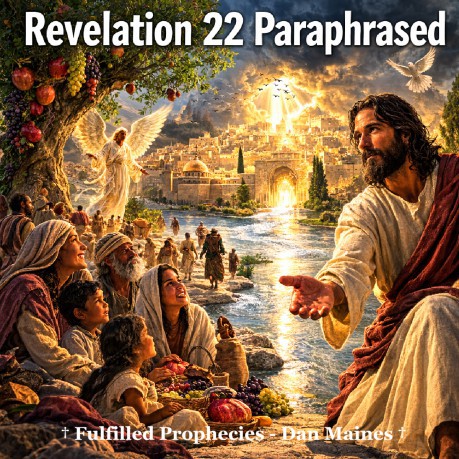
Revelation 22 Paraphrased Introduction † Revelation closes the story that began in
Genesis. The curse, the separation, and the loss of access to the
tree of life are all brought to completion in Christ's victory and
the end of the Old Covenant world. Revelation 22:1 Then he showed me a river filled with the water of life, bright
and pure like crystal, flowing out from the throne of God and from
the Lamb. † The river of life reflects the prophetic
vision of living waters flowing from God's presence, symbolizing the
life that flows from Christ to His people (Ezekiel 47:1; John
7:38). Revelation 22:2 In the center of the city's main street and on both sides of the
river was the tree of life, producing twelve crops of fruit and
giving fruit every month, and the leaves of the tree were for the
healing of the nations. † The return of the tree of life shows the
restoration of what was lost in Eden, access to life with God has
been reopened through Christ (Genesis 3:22-24). Revelation 22:3 Nothing under the curse will remain any longer. The throne of God
and of the Lamb will be in the city, and His servants will worship
Him. † The curse introduced in Genesis is removed
through Christ's redemption, which brought freedom from the law's
condemnation (Galatians 3:13). Revelation 22:4 They will see His face, and His name will be written on their
foreheads. † Seeing God's face represents restored
fellowship that humanity lost in Eden (Genesis 3:8). Revelation 22:5 Night will no longer exist. They won't need the light of a lamp or
the light of the sun, because the Lord God will give them light, and
they will reign forever. † The removal of night symbolizes the end of
spiritual darkness that once covered the world before Christ (Isaiah
60:19). Revelation 22:6 Then he said to me, these words are trustworthy and true. The
Lord, the God who speaks through the prophets, sent His angel to show
His servants what must happen soon. † The phrase must happen soon confirms the
events described in Revelation were near to the original audience
(Revelation 1:1). Revelation 22:7 Look, I am coming quickly. Blessed is the one who keeps the words
written in this prophecy. † Christ's coming quickly refers to His
judgment coming against Jerusalem and the Old Covenant system
(Matthew 24:30-34). Revelation 22:8 I, John, am the one who heard and saw these things. When I heard
and saw them, I fell down to worship at the feet of the angel who
showed them to me. † John's reaction reflects the overwhelming
nature of the revelation he witnessed. Revelation 22:9 But he said to me, don't do that. I am a fellow servant with you
and with your brothers the prophets and with those who keep the words
of this book. Worship God. † The angel refuses worship, confirming that
only God is worthy of worship (Matthew 4:10). Revelation 22:10 Then he told me, do not seal the words of this prophecy, because
the time is near. † Unlike Daniel's prophecy that was sealed for
the distant future, Revelation was to remain open because fulfillment
was near (Daniel 12:4). Revelation 22:11 Let the one who does wrong continue in wrongdoing, and the one who
is filthy remain filthy. Let the one who is righteous continue in
righteousness, and the one who is holy remain holy. † This reflects the approaching judgment where
people's choices would soon reach their consequences (Daniel
12:10). Revelation 22:12 Look, I am coming quickly, and My reward is with Me to give to
each person according to what he has done. † This refers to Christ coming in judgment
within that generation (Matthew 16:27-28). Revelation 22:13 I am the Alpha and the Omega, the first and the last, the
beginning and the end. † Christ declares His eternal authority over
all creation and history (Isaiah 44:6). Revelation 22:14 Blessed are those who wash their robes so they may have the right
to the tree of life and may enter the city through the gates. † Washing robes represents purification through
Christ's sacrifice (Revelation 7:14). Revelation 22:15 Outside are the dogs, the sorcerers, the immoral, the murderers,
the idolaters, and everyone who loves and practices falsehood. † This shows the separation between those in
the kingdom and those who reject God. Revelation 22:16 I, Jesus, sent My angel to testify to you about these things for
the churches. I am the root and descendant of David, the bright
morning star. † Christ identifies Himself as both the
promised king and the fulfillment of Davidic prophecy (Isaiah
11:1). Revelation 22:17 The Spirit and the bride say come. Let the one who hears say come.
Let the one who is thirsty come, let the one who desires take the
water of life freely. † The bride represents the covenant people of
God inviting others into the kingdom (Revelation 21:2). Revelation 22:18 I warn everyone who hears the words of this prophecy, if anyone
adds to them God will add to him the plagues written in this book. † This is a solemn warning not to distort the
message of the prophecy. Revelation 22:19 If anyone takes away from the words of this prophecy God will take
away his share in the tree of life and in the holy city described in
this book. † Altering the message brings covenant
consequences. Revelation 22:20 He who testifies to these things says yes, I am coming quickly.
Amen. Come, Lord Jesus. † The repeated statement coming quickly again
anchors fulfillment in the first century timeframe. Revelation 22:21 The grace of the Lord Jesus be with all. † Revelation ends with grace, reminding
believers that salvation and life come through Christ alone
(Ephesians 2:8). Historical References † Eusebius records the destruction of Jerusalem
as the fulfillment of Christ's warnings about that generation. How It Applies To Us Today † We now live in the kingdom that Christ
established after the judgment of the Old Covenant world. Q & A Appendix Q: If the New Jerusalem has already come, what
does it represent? Q: What is the tree of life in this chapter? Q: Why does Revelation say Jesus was coming
quickly? Q: What is the river of life in Revelation 22? Q: What does it mean that there will be no more
curse? Q: What does it mean that God's servants will see
His face? Q: Why does Revelation keep saying Jesus was
coming quickly? Q: What does the tree of life represent in the
New Jerusalem? † This is the fulfilled perspective we proclaim at
Fulfilled Prophecies † Source Index † Genesis 2:9; Genesis 3:22-24; Isaiah 2:2-3;
Isaiah 44:6; Isaiah 60:19; Ezekiel 47:1-12; Daniel 12:4,10; Matthew
4:10; Matthew 16:27-28; Matthew 24:30-34; John 4:14; John 7:37-38;
John 8:12; John 10:10; Luke 24:44; 2 Peter 1:19; Galatians 3:13;
Ephesians 2:8; Ephesians 2:19-22; Hebrews 1:14; Hebrews 12:28; 2
Timothy 2:19; Revelation 1:1,3; Revelation 3:21; Revelation 7:3,14;
Revelation 21:2. † Josephus, Wars of the Jews Book 6; Eusebius,
Ecclesiastical History Book 3; Tacitus, Histories 5.13.
By Dan Maines
† The
final chapter shows the restored garden imagery, the river of life,
the tree of life, and the complete removal of the curse, which points
to the covenantal restoration that came through Christ and the
judgment of Jerusalem in AD 70 (Genesis 2:9; Ezekiel 47:1-12).
†
This chapter isn't describing a distant future world, it's showing
the completed kingdom that believers now live in through Christ,
where access to life has been restored and the old order has passed
away (Hebrews 12:28).
† The throne of God and the Lamb
together shows the shared authority of the Father and the Son over
the restored kingdom (Revelation 3:21).
† The
life described here is the spiritual life believers now receive
through Christ, not a physical river but the continual source of
eternal life in the kingdom (John 4:14).
†
The twelve fruits reflect covenant completeness and continual
provision for God's people (Galatians 5:22-23).
†
The healing of the nations shows the expansion of the covenant beyond
Israel to all nations through the gospel (Isaiah 2:2-3).
† The throne
in the city shows God's direct presence among His people in the new
covenant kingdom (Ephesians 2:19-22).
†
Worship here reflects continual fellowship with God rather than
temple rituals that ended with the destruction of Jerusalem (John
4:21-23).
†
The name on their foreheads identifies believers as belonging to God
and contrasts the mark of the beast earlier in Revelation (Revelation
7:3).
† This imagery shows covenant identity
and protection for those who belong to Christ (2 Timothy 2:19).
† God's presence as light shows the
complete guidance and life found in Him (John 8:12).
†
Believers reigning reflects the kingdom authority given to Christ's
people (Revelation 1:6).
† God speaking through the
prophets ties Revelation to the fulfillment of Old Testament prophecy
(Luke 24:44).
† This reinforces the fulfilled
perspective that these events occurred within that generation.
† The blessing is for
those who remained faithful during the approaching crisis (Revelation
1:3).
† The warning was urgent for the first
century believers facing persecution and upheaval.
† The
response also shows how powerful the vision of God's plan and
judgment was.
† Yet worship belongs only to
God, which the angel immediately clarifies.
†
Angels are servants alongside believers, not objects of worship
(Hebrews 1:14).
† This reinforces the
authority and centrality of God alone in the kingdom.
† This statement
directly contradicts the idea that Revelation refers to events
thousands of years later.
† The urgency again
confirms the first century context.
† It shows the final separation
between the faithful and the rebellious.
†
The coming judgment would expose the true condition of every person.
†
The reward reflects both judgment and vindication.
†
Faithful believers would receive life while the persecutors would
face judgment.
†
This affirms His sovereignty over the fulfillment of prophecy.
†
Everything begins and ends under His authority.
†
Access to the tree of life shows restored fellowship with God.
†
The city represents the covenant community of believers.
† The
language reflects covenant exclusion rather than physical
geography.
† It parallels the warnings given
throughout the New Testament about remaining faithful.
† The morning star symbolizes the dawn
of the new covenant age (2 Peter 1:19).
† The
message was specifically for the first century churches.
†
The invitation shows the gospel continuing to call people into life
through Christ.
† This reflects the open
invitation given throughout the New Testament (John 7:37).
† The same type of
warning appears in the law regarding God's word (Deuteronomy 4:2).
†
The message was to be preserved exactly as given.
† Faithfulness to God's word is
essential to remaining in the covenant community.
†
This reinforces the seriousness of Revelation's message.
†
Early believers prayed for Christ's vindication and deliverance from
persecution.
† The coming refers to His
covenant judgment and kingdom victory.
† The closing blessing
reinforces the hope and assurance given to the churches.
†
The entire message of Revelation ultimately points to Christ's
victory and the believer's security in Him.
†
Josephus describes the catastrophic fall of Jerusalem in AD 70 and
the judgment that came upon the city.
†
Tacitus also records the Roman destruction of Jerusalem and the end
of the Jewish temple system.
†
Access to the tree of life is available through Christ right now, not
in a distant future.
† Our calling today is
to live as citizens of the New Jerusalem, walking in the life Christ
has given us.
A: It represents the
covenant people of God, the church, the dwelling place of God with
His people (Revelation 21:2; Ephesians 2:19-22).
A:
It represents the eternal life restored through Christ after the
curse was removed (Revelation 22:2; John 10:10).
A: Because the judgment described in
the book was about to occur in that generation (Matthew 24:34;
Revelation 1:1).
A:
It represents the life that flows from God through Christ to His
people. Jesus spoke of this life as living water given through Him
(John 4:14; John 7:38).
A: The curse introduced after Adam's
fall was removed through Christ's redemption. He became a curse for
us so that believers could receive life and freedom from the law's
condemnation (Genesis 3:17; Galatians 3:13).
A: It describes restored fellowship
with God that was lost in Eden. Through Christ believers now have
direct access to God and stand in His presence (Hebrews 10:19-22; 2
Corinthians 3:18).
A: The book was written about
events that were about to happen to that generation, specifically the
judgment on Jerusalem and the end of the Old Covenant system (Matthew
24:34; Revelation 1:1).
A: It represents restored access
to eternal life through Christ. What was lost in Eden is restored in
the kingdom through Him (Genesis 3:22-24; Revelation 22:2).
© Fulfilled Prophecies - Dan
Maines.
Links