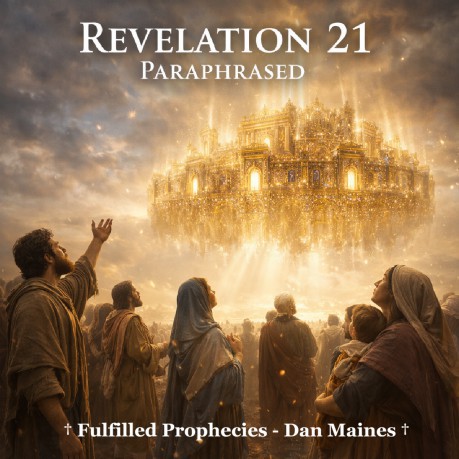
Revelation 21 Paraphrased Introduction † Revelation 21 shows the revealed reality of
the new covenant world after the judgment of the old covenant system.
The prophets used the language of heaven and earth passing away to
describe the collapse of a covenant order and the establishment of
another (Isaiah 65:17). † Jesus warned that the old covenant world
centered in Jerusalem would end within the generation of His
listeners, which happened with the destruction of the temple in AD 70
(Matthew 24:34). † John now sees the fulfilled covenant
community, the New Jerusalem, the bride of Christ, where God
permanently dwells with His people (Hebrews 12:22-24). Revelation 21:1 † The passing of heaven and earth refers to the
end of the covenant world governed by the law of Moses, the same
world Jesus said would pass before His words failed (Matthew 24:35). † The sea often symbolized the restless nations
and chaos in prophetic language. Its removal shows the covenant
turmoil had ended (Isaiah 57:20). † Peter spoke of this covenant transition when
he described the passing away of the old order and the arrival of the
new covenant world where righteousness dwells (2 Peter 3:10-13). Revelation 21:2 † The New Jerusalem represents the covenant
people of God. Paul explained that believers belong to the heavenly
Jerusalem (Galatians 4:26). † The bride imagery identifies the city as the
church united with Christ (Ephesians 5:25-27). † The city descending from heaven shows its
origin comes from God, not human institutions (James 1:17). Revelation 21:3 † This fulfills the covenant promise that God
would dwell among His people (Leviticus 26:11-12). † Under the new covenant God no longer dwells
in temples made with hands but within His people (1 Corinthians
3:16). † Jesus had already said worship would no
longer be tied to a physical temple location (John 4:21-24). Revelation 21:4 † The former things refer to the old covenant
age that was filled with persecution and separation (Hebrews 8:13). † Christ destroyed the power of death and
brought life through the gospel (2 Timothy 1:10). † Isaiah had already prophesied that God would
remove sorrow and swallow up death (Isaiah 25:8). Revelation 21:5 † The renewal here refers to covenant
transformation through Christ (2 Corinthians 5:17). † God promised long before that He would bring
about a new covenant order (Isaiah 43:19). † The promise confirms the certainty of God's
redemptive plan (Hebrews 9:15). Revelation 21:6 † This echoes the completion of Christ's
redemptive work (John 19:30). † The water of life represents eternal life
offered through Christ (John 7:37-38). † The prophets invited the thirsty to receive
life from God (Isaiah 55:1). Revelation 21:7 † Overcoming refers to believers remaining
faithful during persecution (Revelation 2:10). † The promise repeats covenant language used
throughout scripture (2 Corinthians 6:18). † Believers become heirs with Christ (Romans
8:17). Revelation 21:8 † The lake of fire represents final covenant
judgment against those who rejected Christ (Matthew 23:36). † The second death represents exclusion from
covenant life (Revelation 20:14). † Paul described the judgment that came upon
those who opposed the gospel in that generation (1 Thessalonians
2:14-16). Revelation 21:9 † The bride contrasts with Babylon the harlot
which had just been judged (Revelation 17:5). † The bride is the redeemed covenant people
joined to Christ (2 Corinthians 11:2). † This imagery shows the completed union
between Christ and His people (Revelation 19:7). Revelation 21:10 † The city descending from heaven shows divine
origin (James 1:17). † The prophets described restored Zion elevated
above the nations (Isaiah 2:2-3). † Paul described the church as God's building
(Ephesians 2:20-22). Revelation 21:11 † The glory represents God's presence (Exodus
40:34). † Believers reflect that glory as God's temple
(2 Corinthians 3:18). † The imagery emphasizes purity within the
covenant community (Isaiah 60:1). Revelation 21:12 † The twelve tribes show continuity with Israel
(Romans 9:6-8). † The gates represent entry into the covenant
kingdom (Psalm 118:19-20). † God's promises to Israel reach fulfillment
through Christ (Luke 22:30). Revelation 21:13 † Gates in every direction symbolize worldwide
access to God's kingdom (Isaiah 49:6). † Jesus said people would come from every
direction into the kingdom (Matthew 8:11). † The gospel opened the covenant blessings to
all nations (Acts 13:47). Revelation 21:14 † The apostles formed the doctrinal foundation
of the church (Ephesians 2:20). † Their teaching established the new covenant
community (Acts 2:42). † Christ Himself is the cornerstone (1
Corinthians 3:11). Revelation 21:15 † Measuring in prophetic visions symbolizes
divine ownership and protection (Zechariah 2:1-5). † The measurement shows God's covenant
community is perfectly established (Revelation 11:1). † God Himself defines and preserves His people
(Ezekiel 40:3). Revelation 21:16 † The cube shape mirrors the Most Holy Place in
the temple where God's presence dwelled (1 Kings 6:20). † This imagery shows the entire covenant
community now functions as God's holy dwelling place (Ephesians
2:21). † The number twelve thousand reflects
completeness and covenant fulfillment (Revelation 7:4). Revelation 21:17 † The number 144 reflects covenant fullness
connected to the twelve tribes and twelve apostles (Revelation 7:4). † The symbolism emphasizes completeness rather
than literal architecture (Ezekiel 48:35). † The wall shows the security of God's people
(Isaiah 26:1). Revelation 21:18 † The imagery emphasizes purity and holiness
within God's covenant community (Isaiah 60:18). † Gold often symbolized divine glory and
righteousness (Exodus 25:11). † The transparency shows the absence of
corruption in the new covenant order (Psalm 24:3-4). Revelation 21:19 † Precious stones were used in the high
priest's garments representing the tribes of Israel (Exodus
28:17-21). † This imagery shows the fulfillment of
Israel's priestly calling through Christ (1 Peter 2:9). † The beauty reflects the glory of God's
redeemed people (Isaiah 54:11-12). Revelation 21:20 † The list mirrors the priestly breastplate
stones symbolizing God's covenant people (Exodus 28:17-20). † It reflects the completeness and diversity of
the redeemed community (Revelation 5:9). † The imagery highlights the value God places
on His people (Malachi 3:17). Revelation 21:21 † The pearl imagery reflects the great value of
the kingdom of God (Matthew 13:45-46). † The open gates show unrestricted access into
God's covenant kingdom (Isaiah 60:11). † The golden street symbolizes purity and
righteousness in God's presence (Psalm 84:10). Revelation 21:22 I saw no temple in the city, because the Lord God the Almighty and
the Lamb are its temple. † The absence of a temple shows the end of the
old covenant temple system (John 2:19-21). † God's presence now fills the entire covenant
community (Ephesians 2:21-22). † The temple system had served its purpose and
was replaced by direct access to God through Christ (Hebrews
10:19-22). Historical References † Josephus recorded the destruction of
Jerusalem and the temple in AD 70 which ended the sacrificial system. † Eusebius wrote that the fall of Jerusalem
fulfilled the warnings of Jesus about that generation. † Irenaeus described the church as the
spiritual city of God established through Christ. How It Applies To Us Today † We live in the reality of the new covenant
kingdom where God dwells with His people. † Our identity is found in the New Jerusalem,
the covenant community of believers. † Because the old covenant system has passed
away, we now live under the finished work of Christ. Q & A Appendix Q: What does the new heaven and new earth
represent? Q: What is the New Jerusalem? Q: When did this covenant transition complete? Q: Why is there no temple in the New
Jerusalem? Q: Why are the gates always open in the New
Jerusalem? Q: Why are the names of the twelve tribes and
twelve apostles on the city? Q: What does the city being shaped like a cube
mean? † This is the fulfilled perspective we proclaim at
Fulfilled Prophecies † Source Index † Isaiah 2:2-3; Isaiah 25:8; Isaiah 26:1;
Isaiah 43:19; Isaiah 49:6; Isaiah 54:11-12; Isaiah 57:20; Isaiah
60:1, 11; Isaiah 65:17; Matthew 8:11; Matthew 13:45-46; Matthew
23:36; Matthew 24:34-35; John 2:19-21; John 4:21-24; John 7:37-38;
John 19:30; Romans 8:17; Romans 9:6-8; 1 Corinthians 3:11, 16; 2
Corinthians 3:18; 2 Corinthians 5:17; 2 Corinthians 6:18; Galatians
4:26; Hebrews 8:13; Hebrews 9:15; Hebrews 10:19-22; Hebrews 12:22-24;
Acts 2:42; Acts 13:47; Ephesians 2:20-22; Ephesians 5:25-27; 1 Peter
2:9 † Josephus, Wars of the Jews; Eusebius,
Ecclesiastical History; Irenaeus, Against Heresies
By Dan Maines
I saw a new heaven and a new
earth, because the first heaven and the first earth had passed away,
and the sea was no longer there.
Then I saw the holy city,
New Jerusalem, coming down out of heaven from God, prepared like a
bride beautifully ready for her husband.
Then I heard a loud voice
from the throne saying, Look, God's dwelling place is now among
people, and He will live with them. They will be His people, and God
Himself will be with them.
He will wipe away every tear
from their eyes, and death, mourning, crying, and pain will no longer
rule, because the former things have passed away.
The One seated on the throne
said, Look, I am making all things new. Then He said, Write this
down, because these words are trustworthy and true.
Then He said to me, It is
done. I am the Alpha and the Omega, the beginning and the end. I will
freely give water from the spring of life to the one who is thirsty.
The one who overcomes will
inherit these things, and I will be his God and he will be My son.
But the cowardly, the
unbelieving, the corrupt, the murderers, the sexually immoral, those
who practice sorcery, idol worshipers, and all liars will face the
burning lake of fire. This is the second death.
One of the seven angels who
had the bowls full of the seven final plagues came and said to me,
Come, I'll show you the bride, the wife of the Lamb.
He carried me away in the
Spirit to a great high mountain and showed me the holy city,
Jerusalem, coming down out of heaven from God.
It shone with the glory of
God, its brilliance like a very precious jewel, like a crystal clear
jasper stone.
It had a great and high
wall with twelve gates, and at the gates were twelve angels, and the
names of the twelve tribes of Israel were written on them.
There were three gates on
the east, three on the north, three on the south, and three on the
west.
The wall of the city had
twelve foundations, and on them were the names of the twelve apostles
of the Lamb.
The one who spoke with me
had a gold measuring rod to measure the city, its gates, and its
wall.
The city was laid out like
a square, its length the same as its width. He measured the city with
the rod and found it twelve thousand stadia long, wide, and high.
He measured its wall, and
it was one hundred forty four cubits by human measurement, which the
angel was using.
The wall was made of
jasper, and the city was pure gold, clear like glass.
The foundations of the city
wall were decorated with every kind of precious stone.
The stones included jasper,
sapphire, agate, emerald, onyx, carnelian, chrysolite, beryl, topaz,
chrysoprase, jacinth, and amethyst.
The twelve gates were
twelve pearls, each gate made from a single pearl, and the street of
the city was pure gold, transparent like glass.
A: It represents the new covenant
order established after the old covenant world passed away (2 Peter
3:13).
A:
The New Jerusalem represents the people of God, the bride of Christ
(Hebrews 12:22-23).
A:
It completed with the destruction of Jerusalem and the temple in AD
70 (Matthew 24:34).
A: Because God's presence now dwells
directly with His people through Christ, making the entire covenant
community His temple (John 2:19-21; Ephesians 2:21-22; Hebrews
10:19-22).
A: The open gates show that access
to God's kingdom is now freely available through Christ and no longer
restricted by the old covenant system (Isaiah 60:11; Matthew 11:28;
Hebrews 4:16).
A: This shows the
unity of God's covenant plan, the promises given to Israel reached
fulfillment through Christ and were built upon the teaching of the
apostles (Ephesians 2:19-20; Romans 11:17-18).
A: The cube reflects the shape of the
Most Holy Place in the temple, showing that God's entire covenant
community now functions as His holy dwelling place (1 Kings 6:20;
Ephesians 2:21; 1 Peter 2:5).
© Fulfilled Prophecies - Dan
Maines.
Links