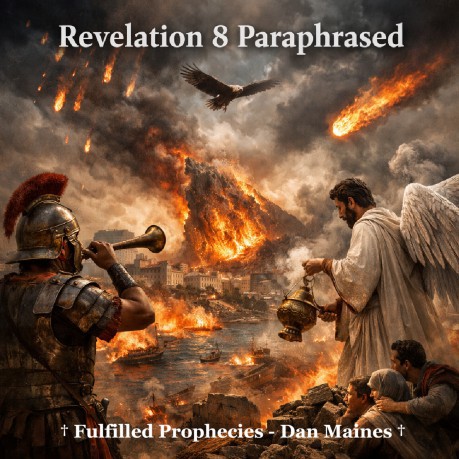
Revelation 8 Paraphrased Introduction † The opening of the seventh seal begins the
final phase of judgment that Jesus warned about during His earthly
ministry. These events point directly to the collapse of the old
covenant system and the destruction of Jerusalem in AD 70. Revelation 8:1 † The silence represents a pause before
judgment, the same pattern seen in the prophets where heaven stands
silent before the Lord acts (Habakkuk 2:20). Revelation 8:2 † Trumpets in Scripture were used to warn of
war or approaching danger, so these trumpet blasts represent warnings
and judgments falling on Israel (Joel 2:1). Revelation 8:3 † The prayers rising like incense show that
God's judgment is connected to the cries of His faithful people who
suffered persecution (Psalm 141:2). Revelation 8:4 † The rising incense symbolizes the acceptance
of those prayers before God, confirming that He heard the cries of
the saints (Psalm 141:2). Revelation 8:5 † Throwing fire to the earth symbolizes
judgment being released against the land of Israel (Ezekiel 10:2). Revelation 8:6 † This moment signals the beginning of the
trumpet judgments that unfold against the land and people who
rejected their Messiah (Matthew 21:43). Revelation 8:7 † The imagery echoes the plagues of Egypt,
showing that Israel had become like Egypt in its rebellion against
God (Exodus 9:23-24). Revelation 8:8 † In prophetic language a mountain often
represents a kingdom or ruling power, suggesting the collapse of the
Jewish leadership (Jeremiah 51:25). Revelation 8:9 † This reflects the economic and social
collapse that followed the Roman assault on Judea. Revelation 8:10 † In prophetic symbolism a falling star often
represents the fall of a ruler or authority figure (Isaiah 14:12). Revelation 8:11 † Wormwood in Scripture symbolizes bitterness
and judgment brought upon a rebellious nation (Jeremiah 23:15). Revelation 8:12 † Darkening of the sun, moon, and stars is
prophetic language describing the collapse of a nation's leadership
and order (Isaiah 13:10). Revelation 8:13 † The three warnings emphasize that even
greater judgment was still coming upon the land. Historical References † Josephus described famine, fire, and
widespread death during the Roman siege of Jerusalem. How It Applies To Us Today † These events confirm that Jesus' prophecies
were fulfilled exactly as He said they would be. Q & A Appendix Q Did the trumpet judgments describe the end of
the world? Q Why does Revelation use symbolic imagery like
stars and darkened skies? Q Were these judgments connected to the
persecution of early Christians? Q Why was there silence in heaven before the
trumpet judgments began? Q Why are the judgments described as affecting a
third of things? Q What does the eagle flying in midheaven
represent? Q Why does Revelation use Old Testament plague
imagery? † This is the fulfilled perspective we proclaim at
Fulfilled Prophecies † Source Index † Revelation 8; Matthew 24:29, 34; Luke
19:41-44; Joel 2:1; Habakkuk 2:20; Jeremiah 23:15; Deuteronomy 28:49 † Josephus, Wars of the Jews; Eusebius,
Ecclesiastical History; Tacitus, Histories.
By Dan Maines
†
The silence in heaven reflects the solemn moment before God's
judgment falls upon the nation that rejected His Son, just as the
prophets often described silence before divine judgment (Habakkuk
2:20; Zephaniah 1:7).
† The trumpets that
follow echo the warning judgments God sent through the prophets and
mirror the trumpet warnings given before Israel's battles and
national crises (Joel 2:1; Numbers 10:9).
When the Lamb broke the
seventh seal, heaven became silent for about half an hour.
†
This moment signals the transition from warning to execution of
judgment upon Jerusalem and the temple system that had rejected
Christ (Matthew 23:38).
† The Lamb opening
the seal shows that Christ Himself is directing the judgment that was
promised against that generation (Matthew 24:34).
Then I saw the seven angels
who stand before God, and seven trumpets were given to them.
†
The imagery echoes the trumpet warnings that called Israel to
repentance, but by this point the nation had largely hardened its
heart (Jeremiah 6:17).
† Jesus Himself warned
that trumpet-like alarms of war and upheaval would precede
Jerusalem's destruction (Matthew 24:6-7).
Another angel came and stood
at the altar holding a golden incense burner, and he was given a
large amount of incense so that he could add it to the prayers of all
God's people on the golden altar before the throne.
† Earlier
in Revelation the martyrs cried out for justice, and this scene shows
that their prayers are now being answered (Revelation 6:9-10).
†
God never ignored the suffering of the early believers who were
persecuted by the unbelieving leadership in Jerusalem (Acts 7:52).
The smoke from the incense,
together with the prayers of God's people, rose up before God from
the angel's hand.
† This moment shows
that divine judgment is not random, it comes as a response to
injustice and persecution (Luke 18:7).
† The
early church suffered heavily under Jewish opposition, and this
judgment answered those prayers for justice (1 Thessalonians
2:14-16).
Then the angel took the
incense burner, filled it with fire from the altar, and threw it to
the earth, and there were thunder, loud sounds, lightning, and an
earthquake.
†
The thunder and earthquake imagery is common in prophetic
descriptions of national collapse and divine judgment (Isaiah
29:6).
† Jesus warned that these kinds of
disturbances would accompany the destruction of Jerusalem (Matthew
24:29).
Then the seven angels who had
the seven trumpets prepared themselves to sound them.
†
Each trumpet represents escalating calamities similar to the warnings
given through the prophets (Amos 3:6).
†
These judgments are covenantal consequences for rejecting the
covenant fulfilled in Christ (Luke 19:41-44).
The first angel sounded his
trumpet, and hail and fire mixed with blood were thrown to the earth,
and a third of the earth was burned up, a third of the trees were
burned up, and all the green grass was burned up.
† The phrase a third
indicates a significant but limited judgment falling on the land of
Israel (Ezekiel 5:12).
† Josephus recorded
devastating fires and destruction during the Roman siege that
consumed large parts of the land.
The second angel sounded his
trumpet, and something like a great mountain burning with fire was
thrown into the sea, and a third of the sea became blood.
† The sea
turning to blood symbolizes massive death and turmoil connected with
war and judgment (Isaiah 19:5).
† During the
Jewish war thousands were killed and their bodies filled the waters
around the region.
A third of the creatures in
the sea died, and a third of the ships were destroyed.
†
Trade and transportation in the region were devastated by the
conflict and destruction.
† The imagery
mirrors Old Testament judgments where God disrupted national
stability through war (Ezekiel 27:34).
The third angel sounded his
trumpet, and a great star burning like a torch fell from heaven, and
it fell on a third of the rivers and on the springs of water.
†
The poisoned waters symbolize the spread of suffering and death
through the land during the war (Jeremiah 9:15).
†
Historical records describe widespread devastation throughout Judea
during this period.
The name of the star is
called Wormwood, and a third of the waters became bitter, and many
people died from the waters because they had been made bitter.
†
The bitter waters reflect the suffering and chaos that overwhelmed
the population during the Roman campaign.
†
The prophets repeatedly warned Israel that rejecting God would bring
bitter consequences (Deuteronomy 29:18).
The fourth angel sounded his
trumpet, and a third of the sun, a third of the moon, and a third of
the stars were struck so that a third of them became dark, and the
day lost a third of its light, and the night the same way.
† Jesus used the
same imagery when predicting the fall of Jerusalem (Matthew 24:29).
†
This symbolizes the complete breakdown of Israel's political and
religious structure.
Then I looked and heard an
eagle flying in midheaven, calling out with a loud voice, Woe, woe,
woe to those who live on the earth, because of the remaining trumpet
blasts of the three angels who are about to sound.
†
Eagles were closely associated with Roman military power, which adds
historical weight to the imagery (Deuteronomy 28:49).
†
The message warns that the worst devastation of the war was still
ahead.
†
Eusebius recorded that believers fled Jerusalem before the
destruction, recognizing the warnings Jesus had given.
†
Tacitus also recorded the catastrophic war and destruction that
overtook Judea during this period.
†
They remind us that God's warnings should always be taken
seriously.
† They also show that God hears
the prayers of His people and will bring justice in His time.
A No. Jesus placed these events
within that generation (Matthew 24:34), and the language used matches
Old Testament prophetic descriptions of national judgment.
A The prophets used
the same language to describe the fall of nations and ruling powers
(Isaiah 13:10; Ezekiel 32:7).
A Yes. The
prayers of the saints asking for justice were answered through the
judgment that fell upon the system that persecuted them (Revelation
6:9-10).
A The silence reflects
the solemn pause before God releases judgment. The prophets often
described the same moment of silence before the Lord acts in judgment
(Habakkuk 2:20; Zephaniah 1:7). It signals that what follows is
deliberate justice, not chaos.
A The repeated phrase a third
shows that the judgments were severe but limited. The prophets used
the same language when describing partial judgment against Israel
(Ezekiel 5:12). God was striking the land in stages before the final
destruction of Jerusalem.
A The eagle fits the Roman symbol
that represented their military power. Jesus warned that judgment
would come like an eagle descending on the land (Deuteronomy 28:49;
Luke 17:37). The image points directly to the Roman armies that
brought destruction to Jerusalem in AD 70.
A The trumpet judgments echo the
plagues of Egypt to show that Israel had become like Egypt in its
rebellion against God (Exodus 7-12). The same God who judged Egypt
was now judging the covenant nation that rejected the Messiah
(Matthew 21:43).
© Fulfilled Prophecies - Dan
Maines.
Links