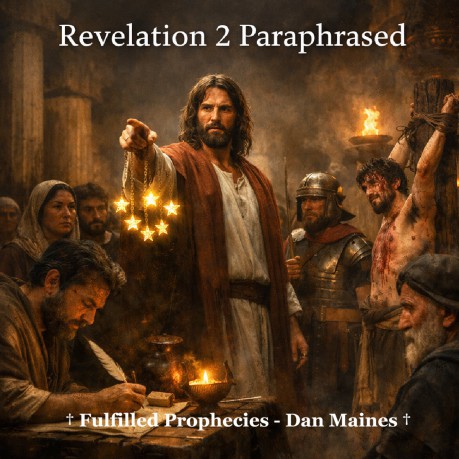
Revelation 2 Paraphrased Introduction † Revelation 2 continues the message Christ gave to the seven
churches in Asia. These churches were real congregations living in
the first century under pressure from persecution, false teachers,
and the coming judgment that would soon fall on Jerusalem and the old
covenant system. † The warnings and encouragements in this chapter were not
written to people thousands of years later. They were directed to
believers who were alive at that time and were about to face events
that Jesus had already predicted in Matthew 24. † These letters show Christ walking among His churches,
correcting, warning, and strengthening them before the great covenant
transition reached its climax. Revelation 2:1 † Christ presents Himself as the One who has authority over the
churches and their leaders. The stars represent the messengers of the
churches and the lampstands represent the congregations themselves
(Revelation 1:20). † The image of Christ walking among the lampstands shows His
active presence with His people. He wasn't distant, He was examining
their faithfulness (Matthew 18:20). † This reminds believers that Christ sees what happens inside
His church and judges it with complete authority (1 Peter 4:17). Revelation 2:2 † The Ephesian church was strong in doctrinal testing. They
examined those claiming spiritual authority and refused to accept
false apostles (1 John 4:1). † This reflects the early church struggle against false teachers
who were already spreading corruption within the congregations (Acts
20:29-30). † Christ commends them because guarding truth is essential for
preserving the faith that was delivered to the saints (Jude 3). Revelation 2:3 † The believers in Ephesus faced persecution and opposition, yet
they continued faithfully. † Endurance was a constant theme in the early church because the
generation of believers was approaching the crisis Jesus warned about
(Matthew 24:9-13). † Their perseverance demonstrated loyalty to Christ during a
time of growing hostility toward Christians (Hebrews 10:32-36). Revelation 2:4 † While they defended truth well, their devotion had grown cold. † The first love refers to their original zeal, affection, and
devotion toward Christ and one another (Matthew 22:37-39). † This warning shows that correct doctrine alone isn't enough if
love fades within the church (1 Corinthians 13:2). Revelation 2:5 † The removal of the lampstand represents the loss of their
standing as a faithful church. † Christ's coming here refers to His judgment against a
congregation that refuses to repent (Luke 19:41-44). † This warning shows that churches are accountable to Christ and
can lose their place if they abandon faithfulness. Revelation 2:6 † The Nicolaitans were associated with corrupt teaching and
immoral compromise within the church. † Early writers described them as promoting moral compromise and
participation in pagan practices. † Christ praises the Ephesian church for rejecting those corrupt
influences. Revelation 2:7 † The call to listen emphasizes that these warnings were for all
the churches. † The tree of life represents restored access to life with God,
something lost in Eden but restored through Christ (Genesis 2:9;
Revelation 22:2). † Overcoming refers to remaining faithful during the trials of
that generation (1 John 5:4). Revelation 2:8 † Christ reminds Smyrna that He has authority over life and
death. † His resurrection gave assurance to believers facing
persecution and martyrdom. † The title First and Last emphasizes His eternal authority
(Isaiah 44:6). Revelation 2:9 † The church in Smyrna was poor materially but rich spiritually. † The reference to those claiming to be Jews reflects opposition
from those who rejected Christ while claiming covenant authority
(Romans 2:28-29). † This language shows the conflict between early Christians and
hostile synagogue communities. Revelation 2:10 † The imprisonment refers to persecution from Roman authorities
influenced by hostile accusers. † The crown of life symbolizes victory and reward for faithful
endurance (James 1:12). † The short time frame shows that their suffering would be
intense but limited. Revelation 2:11 † The second death refers to final separation from life with God
(Revelation 20:14). † Faithful believers who endure persecution are promised eternal
life. † This assurance strengthened Christians facing real threats of
execution. Revelation 2:12 † The sword represents the authority of Christ's word which
judges truth and error (Hebrews 4:12). † Pergamum was a center of imperial worship, making Christian
faith especially dangerous. † Christ's authority stands above the power of earthly rulers. Revelation 2:13 † Pergamum was heavily connected with emperor worship and pagan
temples. † The phrase Satan's throne refers to the stronghold of pagan
power and imperial cults. † Antipas appears to have been a Christian martyr who remained
faithful. Revelation 2:14 † Balaam's story in Numbers 22-25 involved leading Israel into
compromise with pagan practices. † The same pattern was appearing in Pergamum where some
believers were tolerating immoral compromise. † This warning shows how spiritual corruption can spread inside
a church. Revelation 2:15 † The Nicolaitans promoted compromise with pagan society. † Christ condemns teachings that encourage believers to blend
faith with idolatrous culture. † The early church constantly battled these corrupt influences. Revelation 2:16 † Christ warns of swift judgment against those spreading
corruption. † The sword of His mouth represents the power of His word to
judge and expose sin. † This emphasizes that Christ defends the purity of His church. Revelation 2:17 † Hidden manna represents spiritual nourishment from Christ. † The white stone likely symbolizes acceptance or victory. † The new name reflects the new identity given to those who
belong to Christ. Revelation 2:18 † Christ appears as the divine judge who sees everything
clearly. † The imagery emphasizes His authority and purity. † Nothing inside the church escapes His attention. Revelation 2:19 † Unlike Ephesus, this church was growing in love and service. † Their spiritual progress showed genuine faith. † Christ acknowledges faithful growth within the church. Revelation 2:20 † Jezebel represents a corrupt teacher leading believers into
compromise. † The name echoes the wicked queen in the Old Testament who
promoted idolatry (1 Kings 16:31). † Christ condemns the church for allowing this influence to
remain. Revelation 2:21 † God's patience is evident even toward false teachers. † However, refusal to repent leads to judgment. † The delay shows God's mercy before discipline comes. Revelation 2:22 † The judgment imagery reflects severe consequences for
persistent rebellion. † Christ warns those participating in corruption that they must
repent. † Spiritual compromise leads to destruction. Revelation 2:23 † Christ's judgment reveals His authority over every church. † The phrase searching hearts shows His perfect knowledge
(Jeremiah 17:10). † This warning reinforces accountability within the church. Revelation 2:24 † Some believers had remained faithful despite the corruption
around them. † Christ encourages them and does not impose additional demands. † Their faithfulness separated them from the corrupt teaching. Revelation 2:25 † The believers were told to remain faithful until Christ's
coming in judgment. † This coming connects to the covenant judgment that was
approaching in that generation (Matthew 16:27-28). † Their task was endurance. Revelation 2:26 † Faithful believers share in Christ's kingdom authority. † This reflects the promise that the saints would reign with
Christ (Daniel 7:27). † The authority is spiritual, not political. Revelation 2:27 † This language comes from Psalm 2 describing the Messiah's
authority. † Christ shares His rule with those who remain faithful. † It reflects victory over opposing powers. Revelation 2:28 † The morning star symbolizes Christ Himself (Revelation 22:16). † Receiving the morning star represents sharing in His glory and
kingdom. † It signifies victory and new life. Revelation 2:29 † The repeated warning emphasizes that these messages apply to
every congregation. † Listening means responding with obedience. † The Spirit was speaking directly to the first century churches
facing immediate trials. Historical References † Irenaeus wrote that early Christians faced constant pressure
from pagan culture and false teachers within the churches. † Tertullian described how believers were often persecuted and
imprisoned for refusing emperor worship. † Eusebius recorded numerous martyrdoms from the early church
showing the reality of the persecution mentioned in Revelation. How It Applies To Us Today † Christ still examines His church and expects faithfulness. † Churches must guard truth while also maintaining love and
devotion. † Believers today are reminded that compromise with sin destroys
the health of the church. † Faithfulness to Christ remains the mark of those who truly
belong to Him. Q & A Appendix Q Were the seven churches symbolic or real
congregations? Q What does overcoming mean in Revelation 2? Q What does the tree of life represent? Q What does Jesus mean when He says He will
remove a church's lampstand? Q Who were the Nicolaitans mentioned in
Revelation 2? Q What is the hidden manna promised to those who
overcome? Q Why does Jesus repeatedly say, He who has ears,
let him hear? Q What is the morning star promised to the
faithful? † This is the fulfilled perspective we proclaim at
Fulfilled Prophecies † Source Index † Revelation 1:20; Matthew 24:9-13; 1 John 4:1;
Hebrews 10:32-36; Genesis 2:9; Revelation 22:2; Daniel 7:27; Psalm
2:9 † Irenaeus, Against Heresies; Tertullian,
Apology; Eusebius, Church History.
By Dan Maines
Write this message to the
messenger of the church in Ephesus. The One who holds the seven stars
in His right hand and walks among the seven golden lampstands says
this.
I know what you've been
doing. I've seen your hard work and your endurance. I know you won't
tolerate evil people, and you tested those who claimed to be apostles
but weren't, and you exposed them as liars.
You've endured hardship for
My name and you've kept going without giving up.
But I have this against you,
you've left the love you had at the beginning.
Remember where you fell from,
turn back, and start doing the things you did at first. If you don't
change, I'll come to you and remove your lampstand from its place.
But this is in your favor,
you hate the actions of the Nicolaitans, which I also hate.
Anyone who has ears should
listen to what the Spirit is saying to the churches. To the one who
overcomes, I'll give the right to eat from the tree of life in the
paradise of God.
Write this message to the
messenger of the church in Smyrna. The One who is the First and the
Last, who died and came back to life, says this.
I know your suffering and
your poverty, but you're actually rich. I also know the slander from
those who claim to be Jews but aren't, they're a synagogue of Satan.
Don't be afraid of what
you're about to suffer. The devil is about to throw some of you into
prison so you'll be tested, and you'll have trouble for ten days. Be
faithful even to death, and I'll give you the crown of life.
Anyone who has ears should
listen to what the Spirit says to the churches. The one who overcomes
will never be harmed by the second death.
Write this message to the
messenger of the church in Pergamum. The One who has the sharp
two-edged sword says this.
I know where you live, where
Satan's throne is. Yet you hold firmly to My name and didn't deny
your faith even when Antipas, My faithful witness, was killed among
you.
But I have a few things
against you. Some there hold to the teaching of Balaam, who taught
Balak how to lead Israel into sin by eating food sacrificed to idols
and committing sexual immorality.
In the same way, some of you
hold to the teaching of the Nicolaitans.
Turn back from this. If you
don't, I'll come quickly and fight against them with the sword of My
mouth.
Anyone who has ears should
listen to what the Spirit says to the churches. To the one who
overcomes I'll give hidden manna, and I'll give a white stone with a
new name written on it that only the one receiving it knows.
Write this message to the
messenger of the church in Thyatira. The Son of God, whose eyes blaze
like fire and whose feet shine like bronze, says this.
I know your works, your
love, your faith, your service, and your endurance, and your later
works are greater than the first.
But I have this against you,
you tolerate that woman Jezebel who calls herself a prophetess and
leads My servants into sexual immorality and eating food sacrificed
to idols.
I gave her time to turn
back, but she refuses to turn away from her immorality.
So I'll throw her onto a
sickbed, and those committing adultery with her will suffer greatly
unless they turn away from her ways.
I'll strike her followers
with death, and all the churches will know that I am the One who
searches minds and hearts, and I'll repay each of you according to
what you've done.
But to the rest of you in
Thyatira who haven't followed this teaching and haven't learned what
they call the deep things of Satan, I place no other burden on you.
Just hold on to what you
have until I come.
The one who overcomes and
keeps doing My works until the end will receive authority over the
nations.
He'll rule them with a rod
of iron and shatter them like clay pots, just as I received authority
from My Father.
I'll also give him the
morning star.
Anyone who has ears should
listen to what the Spirit says to the churches.
A They were real first century
churches located in Asia Minor who were facing immediate challenges
and persecution (Revelation 1:11).
A
Overcoming refers to remaining faithful to Christ during persecution
and resisting false teaching (1 John 5:4; Revelation 12:11).
A
It represents restored access to eternal life through Christ,
reversing the loss from Eden (Genesis 2:9; Revelation 22:2).
A The lampstand
represents the church itself. If a congregation refuses to repent and
return to faithfulness, Christ can remove its standing as a true
witness. This shows that churches are accountable to Him and can lose
their place if they abandon truth and devotion (Revelation 2:5;
Revelation 1:20; 1 Peter 4:17).
A The Nicolaitans were a group
promoting compromise with pagan practices, including participation in
idol feasts and immoral behavior. Christ strongly condemned this
teaching because it corrupted the church and encouraged believers to
blend faith with idolatrous culture (Revelation 2:6, 15; 1
Corinthians 10:20-21).
A Hidden manna represents the
spiritual nourishment and life that comes from Christ Himself. Just
as manna sustained Israel in the wilderness, Christ sustains His
people with true spiritual life and fellowship (Revelation 2:17; John
6:32-35).
A This phrase calls believers to
pay attention and respond to what the Spirit is saying. Hearing in
scripture means more than listening, it means obeying and responding
in faith (Revelation 2:7; Matthew 13:9; James 1:22).
A The morning star represents Christ
Himself and the life and victory that come through union with Him.
Receiving the morning star means sharing in His kingdom and His glory
(Revelation 2:28; Revelation 22:16; 2 Peter 1:19).
© Fulfilled Prophecies - Dan
Maines.
Links