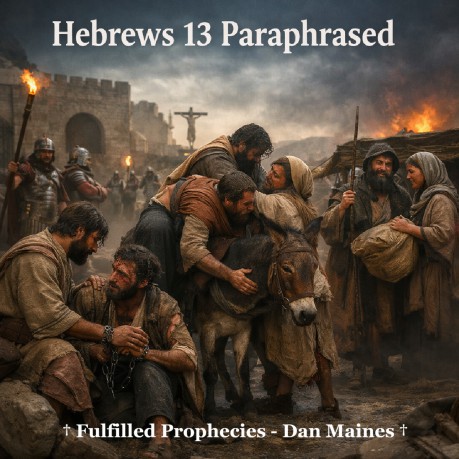
Hebrews 13 Paraphrased Introduction † The final chapter of Hebrews brings the
teaching of the letter into everyday life. After explaining how
Christ fulfilled the old covenant system, the writer now tells
believers how to live in light of that reality. Scripture Hebrews 13:1 † Brotherly love was a defining mark of
Christ's followers, something Jesus commanded directly (John
13:34-35). Hebrews 13:2 † This refers back to examples like Abraham
welcoming strangers who turned out to be messengers from God (Genesis
18:1-8). Hebrews 13:3 † Many believers were imprisoned during the
persecutions under Roman authorities (Hebrews 10:34). Hebrews 13:4 † Marriage was established by God from the
beginning and was meant to be honored among believers (Genesis
2:24). Hebrews 13:5 † The writer echoes God's promise given to
Joshua, reminding believers that God's presence is greater than
earthly security (Joshua 1:5). Hebrews 13:6 † This reflects Psalm 118:6 and shows the
believer's confidence in God's protection. Hebrews 13:7 † The early church honored faithful teachers
who had remained strong through persecution (1 Thessalonians
5:12-13). Hebrews 13:8 † This statement affirms the unchanging
character of Christ. His authority and promises don't change (Malachi
3:6). Hebrews 13:9 † Some believers were being tempted to return
to dietary laws and ceremonial regulations from the old covenant
(Colossians 2:16-17). Hebrews 13:10 † The altar here refers to Christ's sacrifice,
which replaced the temple sacrifices (Hebrews 10:10-12). Hebrews 13:11 † This refers to the Day of Atonement
sacrifices described in the Law (Leviticus 16:27). Hebrews 13:12 † Jesus was crucified outside the walls of
Jerusalem (John 19:17-18). Hebrews 13:13 † Believers were being called to leave the old
covenant system and identify fully with Christ. Hebrews 13:14 † The earthly Jerusalem was temporary and would
soon be destroyed in AD 70 (Matthew 24:1-2). Hebrews 13:15 † Praise replaces the old sacrificial system
because Christ fulfilled the sacrifice for sin (Hebrews 10:18). Hebrews 13:16 † Acts of kindness and generosity are described
as spiritual sacrifices acceptable to God (Philippians 4:18). Hebrews 13:17 † Spiritual leaders carried the responsibility
of guiding the church and protecting it from false teaching (Acts
20:28). Hebrews 13:18 † The writer asks for prayer, showing humility
and dependence on the prayers of the church (1 Thessalonians 5:25). Hebrews 13:19 † The author may have been separated from the
believers due to travel or imprisonment. Hebrews 13:20 † Jesus is called the great Shepherd,
fulfilling the promise that God himself would shepherd his people
(Ezekiel 34:23). Hebrews 13:21 † God empowers believers to live in obedience
through Christ (Philippians 2:13). Hebrews 13:22 † The writer describes Hebrews as a word of
encouragement, meaning exhortation or instruction (Acts 13:15). Hebrews 13:23 † Timothy was a close companion of Paul and
well known among the early churches (Acts 16:1-3). Hebrews 13:24 † This shows the strong connection between
churches across different regions. Hebrews 13:25 † Grace was the central message of the gospel
and the foundation of the new covenant (Ephesians 2:8). Historical References † Clement of Rome described the unity and love
practiced by early Christians. How It Applies To Us Today † We are called to live out genuine love and
care for one another just as the early believers did. Q & A Appendix Q: Why does Hebrews talk about leaving the
camp? Q: What is the altar mentioned in Hebrews
13:10? Q: What city were believers looking for in
Hebrews 13:14? Q: Why does Hebrews say Jesus suffered outside
the gate? Q: Why does Hebrews warn about strange
teachings? Q: What sacrifices please God now that Christ
fulfilled the old system? Q: Why does Hebrews emphasize remembering
faithful leaders? Q: What does it mean that Jesus Christ is the
same yesterday, today, and forever? † This is the fulfilled perspective we proclaim at
Fulfilled Prophecies † Source Index † Hebrews 13; Hebrews 8:13; Hebrews 10:10-12;
Hebrews 12:22
By Dan Maines
†
These instructions were written to believers who were living during
the final years before the destruction of Jerusalem. They were
learning to walk in the freedom of the fulfilled work of Christ
rather than returning to the temple system that was about to pass
away (Hebrews 8:13).
† The chapter reminds
them that faith isn't just belief, it shows itself in love,
hospitality, faithfulness, and trust in God rather than the fading
system of sacrifices and priests.
Keep showing real love toward
one another as brothers and sisters.
† The early church practiced this
love openly, supporting one another through persecution and hardship
(Acts 2:44-45).
† Tertullian wrote that
outsiders recognized Christians by their love for one another, saying
they would say, See how they love one another.
Don't forget to show
hospitality to strangers, because some people have welcomed angels
without realizing it.
† Hospitality was essential in the
first century because believers often traveled and depended on fellow
Christians for shelter (3 John 1:5-8).
†
Clement of Rome praised early Christians for their generosity toward
travelers and strangers.
Remember those who are in
prison as if you were there with them, and remember those who are
mistreated, since you also live in a body and can suffer.
†
Sharing in the suffering of others was a central part of Christian
fellowship (Romans 12:15).
† Ignatius of
Antioch praised churches that cared for imprisoned believers and
those suffering persecution.
Marriage must be honored by
everyone, and the marriage bed kept pure, because God will judge
sexual immorality and adultery.
† The New Testament consistently calls
believers to sexual purity as part of holy living (1 Corinthians
6:18-20).
† Early Christian writings like The
Didache strongly warned against adultery and immoral behavior.
Don't let your life be driven
by the love of money. Be satisfied with what you have, because God
himself said, I will never leave you or abandon you.
† Contentment
was taught throughout the early church as a sign of trust in God's
provision (1 Timothy 6:6-8).
† Clement of
Alexandria taught that true riches were found in faith rather than
possessions.
So we confidently say, The Lord
is my helper, I will not be afraid. What can people do to me?
†
Jesus also taught that believers shouldn't fear those who can harm
the body but cannot touch the soul (Matthew 10:28).
†
Polycarp demonstrated this confidence when he faced execution without
fear.
Remember your leaders who spoke
God's message to you. Consider the outcome of their lives and imitate
their faith.
† Their example showed that true
faith endures even through suffering (Hebrews 11:36-38).
†
Eusebius recorded many early leaders who remained faithful even to
death.
Jesus Christ is the same
yesterday, today, and forever.
† Even though the covenant system
changed, Christ himself remained constant as the eternal High Priest
(Hebrews 7:24-25).
† Irenaeus taught that
Christ's nature and authority remain unchanging throughout history.
Don't be carried away by
strange teachings. It's good for the heart to be strengthened by
grace, not by foods, which never helped those who followed such
rules.
† The writer reminds
them that grace, not rituals, strengthens the believer's heart
(Ephesians 2:8-9).
† Justin Martyr wrote that
the ceremonial food laws were temporary shadows pointing to Christ.
We have an altar from which
those who serve the tabernacle have no right to eat.
†
Those still serving the old system couldn't receive the benefits of
Christ while holding onto the temple system (Galatians 5:2-4).
†
The writer is showing the complete transition from the old covenant
system to the fulfilled work of Christ.
The bodies of animals whose
blood is brought into the holy place by the high priest for sin are
burned outside the camp.
†
These sacrifices symbolized sin being carried outside the camp,
pointing forward to Christ.
† Early Christian
teachers often used these images to explain Christ's sacrifice.
In the same way, Jesus also
suffered outside the city gate so that he could make the people holy
through his own blood.
† His sacrifice
fulfilled the entire sacrificial system that the temple rituals
pointed toward (Hebrews 9:12).
† Eusebius
noted the symbolic meaning of Christ suffering outside the city just
as the sin offerings were taken outside the camp.
So let's go to him outside the
camp, accepting the shame he endured.
†
This meant separation from the temple system that was about to
disappear (Hebrews 8:13).
† Many early
Christians were rejected by Jewish leaders for following Christ
rather than temple traditions.
For we don't have a lasting
city here, but we are looking for the city that is coming.
†
Believers were looking for the heavenly city, the New Jerusalem,
which represents the new covenant people of God (Hebrews 12:22).
†
Early Christians often described the church itself as the true city
of God.
Through him then, let's
continually offer a sacrifice of praise to God, that is, the fruit of
lips that openly give thanks to his name.
†
Believers now offer spiritual sacrifices such as praise and
thanksgiving (1 Peter 2:5).
† Justin Martyr
wrote that Christian worship replaced animal sacrifices with prayers
and praise.
And don't forget to do good
and share what you have, because God is pleased with sacrifices like
these.
†
The early church regularly cared for the poor and those in need (Acts
4:34-35).
† The Didache instructed believers
to share freely with those in need.
Obey your leaders and submit
to them, because they keep watch over your souls as those who must
give an account. Let them do this with joy and not with grief,
because that would be harmful to you.
† Accountability before God was part
of their role (James 3:1).
† Ignatius wrote
extensively about respecting church leadership.
Pray for us, because we are
confident that we have a clear conscience and want to live honorably
in everything.
†
Living honorably was essential for Christian witness (1 Peter
2:12).
† Early Christian letters often ended
with requests for prayer.
And I especially urge you to
pray that I may be restored to you soon.
†
Requests for prayer show the close connection between early Christian
communities.
† Many early church leaders
wrote letters to congregations while they were separated from them.
Now may the God of peace, who
brought up from the dead the great Shepherd of the sheep through the
blood of the eternal covenant, our Lord Jesus,
† The resurrection confirms
the power and authority of Christ's eternal covenant (Romans 6:9).
†
Early Christians often described Christ as the Shepherd guiding the
church.
equip you with everything good
so that you may do his will, working in us what is pleasing in his
sight through Jesus Christ, to whom be glory forever and ever. Amen.
† The goal
of the Christian life is to reflect what pleases God.
†
Early Christian prayers often ended with praise directed to Christ.
I ask you brothers and sisters
to accept this message of encouragement, because I have written to
you briefly.
†
Even though the letter is long, it summarizes deep truths about
Christ's fulfilled work.
† Early church
leaders frequently referred to Hebrews as a powerful teaching letter.
You should know that our
brother Timothy has been released. If he arrives soon, I'll come with
him to see you.
†
His release suggests imprisonment related to persecution.
†
Early church writings confirm Timothy's role in strengthening
congregations.
Greet all your leaders and all
the believers. Those from Italy send you greetings.
† Early
Christian communities regularly shared greetings and encouragement
across distances.
† Eusebius noted the
widespread communication among early churches.
Grace be with you all.
†
Many New Testament letters close with this reminder of God's favor
toward believers.
† The early church
consistently emphasized grace as the heart of the Christian message.
† Ignatius of
Antioch wrote about respecting church leadership and enduring
persecution.
† Justin Martyr explained how
Christian worship replaced temple sacrifices.
†
Irenaeus affirmed the unchanging nature of Christ.
†
Eusebius recorded the faithfulness of early church leaders during
persecution.
†
Our faith isn't built on rituals or religious systems but on the
finished work of Christ.
† True worship today
is expressed through praise, generosity, obedience, and trust in
God.
† Even though the old covenant system
has passed away, the principles of love, faithfulness, and
perseverance still guide believers today.
A: It refers to leaving the old covenant
temple system and identifying fully with Christ (Hebrews 13:13;
Hebrews 8:13).
A: It represents Christ's sacrifice,
which replaced the temple sacrifices of the old covenant (Hebrews
10:10-12).
A: The heavenly Jerusalem,
representing the new covenant people of God rather than the earthly
city that was destroyed in AD 70 (Hebrews 12:22; Matthew 24:1-2).
A: The sin offerings under the Law
were taken outside the camp and burned (Leviticus 16:27). Jesus
fulfilled that picture when he was crucified outside the city of
Jerusalem, showing that his sacrifice replaced the entire temple
system (Hebrews 13:12; John 19:17-18).
A: Many believers were being
pressured to return to old covenant food laws and temple traditions.
The writer reminds them that the heart is strengthened by grace, not
by ceremonial rules that never perfected anyone (Hebrews 13:9;
Colossians 2:16-17).
A: The sacrifices God
desires now are spiritual ones, praise, thanksgiving, doing good, and
sharing with others. These replace the animal sacrifices that pointed
forward to Christ (Hebrews 13:15-16; 1 Peter 2:5; Philippians 4:18).
A: The early church had
leaders who endured persecution and remained faithful to Christ.
Their lives served as examples for believers to imitate, showing what
genuine faith looks like in action (Hebrews 13:7; 1 Thessalonians
5:12-13).
A: It means
Christ's character, authority, and promises never change. Even though
the covenant system changed from the old to the new, the Lord himself
remains the same faithful Savior and High Priest forever (Hebrews
13:8; Hebrews 7:24-25; Malachi 3:6).
© Fulfilled Prophecies - Dan
Maines.
† Clement of Rome, First
Epistle to the Corinthians
† Ignatius of
Antioch, Epistles
† Justin Martyr, Dialogue
with Trypho
† Irenaeus, Against Heresies
†
Eusebius, Ecclesiastical History
Links