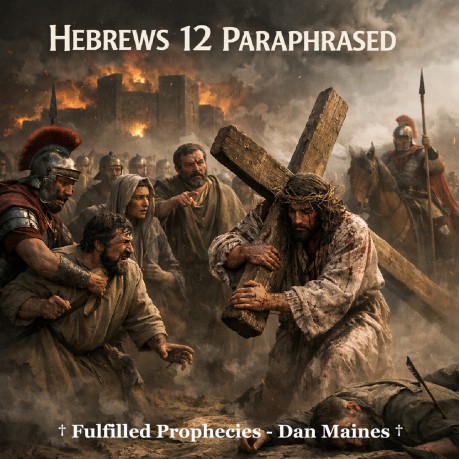
Hebrews 12 Paraphrased Introduction † The previous chapter showed the long line of
faithful people who trusted God before the old covenant age came to
its end. Now the writer turns to the believers living in that
transition period, encouraging them to endure the pressure and
persecution they were facing as the old system was passing away.
(Hebrews 11:39-40) † This chapter focuses on perseverance,
discipline, and the shaking of the old covenant world. The writer
reminds them that the kingdom they were receiving could never be
shaken, unlike the temple system that was about to collapse. (Hebrews
12:26-28) † The audience was living only a few years
before the destruction of Jerusalem in AD 70. The warnings and
encouragements make sense only within that first century setting when
believers were suffering under Jewish opposition and Roman pressure.
(Matthew 24:34) Hebrews 12:1 Hebrews 12:1 † The witnesses are the faithful people
mentioned in the previous chapter who trusted God through suffering
and hardship. Their lives testify that endurance is possible even in
difficult times. (Hebrews 11:32-40) † The race language shows that the Christian
life required perseverance during the intense persecution of the
first century church. (1 Corinthians 9:24) † Clement of Alexandria also spoke of the
faithful of old as examples who strengthen believers through their
testimony of endurance. Hebrews 12:2 Hebrews 12:2 † Jesus is called the author and finisher
because he brought the old covenant promises to their fulfillment
through his death and resurrection. (Hebrews 2:10) † His suffering became the model for believers
who were also enduring shame and persecution from their own people.
(1 Peter 2:21) † Early Christian writers like Irenaeus
emphasized Christ's endurance as the pattern believers must follow. Hebrews 12:3 Hebrews 12:3 † The hostility refers to the opposition Jesus
faced from the religious leaders who rejected him. (Matthew 23:29-36) † The believers reading this letter were facing
similar hostility from the same system that rejected Christ. (Acts
7:51-52) † Tertullian wrote that the suffering of Christ
strengthened the courage of the early church under persecution. Hebrews 12:4 Hebrews 12:4 † Some believers had suffered persecution, but
most had not yet faced martyrdom when this letter was written.
(Hebrews 10:32-34) † The statement reminds them that their
struggle was still ongoing and required continued faithfulness. (2
Timothy 3:12) † Eusebius recorded how persecution intensified
later in the first century. Hebrews 12:5 Hebrews 12:5 † This quote comes from Proverbs and shows that
discipline is part of God's care for his people. (Proverbs 3:11-12) † The hardships believers were experiencing
were not abandonment by God but training for righteousness. (James
1:2-4) † Barnabas wrote that suffering often prepares
believers for deeper faith. Hebrews 12:6 Hebrews 12:6 † Discipline is proof of belonging, not
rejection. (Revelation 3:19) † The trials of the early church helped refine
and strengthen the believers' faith. (1 Peter 1:6-7) † Justin Martyr explained that suffering often
confirmed the faith of believers. Hebrews 12:7 Hebrews 12:7 † The comparison with family life shows that
correction is a normal part of growing into maturity. (Proverbs
13:24) † The first century church needed endurance
because the transition from the old covenant to the new kingdom was
difficult. (Hebrews 10:36) † Early Christian teachers often described
trials as training from God. Hebrews 12:8 Hebrews 12:8 † Genuine faith involves correction and growth
through trials. (James 1:12) † The believers' hardships showed they truly
belonged to God. (Romans 8:17) † Irenaeus emphasized that suffering often
proves genuine faith. Hebrews 12:9 Hebrews 12:9 † The argument moves from earthly discipline to
God's perfect correction. (Matthew 7:11) † Submission to God leads to life in his
kingdom. (John 10:10) † Clement of Rome wrote that obedience to God
produces true life. Hebrews 12:10 Hebrews 12:10 † God's discipline is purposeful and aimed at
producing holiness. (1 Peter 1:15-16) † The suffering of the early believers helped
shape them into faithful witnesses. (Acts 5:41) † Tertullian described persecution as
strengthening the church. Hebrews 12:11 Hebrews 12:11 † The result of discipline is spiritual growth
and peace. (James 3:18) † The early church often grew stronger after
periods of persecution. (Acts 8:1-4) † Eusebius recorded how trials often purified
the faith of believers. Hebrews 12:12 Hebrews 12:12 † The language reflects encouragement to
continue despite exhaustion. (Isaiah 35:3) † The believers were being urged to renew their
courage during a difficult time. (Galatians 6:9) † Early Christian writings often used similar
encouragement during persecution. Hebrews 12:13 Hebrews 12:13 † Faithful living helps others remain strong
rather than stumbling. (Romans 14:13) † The community of believers had responsibility
to help one another endure. (Hebrews 10:24-25) † Clement taught that unity strengthened the
church. Hebrews 12:14 Hebrews 12:14 † Peace and holiness are marks of God's people.
(Romans 12:18) † Holiness reflects God's character in his
people. (1 Peter 1:16) † Justin Martyr described holiness as essential
for believers. Hebrews 12:15 Hebrews 12:15 † The bitter root refers to rebellion that
spreads within the community. (Deuteronomy 29:18) † The church had to guard against influences
pulling believers back to the old system. (Galatians 5:4) † Early writers warned about divisions harming
the church. Hebrews 12:16 Hebrews 12:16 † Esau represents someone who traded lasting
inheritance for temporary satisfaction. (Genesis 25:29-34) † The warning applies to those tempted to
abandon Christ under pressure. (Hebrews 10:38-39) † Irenaeus used Esau as an example of spiritual
carelessness. Hebrews 12:17 Hebrews 12:17 † Some decisions have lasting consequences that
can't easily be reversed. (Genesis 27:34-38) † The warning stresses the seriousness of
abandoning faith. (Hebrews 6:4-6) † Tertullian used this example to warn
believers about falling away. Hebrews 12:18 Hebrews 12:18 † This refers to Mount Sinai where the old
covenant was given. (Exodus 19:16-18) † The writer contrasts the old covenant
experience with the new covenant reality. (Hebrews 8:13) † Early Christian teachers frequently
contrasted Sinai and the new covenant. Hebrews 12:19 Hebrews 12:19 † At Sinai the people were terrified by God's
voice. (Exodus 20:18-19) † The contrast shows the difference between
fear under the old covenant and access under the new. (Hebrews 4:16) † Clement of Alexandria noted that Christ
brought believers closer to God. Hebrews 12:20 Hebrews 12:20 † God's holiness at Sinai emphasized the
distance between God and man under the law. (Exodus 19:12-13) † The law revealed sin but couldn't remove it.
(Romans 7:7) † Early writers explained the law's purpose as
exposing sin. Hebrews 12:21 Hebrews 12:21 † Even Moses experienced fear in God's presence
at Sinai. (Deuteronomy 9:19) † This demonstrates the overwhelming nature of
the old covenant revelation. (Hebrews 9:8) † Eusebius described the contrast between Sinai
and the gospel. Hebrews 12:22 Hebrews 12:22 † Mount Zion represents the new covenant
kingdom established through Christ. (Revelation 21:2) † The heavenly Jerusalem describes the covenant
community of believers. (Galatians 4:26) † Early Christians often identified the church
as the heavenly city. Hebrews 12:23 Hebrews 12:23 † The firstborn refers to the gathered people
of God in Christ. (Romans 8:29) † The righteous made complete points to
believers who had finished their earthly race. (Hebrews 11:39-40) † Irenaeus spoke of the faithful entering God's
presence. Hebrews 12:24 Hebrews 12:24 † Abel's blood cried out for justice, but
Christ's blood brings forgiveness. (Genesis 4:10) † Jesus' sacrifice established the new covenant
relationship with God. (Hebrews 9:15) † Justin Martyr wrote extensively about
Christ's sacrifice replacing the old system. Hebrews 12:25 Hebrews 12:25 † The warning stresses the seriousness of
rejecting Christ. (Hebrews 2:3) † The generation hearing the gospel was
accountable for their response. (Matthew 23:36) † Tertullian emphasized obedience to Christ's
message. Hebrews 12:26 Hebrews 12:26 † The shaking refers to the coming removal of
the old covenant system. (Haggai 2:6) † This shaking reached its climax in the
destruction of Jerusalem in AD 70. (Matthew 24:29-34) † Early Christian historians connected the fall
of Jerusalem with God's judgment. Hebrews 12:27 Hebrews 12:27 † The temple system and old covenant structures
were temporary. (Hebrews 8:13) † God's kingdom established through Christ
cannot be destroyed. (Daniel 2:44) † Eusebius wrote about the passing of the old
system after Jerusalem fell. Hebrews 12:28 Hebrews 12:28 † The kingdom believers were receiving was
permanent and unshakable. (Luke 17:20-21) † Worship now centers on Christ rather than the
temple system. (John 4:21-24) † Early Christians worshiped without reliance
on the temple after AD 70. Hebrews 12:29 Hebrews 12:29 † The phrase reminds believers that God's
holiness remains powerful and pure. (Deuteronomy 4:24) † God's judgment removed the old covenant
system while establishing the eternal kingdom. (Matthew 21:43) † Early writers often used this phrase to
emphasize God's holiness and justice. Historical References † Josephus recorded the destruction of
Jerusalem and the temple in AD 70, marking the end of the old
covenant system. † Eusebius wrote that Christians fled Jerusalem
before the Roman siege, recognizing Jesus' prophecy about the city's
destruction. † Justin Martyr and Irenaeus both described the
transition from the old covenant temple system to the kingdom
established through Christ. How it applies to us today † This chapter reminds us that God's kingdom is
permanent while human systems pass away. † Believers today still look to Jesus as the
one who completed our faith and secured our place in God's kingdom. † We also learn that discipline and hardship
can strengthen faith rather than destroy it. Q & A Appendix Q Why does Hebrews compare Mount Sinai and Mount
Zion? Q What does the shaking of heaven and earth refer
to? Q What is the kingdom that cannot be shaken? Q What does it mean that believers are surrounded
by a great cloud of witnesses? Q Why does Hebrews say believers have come to the
heavenly Jerusalem? Q What does it mean that God is a consuming
fire? Q Why were the first century believers warned not
to refuse the one who speaks from heaven? Q What is the unshakable kingdom believers were
receiving? † This is the fulfilled perspective we proclaim at
Fulfilled Prophecies † Source Index † Hebrews 11:32-40; Hebrews 10:32-36; Hebrews
8:13; Hebrews 9:15; Hebrews 12:18-29
By Dan Maines
Since we're surrounded by such
a huge crowd of witnesses from the past, let's throw off everything
that slows us down, especially the sin that keeps trapping us, and
let's keep running the race set before us with endurance.
Let's keep our eyes fixed on
Jesus, the one who started our faith and brought it to completion.
Because of the joy set before him, he endured the cross, ignoring the
shame, and now he's seated at the right hand of God's throne.
Think about the hostility he
endured from sinners so you won't grow tired and lose heart.
You haven't yet resisted sin to
the point of shedding your own blood.
Have you forgotten the
encouragement spoken to you as sons: My son, don't take the Lord's
discipline lightly, and don't lose heart when he corrects you.
Because the Lord disciplines
the one he loves, and he corrects every son he receives.
Endure hardship as discipline,
God is treating you as sons. What son isn't disciplined by his
father?
But if you're without
discipline, which everyone receives, then you're not true sons but
illegitimate children.
Besides that, we had earthly
fathers who disciplined us and we respected them. Shouldn't we submit
even more to the Father of spirits and live?
They disciplined us for a
short time as they thought best, but God disciplines us for our good
so we can share in his holiness.
No discipline feels pleasant
at the time, it feels painful. But later it produces a harvest of
righteousness and peace for those trained by it.
So strengthen your tired hands
and your weak knees.
Make straight paths for your
feet so what is lame won't be disabled but rather healed.
Pursue peace with everyone and
the holiness without which no one will see the Lord.
Watch carefully so no one
falls short of God's grace, and so no bitter root grows up causing
trouble and contaminating many.
Make sure no one is immoral or
godless like Esau, who sold his birthright for a single meal.
Later when he wanted to
inherit the blessing he was rejected, even though he sought it with
tears, because he found no opportunity to change the outcome.
You haven't come to a mountain
that can be touched, a blazing fire, darkness, gloom, and storm.
You haven't come to the sound
of a trumpet and a voice speaking words that made those who heard beg
that no further message be spoken.
They couldn't bear the
command: If even an animal touches the mountain it must be stoned.
The sight was so terrifying
that Moses said, I am trembling with fear.
But you've come to Mount Zion,
the city of the living God, the heavenly Jerusalem, and to countless
angels gathered in celebration.
You've come to the assembly of
the firstborn who are registered in heaven, and to God the judge of
all, and to the spirits of the righteous made complete.
You've come to Jesus, the
mediator of a new covenant, and to the sprinkled blood that speaks
better than the blood of Abel.
Be careful not to reject the
one who is speaking. If those who rejected the warning on earth
didn't escape, we certainly won't if we turn away from the one who
warns from heaven.
His voice shook the earth
then, but now he promises: Once more I will shake not only the earth
but also the heavens.
The words once more show that
created things will be removed so that what cannot be shaken will
remain.
Since we're receiving a
kingdom that cannot be shaken, let's be thankful and worship God
acceptably with reverence and awe.
Because our God is a consuming
fire.
A It shows the difference between the old
covenant based on fear and distance and the new covenant where
believers have access to God through Christ. (Hebrews 12:18-24)
A It refers to the removal of the old
covenant world, especially the temple system that ended in AD 70.
(Hebrews 12:26-27)
A
It is the kingdom established through Christ that replaced the old
covenant system and continues forever. (Daniel 2:44)
A It means the
faithful people mentioned in the previous chapter stand as testimony
that trusting God through trials leads to victory. Their lives show
that endurance is possible even in suffering. (Hebrews 11:39-40;
Hebrews 12:1)
A It describes the new
covenant community established through Christ, not a physical city
but the gathered people of God under the new covenant kingdom.
(Hebrews 12:22-23; Galatians 4:26)
A It shows that God's holiness and
judgment remove what is corrupt while preserving what is righteous,
which is why the old covenant system was shaken and removed while
God's kingdom remains. (Hebrews 12:29; Deuteronomy 4:24)
A
Because they were living in the generation when the old covenant
world was about to be judged. Rejecting Christ meant facing the same
judgment that came upon Jerusalem. (Hebrews 12:25; Matthew 23:36;
Matthew 24:34)
A It is the kingdom established
through Christ that replaced the old covenant temple system and
continues permanently as God's eternal reign among his people.
(Hebrews 12:28; Daniel 2:44)
© Fulfilled Prophecies - Dan
Maines.
†
Josephus, Wars of the Jews Book 6
† Eusebius,
Ecclesiastical History Book 3
† Justin
Martyr, Dialogue with Trypho
† Irenaeus,
Against Heresies
Links