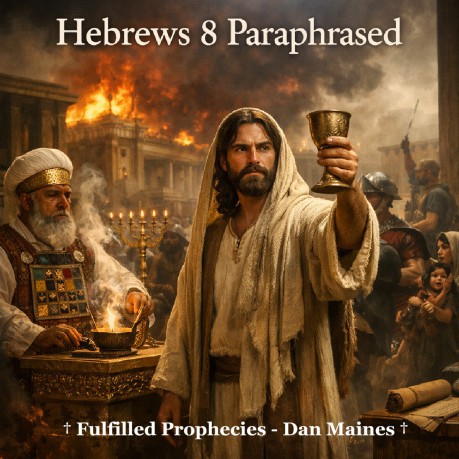
Hebrews 8 Paraphrased Introduction † The writer of Hebrews is explaining the
superiority of Christ's priesthood over the old priesthood of the
Law. Hebrews 8:1 Hebrews 8:1 † The key point is that Christ's priesthood is
already established and complete. His work isn't waiting to begin in
the future. Hebrews 8:2 Hebrews 8:2 † The earthly tabernacle in Jerusalem was only
a temporary structure built by men. Hebrews 8:3 Hebrews 8:3 † The priests under the Law offered animals
repeatedly, but Christ offered Himself once for all. Hebrews 8:4 Hebrews 8:4 † Jesus wasn't from the tribe of Levi but from
the tribe of Judah, so He couldn't serve as a priest under the Mosaic
Law. Hebrews 8:5 Hebrews 8:5 † The earthly system wasn't the ultimate
reality, it was only a shadow pointing forward. Hebrews 8:6 Hebrews 8:6 † The new covenant is called better because it
brings complete forgiveness and internal transformation. Hebrews 8:7 Hebrews 8:7 † The problem wasn't God's Law itself but the
inability of the people to keep it. Hebrews 8:8 Hebrews 8:8 † This is a direct quotation from Jeremiah
31:31. Hebrews 8:9 Hebrews 8:9 † The Sinai covenant depended on Israel's
obedience and repeatedly failed because of their unfaithfulness. Hebrews 8:10 Hebrews 8:10 † The new covenant moves God's law from stone
tablets to transformed hearts. Hebrews 8:11 Hebrews 8:11 † This describes the universal access believers
now have to God through Christ. Hebrews 8:12 Hebrews 8:12 † Complete forgiveness is the foundation of the
new covenant. Hebrews 8:13 Hebrews 8:13 † At the time Hebrews was written the old
covenant system was still standing but already fading away. Historical References † Josephus recorded the destruction of
Jerusalem and the temple in AD 70 in Wars of the Jews, Book 6. How It Applies To Us Today † We don't live under the Old Covenant system
because Christ has already established the better covenant. Q And A Appendix Q: When did the Old Covenant become obsolete? Q: Why is the new covenant better? Q: Who is the High Priest of the new covenant? Q: Why did God promise a new covenant while the
old one was still in place? Q: What does it mean that God's law would be
written on their hearts? Q: How do we know the Old Covenant system has
ended? Q: Why are temple sacrifices no longer needed? Q: Who are the people included in the new
covenant? † This is the fulfilled perspective we proclaim at
Fulfilled Prophecies † Source Index † Hebrews 8:1-13
By Dan Maines
† The entire chapter shows that the Old
Covenant system was temporary and was replaced by the better covenant
established through Christ.
† This directly
supports the fulfilled perspective because the covenant that was
"becoming obsolete" reached its end with the judgment of
Jerusalem in AD 70.
Now here's the main point of
everything we've been saying. We have a High Priest who sat down at
the right hand of the throne of the Majesty in heaven.
† Sitting down shows the work of
sacrifice is finished, just as Hebrews 10:12 explains when it says
Christ sat down after offering one sacrifice for sins.
†
Early Christian writer Eusebius recorded that the church understood
Christ's priesthood as already active in heaven after His ascension.
He serves in the true sanctuary,
the real tent set up by the Lord and not by human hands.
† The
real sanctuary is God's heavenly presence where Christ ministers as
High Priest.
† Philo and later early
Christian writers described the earthly temple as a shadow of
heavenly realities, which matches the argument here.
Every high priest is appointed
to present offerings and sacrifices, so it was necessary for this
High Priest to have something to offer also.
†
Hebrews 9:26 explains that Christ appeared once to remove sin by the
sacrifice of Himself.
† Clement of Rome wrote
that Christ fulfilled the priestly role by offering His own life as
the perfect sacrifice.
If He were on earth, He wouldn't
even be a priest, since there are already priests who offer the gifts
required by the Law.
† Hebrews 7:14 confirms that our Lord
came from Judah, a tribe Moses never connected with priesthood.
†
This shows the necessity of a completely different priesthood.
These priests serve a copy and
shadow of the heavenly things. This is why Moses was warned when he
was about to build the tabernacle, See that you make everything
according to the pattern shown to you on the mountain.
†
Colossians 2:17 says the Law contained shadows of what was to come,
but the substance belongs to Christ.
† Justin
Martyr explained that the temple system existed as a prophetic
picture of the greater work Christ would accomplish.
But now Jesus has received a
much greater ministry, just as the covenant He mediates is better and
is established on better promises.
†
Hebrews 7:22 says Jesus became the guarantee of a better covenant.
†
The early church consistently taught that the new covenant replaced
the old covenant system after Christ.
If that first covenant had been
faultless, there would have been no need to look for another.
† Romans
8:3 explains that the Law was weakened through human flesh.
†
This is why God promised a new covenant long before the old one
ended.
But finding fault with them, God
says, The days are coming, says the Lord, when I'll establish a new
covenant with the house of Israel and with the house of Judah.
† The promise shows that even during
the Old Covenant period God already planned its replacement.
†
The new covenant began through Christ's death and was fully
manifested after the old system ended.
It won't be like the covenant I
made with their fathers when I took them by the hand to lead them out
of Egypt, because they didn't remain faithful to my covenant, and I
turned away from them, says the Lord.
†
The prophets repeatedly warned that covenant breaking would lead to
judgment.
† Josephus records the final
national judgment that came upon Jerusalem in AD 70.
This is the covenant I'll make
with the house of Israel after those days, says the Lord. I'll put My
laws into their minds and write them on their hearts, and I'll be
their God, and they will be My people.
† This promise
is echoed in Ezekiel 36:26 where God promises a new heart and new
spirit.
† The church experienced this through
the work of the Holy Spirit.
They won't teach each other
saying Know the Lord, because they will all know Me, from the least
of them to the greatest.
† Under the
old system only priests approached God directly, but now all
believers draw near through Christ.
† Hebrews
10:19-22 describes this new bold access to God's presence.
Because I'll be merciful toward
their wrongdoing, and I'll remember their sins no more.
† Psalm 103:12 describes this
same removal of sin, as far as the east is from the west.
†
Christ's sacrifice accomplished what repeated temple sacrifices never
could.
When He said a new covenant, He
made the first one obsolete. And whatever is becoming obsolete and
growing old is ready to disappear.
†
The temple and sacrificial system finally disappeared when Jerusalem
and the temple were destroyed in AD 70.
†
This historical event confirmed exactly what Hebrews predicted.
†
Eusebius wrote that the church fled Jerusalem before its destruction,
recognizing Christ's warnings.
† Tertullian
wrote that the old covenant sacrifices ended because Christ fulfilled
them.
†
We approach God directly through Christ instead of through temple
sacrifices or priests.
† Our relationship
with God is based on the finished work of Christ, not on repeated
rituals.
A:
Hebrews says it was already becoming obsolete and ready to disappear.
That process reached its completion with the destruction of the
temple in AD 70 (Hebrews 8:13; Matthew 24:2).
A:
Because it provides full forgiveness of sins and writes God's law on
the hearts of believers instead of on stone tablets (Hebrews 8:10-12;
Jeremiah 31:31-34).
A:
Jesus Christ serves as the eternal High Priest who offered Himself
once for all (Hebrews 8:1; Hebrews 7:24-27).
A: Because the
people repeatedly broke the first covenant, so God promised a better
one that would deal with sin permanently and transform the heart
(Jeremiah 31:31-33; Hebrews 8:7-8).
A: It means obedience
would come from inward transformation instead of external commands
written on stone tablets (Hebrews 8:10; Ezekiel 36:26-27).
A: Hebrews says it was already becoming
obsolete and ready to disappear, and history confirms this when the
temple and sacrificial system were destroyed in AD 70 (Hebrews 8:13;
Matthew 24:2).
A:
Because Christ offered one perfect sacrifice that fully removed sin,
something the repeated sacrifices of the Law could never accomplish
(Hebrews 9:26; Hebrews 10:12-14).
A: All who belong to Christ share in
the promises, whether Jew or Gentile, because the covenant is
fulfilled in Him (Galatians 3:28-29; Ephesians 2:13-16).
© Fulfilled Prophecies - Dan
Maines.
†
Jeremiah 31:31-34; Hebrews 7:22; Hebrews 7:24-27; Hebrews 9:26;
Hebrews 10:12; Romans 8:3; Ezekiel 36:26; Psalm 103:12; Hebrews
10:19-22; Matthew 24:2
† Josephus, Wars of
the Jews Book 6; Eusebius, Ecclesiastical History; Tertullian,
Against Marcion.
Links