Hebrews 7 Paraphrased Introduction Hebrews 7:1 Hebrews 7:2 Hebrews 7:3 Hebrews 7:4 Hebrews 7:5 Hebrews 7:6 Hebrews 7:7 Hebrews 7:8 Hebrews 7:9 Hebrews 7:10 Hebrews 7:11 Hebrews 7:12 Hebrews 7:13 Hebrews 7:14 Hebrews 7:15 Hebrews 7:16 Hebrews 7:17 Hebrews 7:18 Hebrews 7:19 Hebrews 7:20 Hebrews 7:21 Hebrews 7:22 Hebrews 7:23 Hebrews 7:24 Hebrews 7:25 Hebrews 7:26 Hebrews 7:27 Hebrews 7:28 Historical References How It Applies To Us Today Q & A Appendix Q Why does Hebrews focus on Melchizedek? Q Why couldn't the Levitical priesthood bring
perfection? Q How do we know the priesthood changed? Q Why did the writer emphasize that Jesus came
from the tribe of Judah instead of Levi? Q What does it mean that Jesus saves
completely? Q Why is the oath in Psalm 110:4 so important? Q How did the destruction of the temple confirm
Hebrews 7? † This is the fulfilled perspective we proclaim at
Fulfilled Prophecies † Source Index † Hebrews 7:1-28
By Dan Maines
† The writer
of Hebrews explains why Jesus is the true and final High Priest. He
points back to Melchizedek in Genesis to show a priesthood greater
than Levi's. This chapter proves that the priesthood changed, which
means the covenant system connected to it also had to change.
†
The argument shows that Jesus did not come from the tribe of Levi,
yet He still became the true High Priest because His priesthood comes
from a higher order, the order of Melchizedek (Genesis 14:18-20;
Psalm 110:4).
† This matters because it shows
that the temple system, sacrifices, and Levitical priesthood were
temporary and were replaced by Christ's eternal priesthood.
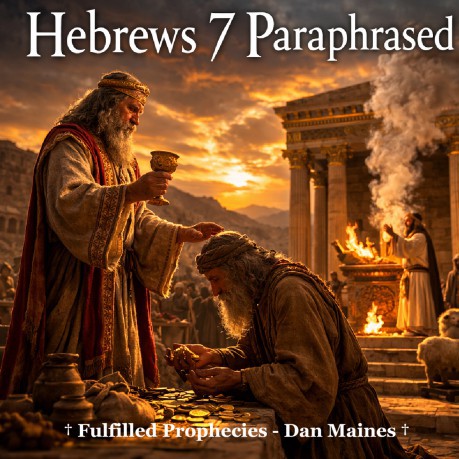
This Melchizedek was king of
Salem and a priest of the Most High God. He met Abraham returning
from the defeat of the kings and gave him a blessing.
†
Melchizedek appears suddenly in the Genesis record as both king and
priest, something unique in the Old Testament (Genesis 14:18-20).
†
Abraham receiving a blessing from him shows Melchizedek held a higher
spiritual position than Abraham.
† The writer
is setting the stage to prove that Jesus' priesthood follows this
greater order (Psalm 110:4).
Abraham gave him a tenth of
everything he had taken. His name means king of righteousness, and he
was also king of Salem, meaning king of peace.
†
Abraham giving a tenth shows honor and recognition of Melchizedek's
authority (Genesis 14:20).
† The meanings of
his titles point directly to Christ, righteousness and peace both
come through Him (Isaiah 9:6; Jeremiah 23:5-6).
†
The combination of king and priest points forward to the Messiah who
would rule and intercede.
There is no record of his
father, mother, family line, beginning of life, or end of days. In
the biblical record he remains like the Son of God, continuing as a
priest in the pattern shown in Scripture.
†
The point is not that Melchizedek had no parents, but that the
genealogy is intentionally absent in the record (Genesis 14).
†
Levitical priests required documented ancestry, but Melchizedek's
priesthood didn't depend on genealogy (Ezra 2:62).
†
This mirrors Christ's priesthood which comes by divine appointment,
not tribal descent (Psalm 110:4).
Look at how great this man was,
even Abraham the patriarch gave him a tenth of the spoils.
†
Abraham is the ancestor of Israel, so if he honored Melchizedek, that
priesthood must be greater.
† This
establishes the foundation for the argument that Levi's priesthood is
subordinate.
† The writer is proving
superiority through Abraham's actions (Genesis 14:20).
The descendants of Levi who
receive the priesthood are commanded in the Law to collect tithes
from the people, that is, from their fellow Israelites, even though
they also came from Abraham.
† The Law
authorized Levitical priests to collect tithes from Israel (Numbers
18:21).
† Yet those priests were still
descendants of Abraham just like the rest of the people.
†
This shows the system was internal to Israel and temporary.
But this man, whose ancestry
wasn't traced from Levi, collected a tenth from Abraham and blessed
the one who held the promises.
† Melchizedek
blessed Abraham, the one carrying the covenant promises (Genesis
12:1-3).
† This shows that spiritual
authority did not originate with the Levitical system.
†
The blessing establishes the greater position of Melchizedek's
priesthood.
It is beyond dispute that the
lesser person is blessed by the greater.
†
The argument is simple and clear, the one giving the blessing holds
the greater authority.
† Therefore
Melchizedek stands above Abraham in that moment.
†
Since Levi came through Abraham, Levi's priesthood is shown to be
inferior.
In one case mortal men receive
tithes, but in the other case it is testified that he lives.
†
Levitical priests eventually died and were replaced (Numbers
20:28).
† In the scriptural narrative
Melchizedek is presented without recorded death, symbolizing a
continuing priesthood.
† This points forward
to Christ's eternal priesthood.
You could even say that Levi,
who receives tithes, paid tithes through Abraham.
†
Since Levi was still within Abraham's lineage at that time, the act
symbolically included him.
† This strengthens
the argument that Levi acknowledged Melchizedek's superiority.
†
The priesthood connected to Levi therefore comes after and beneath
the earlier priesthood.
Because he was still within his
ancestor when Melchizedek met Abraham.
† The
writer uses ancestry logic common in Jewish teaching to make the
point.
† Levi's future priesthood was
represented in Abraham.
† This reinforces
that Melchizedek's priesthood existed first and was greater.
If perfection had come through
the Levitical priesthood, since the people received the Law through
it, why would there still be a need for another priest to arise in
the order of Melchizedek and not in the order of Aaron?
†
The Law and priesthood were connected systems (Exodus 28:1).
†
Psalm 110:4 predicted another priest would come, showing the
Levitical system was incomplete.
† The
prophecy itself proves the earlier priesthood would not last.
When the priesthood changes,
the law connected to it must also change.
†
The priesthood and covenant system functioned together.
†
When Christ became the High Priest, the covenant structure tied to
the Levitical system ended (Hebrews 8:13).
†
This explains why the temple system no longer stands.
The one these things are spoken
about belongs to another tribe, and no one from that tribe has ever
served at the altar.
† Jesus came from the
tribe of Judah (Matthew 1:2-3).
† The tribe
of Judah had no role in the temple priesthood.
†
This proves His priesthood must come from a different order.
It is clear that our Lord came
from Judah, a tribe Moses said nothing about regarding priests.
†
The Law limited priesthood to the tribe of Levi (Numbers 3:10).
†
Jesus serving as priest proves a new priesthood had begun.
†
This fulfills Psalm 110:4.
This becomes even clearer when
another priest appears in the likeness of Melchizedek.
†
The new priesthood follows the Melchizedek pattern, not the Levitical
one.
† It is based on divine appointment, not
genealogy.
† This is fulfilled in Christ.
He became a priest not through
the law of physical descent but through the power of an endless
life.
† Levitical priests served temporarily
and died.
† Christ's resurrection proves His
priesthood is permanent (Romans 6:9).
† His
life is the foundation of the new priesthood.
Because it is testified, You
are a priest forever according to the order of Melchizedek.
†
This quote comes directly from Psalm 110:4.
†
David prophesied a future eternal priest.
†
The writer of Hebrews applies that prophecy to Jesus.
The previous commandment is set
aside because it was weak and ineffective.
†
The Law could reveal sin but couldn't remove it (Romans 8:3).
†
The sacrifices were repeated constantly because they were
incomplete.
† This shows the need for
Christ's perfect sacrifice.
The Law made nothing perfect,
but a better hope was introduced through which we draw near to God.
†
Access to God became possible through Christ's priesthood (Hebrews
10:19-22).
† The old system pointed forward
but couldn't complete redemption.
† Christ
brought the reality the Law foreshadowed.
This didn't happen without an
oath.
† God's oath confirms the permanence of
Christ's priesthood.
† Divine oaths in
Scripture mark unchangeable promises (Genesis 22:16-18).
†
This establishes the certainty of the new covenant.
Those priests became priests
without an oath, but this one became a priest with an oath by the One
who said to Him, The Lord has sworn and will not change His mind, You
are a priest forever.
† This again refers to
Psalm 110:4.
† The Levitical priests entered
service by lineage, not divine oath.
†
Christ's priesthood is guaranteed by God's sworn promise.
Because of this oath, Jesus has
become the guarantee of a better covenant.
†
The covenant connected to Christ surpasses the old one (Hebrews
8:6).
† He Himself guarantees its
permanence.
† This covenant was established
through His sacrifice.
Many priests existed because
death prevented them from continuing.
† The
Levitical priesthood constantly changed due to death.
†
No priest served permanently.
† This
highlighted the temporary nature of the system.
But Jesus holds His priesthood
permanently because He lives forever.
† His
resurrection guarantees His eternal priesthood.
†
No successor is needed.
† His intercession
continues without interruption.
Therefore He is able to save
completely those who come to God through Him, because He always lives
to intercede for them.
† Christ's priesthood
provides complete salvation.
† His continual
life ensures ongoing intercession (Romans 8:34).
†
This is the final priesthood that never ends.
This kind of High Priest fits
our need, holy, innocent, pure, separated from sinners, and exalted
above the heavens.
† Unlike the Levitical
priests, Christ is completely sinless (1 Peter 2:22).
†
His holiness qualifies Him uniquely as High Priest.
†
He stands above the earthly priesthood.
He doesn't need to offer
sacrifices daily like those high priests who first offer sacrifices
for their own sins and then for the people. He did this once for all
when He offered Himself.
† Levitical priests
had to sacrifice for themselves (Leviticus 16:6).
†
Christ offered Himself once, ending the need for repeated sacrifices
(Hebrews 10:10).
† This single sacrifice
fulfilled the entire system.
The Law appoints men as high
priests who have weakness, but the word of the oath, which came after
the Law, appoints the Son who has been made perfect forever.
†
The Law installed imperfect priests.
† God's
oath appointed the perfect Son as eternal High Priest.
†
This closes the argument that Christ's priesthood surpasses the old
system.
†
Justin Martyr explained that Melchizedek was a prophetic type
pointing forward to Christ's eternal priesthood.
†
Irenaeus taught that Christ fulfilled the priesthood that the Law
only foreshadowed.
† Eusebius recorded that
early Christians saw Psalm 110:4 as direct proof of Christ's eternal
priesthood.
†
We don't rely on earthly priests or temple sacrifices because
Christ's priesthood is complete.
† Our access
to God doesn't come through ritual systems but through the finished
work of Jesus.
† The destruction of the
temple in AD 70 confirmed that the old priesthood had passed and
Christ's priesthood remained.
A
Because Melchizedek's priesthood came before Levi's and shows the
pattern for Christ's eternal priesthood (Genesis 14:18-20; Psalm
110:4).
A Because the Law and sacrifices
only pointed forward to the true solution, Christ's sacrifice
(Hebrews 10:1-4).
A
Scripture predicted another priest would come in the order of
Melchizedek, showing the Levitical system would be replaced (Psalm
110:4; Hebrews 7:11-12).
A
Because the Law said priests had to come from Levi, yet Jesus came
from Judah. This proves a different priesthood had been established,
the one foretold in Psalm 110:4. Hebrews explains that when the
priesthood changed, the law connected to it had to change as well
(Hebrews 7:12-14; Psalm 110:4).
A It means His sacrifice and
priesthood finish the work of salvation. Unlike the temple priests
who had to repeat sacrifices constantly, Jesus offered Himself once
and forever secured redemption. Because He lives forever, His
priesthood never ends (Hebrews 7:25-27; Hebrews 10:10-14).
A
Because God swore an oath that the Messiah would be a priest forever
according to the order of Melchizedek. The Levitical priests became
priests by genealogy, but Jesus became priest by God's sworn promise,
making His priesthood permanent (Psalm 110:4; Hebrews 7:20-22).
A Hebrews explains that the old
priesthood would be replaced by Christ's priesthood. When the temple
was destroyed in AD 70, the Levitical priesthood ended completely,
confirming that the priesthood of Jesus was the only one that
remained (Hebrews 7:12; Hebrews 8:13; Matthew 24:2).
© Fulfilled Prophecies - Dan
Maines.
†
Genesis 14:18-20; Psalm 110:4; Numbers 18:21; Matthew 1:2-3; Romans
6:9; Hebrews 8:13; Hebrews 10:10
† Justin
Martyr, Dialogue with Trypho; Irenaeus, Against Heresies; Eusebius,
Ecclesiastical History.
Links