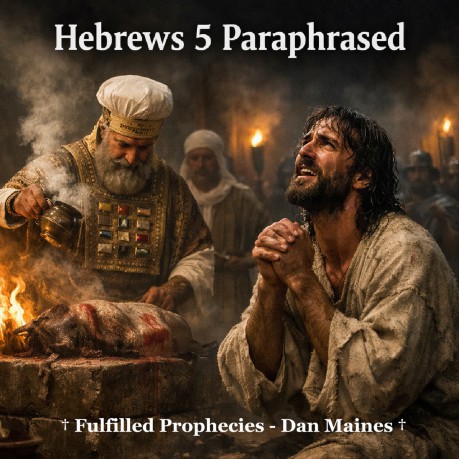
Hebrews 5 Paraphrased Introduction † The writer of Hebrews explains the role of
the high priest and shows how Jesus fulfilled that role in a greater
way. The priesthood under the Law served as a shadow that pointed
forward to Christ. By the time this letter was written, the old
priesthood was about to disappear with the coming destruction of
Jerusalem in AD 70. Hebrews 5:1 † The high priest stood as a mediator between
the people and God under the Law of Moses (Leviticus 16:32-34). Hebrews 5:2 † The earthly priests were not perfect, they
were sinners themselves and understood human weakness (Hebrews
7:27). Hebrews 5:3 † The Day of Atonement showed this clearly,
because the high priest first made sacrifice for his own sin before
he could intercede for the nation (Leviticus 16:6,11). Hebrews 5:4 † The priesthood was not something a man could
claim for himself, it required God's appointment (Exodus 28:1). Hebrews 5:5 † This references Psalm 2:7, a messianic
prophecy pointing to the authority given to Christ. Hebrews 5:6 † This comes from Psalm 110:4, which predicted
a priesthood different from the Levitical system. Hebrews 5:7 † This reflects Jesus' prayers in Gethsemane as
He faced the suffering of the cross (Matthew 26:39). Hebrews 5:8 † Jesus did not learn obedience because He was
disobedient, but because He experienced human suffering firsthand
(Philippians 2:8). Hebrews 5:9 † Christ's work was completed through His death
and resurrection (John 19:30). Hebrews 5:10 † This confirms again that Jesus' priesthood is
superior to the Levitical priesthood (Hebrews 7:11). Hebrews 5:11 † The writer rebukes the audience for spiritual
dullness and lack of growth (Hebrews 6:1). Hebrews 5:12 † Milk represents the foundational teachings of
the faith (1 Corinthians 3:1-2). Hebrews 5:13 † Spiritual infancy keeps believers from
understanding the deeper truths of God's kingdom (1 Corinthians
14:20). Hebrews 5:14 † Spiritual maturity comes through consistent
practice and discernment (Romans 12:2). Historical References † Clement of Alexandria wrote that Christ is
the true High Priest who fulfilled the priestly shadows of the Law. How It Applies To Us Today † We no longer depend on earthly priests
because Jesus is our eternal High Priest (Hebrews 7:24-25). Q & A Appendix Q: Why did the old covenant need priests? Q: How is Jesus different from the Levitical
priests? Q: What does it mean to move from milk to solid
food? Q: Why does Hebrews connect Jesus to Melchizedek
instead of Aaron? Q: What does it mean that Jesus learned obedience
through suffering? Q: Why does the writer rebuke the readers for
still needing milk? Q: How do believers train themselves to discern
good and evil? † This is the fulfilled perspective we proclaim at
Fulfilled Prophecies † Source Index † Hebrews 5:1-14
By Dan Maines
† The message also
rebukes believers who should have matured but were still spiritually
immature. They needed to grow in understanding instead of remaining
dependent on elementary teaching.
† Jesus was
not only a priest, He was appointed by God as the eternal High
Priest, fulfilling the pattern spoken of long before in the
Scriptures.
Every high priest chosen from
among men is appointed to represent people before God, offering gifts
and sacrifices for sins.
†
His work involved presenting sacrifices on behalf of others because
the people could not approach God directly in the old covenant system
(Hebrews 9:7).
† This role pointed forward to
Christ, who would become the true mediator between God and mankind (1
Timothy 2:5).
Because he is also surrounded by
weakness himself, he is able to deal gently with those who are
ignorant and those who go astray.
† This weakness allowed them to show
compassion toward others who struggled with sin (Numbers 15:27-28).
†
Yet this also showed the limitation of the old priesthood, because
the priest himself needed forgiveness.
For this reason he had to offer
sacrifices not only for the sins of the people but also for his own
sins.
†
This exposed the weakness of the Levitical priesthood since the
priest himself was not sinless (Hebrews 7:28).
†
Jesus was different because He had no sin and did not need to offer
sacrifices for Himself (1 Peter 2:22).
No one takes this honor upon
himself, he must be called by God just as Aaron was.
†
Aaron was chosen by God to begin the priestly line in Israel (Numbers
18:7).
† This principle prepares the reader
to understand that Jesus also received His priesthood by God's
appointment.
In the same way, Christ did not
glorify Himself to become High Priest, but the One who said to Him,
You are My Son, today I have become Your Father.
†
Jesus did not appoint Himself, the Father declared His role and
authority (Matthew 3:17).
† The resurrection
publicly confirmed His identity and authority as God's Son (Acts
13:33).
And in another place God says,
You are a priest forever according to the order of Melchizedek.
†
Melchizedek was both king and priest, showing a greater pattern
fulfilled in Christ (Genesis 14:18).
† Jesus'
priesthood is eternal and does not depend on the lineage of Levi.
During the days of His life on
earth, Jesus offered up prayers and requests with loud cries and
tears to the One who was able to save Him from death, and He was
heard because of His reverence.
†
His prayers showed His complete submission to the Father even while
facing suffering (Luke 22:44).
† Though He
died, God answered His prayer by raising Him from the dead (Acts
2:24).
Although He was the Son, He
learned obedience through the suffering He experienced.
† His suffering
demonstrated complete obedience to God's will (Isaiah 53:7).
†
This prepared Him to become the perfect High Priest who understands
human struggle.
After being made complete, He
became the source of eternal salvation for everyone who obeys Him.
† Eternal
salvation came through His finished sacrifice rather than repeated
temple offerings (Hebrews 10:12).
† Obedience
here refers to faith and submission to Christ's authority (Romans
1:5).
And He was declared by God to
be a High Priest according to the order of Melchizedek.
†
Melchizedek's priesthood existed before the Law and therefore was
greater than the system that came through Moses.
†
Christ's priesthood continues forever and does not pass from one
generation to another.
We have much more to say about
this, but it is hard to explain because you have become slow to
understand.
†
They should have been ready for deeper teaching but were still
struggling with basic truths.
† Spiritual
immaturity often comes when believers stop studying and applying
God's word.
By now you should already be
teachers, but instead you need someone to teach you the basic
principles of God's message again. You need milk, not solid food.
† Solid food
represents deeper understanding and maturity in the word (Ephesians
4:13-14).
† The believers had stalled in
their growth instead of progressing toward maturity.
Anyone who lives only on milk
is inexperienced with the message of righteousness because he is
still like a child.
† Growth in righteousness requires
learning and applying the word of God (Psalm 119:105).
†
The audience was being urged to grow beyond beginner-level
understanding.
But solid food is for the
mature, for those who have trained their senses through practice to
recognize both good and evil.
†
Mature believers learn to test what is true and reject error (1
Thessalonians 5:21).
† This kind of
discernment protects the church from false teaching.
†
Justin Martyr explained that the sacrifices and priesthood of Israel
were symbols pointing to Christ's once-for-all sacrifice.
†
Eusebius recorded that early Christians understood the destruction of
the temple in AD 70 as the end of the Levitical priesthood system.
†
Believers are called to grow beyond basic teachings and become mature
in understanding God's word (Hebrews 6:1).
†
Spiritual growth comes through regular study, obedience, and applying
the truth of Scripture.
A:
Because the people could not directly approach God under the Law. The
priest served as mediator and offered sacrifices for sin (Hebrews
9:6-7).
A: Jesus was sinless and offered
Himself once for all, while the Levitical priests offered repeated
sacrifices (Hebrews 7:27).
A: It means growing from basic teachings
to deeper understanding and maturity in the word of God (Hebrews
5:12-14).
A: Because Melchizedek's
priesthood existed before the Law and did not depend on the tribe of
Levi. This shows that Christ's priesthood is greater and eternal, not
tied to the temporary system of the Law (Psalm 110:4; Hebrews
7:11-17).
A: It means that during His
life on earth He experienced real human suffering and remained
perfectly faithful to God's will. His obedience was proven through
what He endured (Philippians 2:8; Hebrews 2:17-18).
A: Because by that time
they should have matured enough to teach others, but they were still
dependent on the basic principles of the faith instead of growing
deeper in understanding (Hebrews 5:12-13; 1 Corinthians 3:1-2).
A: Through constant exposure to
God's word and by applying it in daily life. Mature believers grow in
discernment as they practice righteousness and test everything
against the truth of Scripture (Romans 12:2; 1 Thessalonians 5:21).
© Fulfilled Prophecies - Dan
Maines.
†
Leviticus 16:6-34; Psalm 2:7; Psalm 110:4; Matthew 26:39; Luke 22:44;
Acts 2:24; Philippians 2:8
† Justin Martyr,
Dialogue with Trypho; Clement of Alexandria, Stromata; Eusebius,
Ecclesiastical History
Links