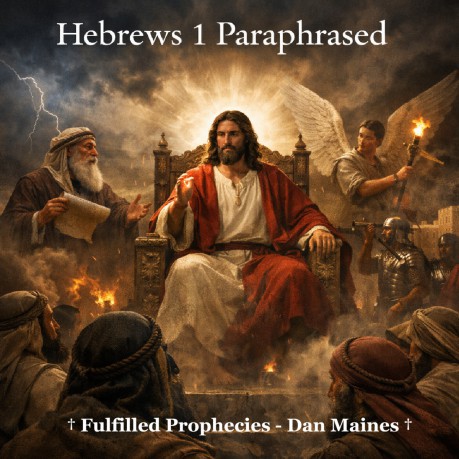
Hebrews 1 Paraphrased Introduction † The opening of Hebrews immediately
establishes that God's final and complete revelation came through His
Son. In earlier times God spoke through prophets in many ways, but in
the last days of the Old Covenant age He spoke through Christ. This
chapter shows the absolute authority and supremacy of the Son over
angels, prophets, and all created things. † The audience of Hebrews was made up largely
of Jewish believers who knew the Law, the prophets, and the temple
system. The writer begins by proving that Jesus is greater than all
of those earlier messengers. † This matters because the Old Covenant system
was passing away in their generation, exactly as Jesus warned in
Matthew 24:34, and Christ was the final authority speaking to that
generation. Hebrews 1:1 God spoke to our ancestors long ago through the prophets in many
different times and in many different ways. † Throughout Israel's history God revealed His
will through prophets like Moses, Isaiah, Jeremiah, and others. These
messages came over many centuries and in many forms such as visions,
dreams, and spoken prophecy (Numbers 12:6-8). † The Old Covenant revelation was progressive.
Each prophet added another part to what God was revealing, but the
full picture wasn't complete yet (1 Peter 1:10-11). † The point being made is that those earlier
revelations were partial and temporary, preparing the way for the
final message that would come through the Son (Hebrews 3:5-6). Hebrews 1:2 But in these last days He's spoken to us through His Son, the one
He appointed heir of everything, and through Him He created the ages. † The phrase last days refers to the last days
of the Old Covenant age, not the end of the physical world. Peter
used the same language in Acts 2:16-17 when he said the last days had
already begun. † Jesus is described as the heir of all things,
meaning He received the authority and kingdom promised to the Messiah
(Psalm 2:7-8). † The phrase created the ages shows that Christ
stands above the entire covenantal history of God's redemptive plan
(Colossians 1:16-17). Hebrews 1:3 He reflects God's glory and shows exactly what God is like. He
upholds everything by His powerful word, and after He accomplished
the cleansing of sins, He sat down at the right hand of the Majesty
on high. † Jesus perfectly reveals the nature of God.
Anyone who sees the Son sees the Father because He is the visible
expression of God's nature (John 14:9). † His sitting down shows that His sacrificial
work was completed. Unlike the priests who stood daily offering
sacrifices, Christ finished the work of redemption (Hebrews
10:11-12). † The right hand position represents authority
and kingship, fulfilling the prophecy of Psalm 110:1 where the
Messiah reigns beside God. Hebrews 1:4 He became far greater than the angels, inheriting a name much more
excellent than theirs. † Angels were highly respected in Jewish
tradition because the Law was delivered through angelic mediation
(Acts 7:53). † The writer is showing that Jesus is not
simply another heavenly messenger. His authority and identity are far
above angels (Philippians 2:9-11). † This prepares the reader for the argument
that follows where the writer uses Old Testament scripture to prove
the Son's superiority. Hebrews 1:5 God never said to any angel, You are My Son, today I have become
your Father. Nor did He ever say about an angel, I will be a Father
to Him and He will be a Son to Me. † This references Psalm 2:7 and 2 Samuel 7:14,
both of which point to the Messiah's unique relationship with God. † Angels are servants of God, but Christ is the
Son who shares the Father's authority (John 5:22-23). † The point is that no angel was ever given the
royal identity or covenant authority given to the Messiah. Hebrews 1:6 And when God brings the firstborn into the world, He says, Let all
the angels of God worship Him. † The Son is called the firstborn, meaning the
one with the highest authority and inheritance rights (Colossians
1:15). † Angels worship Christ because He stands above
them as Lord and King (Revelation 5:11-12). † The writer again emphasizes that the Son's
authority is recognized even in the heavenly realm. Hebrews 1:7 Speaking of the angels He says, He makes His angels winds, and His
servants flames of fire. † Angels serve as God's messengers and agents
carrying out His will in the world (Psalm 104:4). † Their role is service, not rulership. They
carry out commands but do not sit on the throne. † This contrast highlights the difference
between servants and the ruling Son. Hebrews 1:8 But about the Son He says, Your throne, O God, lasts forever and
ever, and righteousness is the scepter of Your kingdom. † This quotation from Psalm 45:6 directly
identifies the Son with divine authority and eternal kingship. † The Messiah rules with righteousness, meaning
His authority is just and perfectly aligned with God's will (Isaiah
9:6-7). † The Son's throne contrasts with the temporary
priesthood and kingdom structures that existed under the Old
Covenant. Hebrews 1:9 You loved righteousness and hated lawlessness, so God, Your God,
has anointed You with the oil of joy above Your companions. † Christ's perfect obedience qualified Him to
reign as the righteous King (Philippians 2:8-9). † The anointing language points to His role as
Messiah, which means the anointed one (Acts 10:38). † His companions likely refers to kings or
rulers, yet Christ stands above them all. Hebrews 1:10 You, Lord, laid the foundation of the earth in the beginning, and
the heavens are the work of Your hands. † This citation from Psalm 102 attributes the
work of creation to the Son. † It reinforces the idea that Christ is not a
created being but the creator Himself (John 1:1-3). † This further proves the Son's supremacy over
angels and all creation. Hebrews 1:11 They will perish, but You remain. They will all wear out like
clothing. † The created order is temporary, but Christ
remains eternal and unchanging (Psalm 102:26). † This reinforces that the Son stands outside
the limitations of creation. † It also echoes the theme that covenant
structures and systems were temporary while Christ's kingdom endures. Hebrews 1:12 You will roll them up like a robe, like clothing they will be
changed, but You remain the same and Your years will never end. † The imagery shows that God can change or
remove created systems just as easily as changing clothes. † In the context of Hebrews, this points to the
passing away of the Old Covenant system (Hebrews 8:13). † Christ remains constant while covenant
administrations change throughout redemptive history. Hebrews 1:13 But to which of the angels has God ever said, Sit at My right hand
until I make Your enemies a footstool for Your feet? † This again quotes Psalm 110:1, the most
frequently cited Old Testament verse in the New Testament. † It describes the Messiah ruling until His
enemies are subdued. † The destruction of Jerusalem in AD 70
demonstrated the defeat of those who rejected Christ's authority
(Matthew 22:7). Hebrews 1:14 Aren't all angels ministering spirits sent to serve those who will
inherit salvation? † Angels serve believers by carrying out God's
purposes for His people. † Their role is supportive and ministerial, not
ruling or governing. † This final verse reminds readers that
salvation belongs to those who belong to Christ, not to angelic
beings. Historical References † Clement of Rome referred to Christ as the
supreme authority above angels and rulers in First Clement,
emphasizing the same truth Hebrews teaches. † Justin Martyr wrote that the Son existed
before creation and was the one through whom God revealed Himself to
humanity. † Irenaeus affirmed that the Son shares the
same divine authority as the Father and rules over creation. How It Applies To Us Today † This chapter reminds us that our faith rests
on the authority of Christ, not on human teachers, traditions, or
systems. † Since Christ's work is complete, we live in
confidence rather than fear of unfinished prophecy. † We follow the living King who already reigns,
not a future ruler who hasn't yet taken His throne. Q & A Appendix Q: Why does Hebrews emphasize Jesus being greater
than angels? A: Because many Jews held angels in very high
regard, but the writer shows that Christ alone holds divine
authority. Scripture demonstrates this clearly in Hebrews 1:4-8 and
Colossians 2:9-10. Q: What do the last days refer to in Hebrews 1:2? A: They refer to the last days of the Old
Covenant age, the same period described in Acts 2:16-17 and Hebrews
8:13 when the old system was about to disappear. Q: What does it mean that Jesus sat down at God's
right hand? A: It means His redemptive work was completed and
He now reigns as King. Hebrews 10:12 and Psalm 110:1 both confirm
this authority. Q: Why does Hebrews begin by talking about how
God spoke through prophets? A: Because the writer is showing a transition
from partial revelation to the final revelation in Christ. God spoke
through prophets under the Old Covenant, but the complete message
came through the Son. Hebrews 1:1-2 explains this, and Jesus Himself
confirmed that the prophets pointed forward to Him in Luke 24:27. Q: Why does Hebrews quote so many Old Testament
passages about the Son? A: The writer is proving from the Hebrew
Scriptures that the Messiah has always been superior to angels and
earthly rulers. Psalm 45:6-7 and Psalm 110:1 are used in Hebrews
1:8-13 to show that the Messiah sits on the throne and rules with
divine authority. Q: What does it mean that angels serve those who
inherit salvation? A: Hebrews 1:14 explains that angels are
ministering spirits sent to serve God's people. Throughout scripture
angels carried out God's purposes for believers, such as protecting
them or delivering messages. Examples include Daniel 6:22 and Acts
12:7-11. Q: How does Hebrews 1 support the fulfilled
perspective? A: Hebrews shows that Christ already reigns and
has completed the work of redemption. He sat down at the right hand
of God after finishing His sacrifice, as stated in Hebrews 1:3 and
Hebrews 10:12. This confirms that the kingdom authority of Christ was
already established in the first century. † This is the fulfilled perspective we proclaim at
Fulfilled Prophecies † Source Index † Hebrews 1:1-14
By Dan Maines
© Fulfilled Prophecies - Dan
Maines.
†
Matthew 24:34; Acts 2:16-17; Psalm 2:7-8; Psalm 110:1; John 1:1-3;
John 14:9; Hebrews 8:13; Hebrews 10:11-12; Colossians 1:15-17;
Philippians 2:8-11
† Clement of Rome, First
Epistle to the Corinthians; Justin Martyr, Dialogue with Trypho;
Irenaeus, Against Heresies.
Links