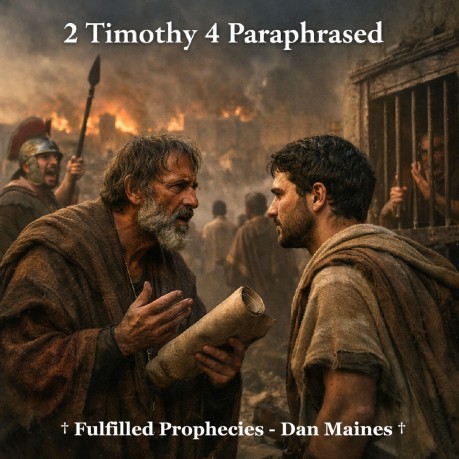
2 Timothy 4 Paraphrased Introduction † Paul is giving Timothy his final charge,
urging him to remain faithful as the old covenant age was reaching
its end and as false teachers were multiplying in the last days of
that generation (Matthew 24:11; 2 Timothy 3:1). 2 Timothy 4:1 I charge you before God and before Christ Jesus, who will judge
the living and the dead, and in view of his appearing and his
kingdom. † Paul is reminding Timothy that his ministry
is carried out before God himself, meaning he must remain faithful
regardless of opposition (Galatians 1:10). 2 Timothy 4:2 Proclaim the message, stay ready whether the time feels right or
not, correct people when they're wrong, warn them when they wander,
and encourage them with steady patience and careful teaching. † The urgency shows the apostles understood
that the gospel had to spread quickly before the end of the age
arrived (Matthew 24:14). 2 Timothy 4:3 Because the time will come when people won't tolerate sound
teaching, instead they'll gather teachers who tell them exactly what
they want to hear. † Paul is describing the apostasy already
beginning to spread in the first century church (2 Peter 2:1). 2 Timothy 4:4 They'll turn their ears away from the truth and wander off into
made-up stories. † Many in that generation preferred myths and
speculative teachings instead of the clear message of Christ (1
Timothy 1:4). 2 Timothy 4:5 But you stay clear minded in everything, endure suffering, do the
work of telling the good news, and complete the ministry entrusted to
you. † Timothy is called to remain steady while
others fall away, which was a common challenge for first century
ministers (1 Corinthians 16:13). 2 Timothy 4:6 As for me, I'm already being poured out like a drink offering, and
the time for my departure is close. † Paul is using temple language to describe his
life being offered to God as a sacrifice (Philippians 2:17). 2 Timothy 4:7 I've fought the good fight, I've finished the race, and I've
remained faithful to the faith. † Paul describes his ministry as a race that
has now reached its finish (1 Corinthians 9:24-27). 2 Timothy 4:8 Now the crown of righteousness is waiting for me, which the Lord,
the righteous judge, will give me on that day, and not only to me but
also to everyone who has loved his appearing. † The crown represents vindication and reward
for faithful endurance (James 1:12). 2 Timothy 4:9 Do your best to come to me soon. † Paul's imprisonment made companionship
important in his final days (Philippians 2:25). 2 Timothy 4:10 Because Demas has abandoned me, loving this present world, and has
gone to Thessalonica. Crescens has gone to Galatia, and Titus to
Dalmatia. † Even close companions sometimes turned away
when hardship increased (Matthew 13:21). 2 Timothy 4:11 Only Luke is with me. Bring Mark with you, because he's useful to
me for ministry. † Luke remained a faithful companion throughout
Paul's ministry (Acts 16:10). 2 Timothy 4:12 I've sent Tychicus to Ephesus. † Tychicus often carried letters and assisted
the churches (Ephesians 6:21). 2 Timothy 4:13 When you come, bring the cloak I left in Troas with Carpus, and
also the scrolls, especially the parchments. † The cloak would have helped Paul endure the
cold conditions of Roman imprisonment. 2 Timothy 4:14 Alexander the metalworker did me great harm. The Lord will repay
him for what he did. † Opposition from hostile individuals was
common in Paul's ministry (Acts 19:33). 2 Timothy 4:15 You should watch out for him too, because he strongly opposed our
message. † False teachers and hostile opponents
threatened the stability of the early churches (Galatians 1:7). 2 Timothy 4:16 At my first defense no one stood with me, but everyone abandoned
me. I pray it won't be held against them. † Paul shows Christlike forgiveness toward
those who failed him (Luke 23:34). 2 Timothy 4:17 But the Lord stood with me and strengthened me, so that the
message would be fully proclaimed and all the nations would hear it,
and I was rescued from the lion's mouth. † God strengthened Paul so the gospel could
reach the nations before the end of that age (Matthew 24:14). 2 Timothy 4:18 The Lord will rescue me from every evil attack and will safely
bring me into his heavenly kingdom. To him be glory forever and ever.
Amen. † Paul's confidence wasn't that he'd avoid
death, but that God would preserve him spiritually (Romans
8:38-39). 2 Timothy 4:19 Greet Prisca and Aquila, and the household of Onesiphorus. † These believers were longtime coworkers who
helped establish churches (Acts 18:2-3). 2 Timothy 4:20 Erastus stayed in Corinth, and I left Trophimus sick in Miletus. † The apostles did not heal every sickness
automatically, showing miracles weren't constant or mechanical (2
Corinthians 12:7-9). 2 Timothy 4:21 Do your best to come before winter. Eubulus greets you, and so do
Pudens, Linus, Claudia, and all the brothers. † Winter travel in the ancient world often
stopped because of storms and dangerous seas (Acts 27:9-12). 2 Timothy 4:22 The Lord be with your spirit. Grace be with you. † Paul's closing blessing reflects the central
message of the gospel, God's grace through Christ (Ephesians
2:8-9). Historical References † Clement of Rome (First Epistle to the
Corinthians) wrote that Paul endured persecution and reached the
limits of the west before his martyrdom. How It Applies To Us Today † We still need faithful teachers who will
preach truth even when people prefer comfortable messages (2 Timothy
4:3). Q & A Appendix Q: What does the crown of righteousness
represent? Q: What is the appearing Paul refers to? Q: Why did Paul stress preaching the message
urgently? Q: Why did Paul say people would gather teachers
who tell them what they want to hear? Q: What does Paul mean when he says he was being
poured out like a drink offering? Q: What is meant by fighting the good fight and
finishing the race? Q: Why did Paul warn Timothy about Alexander the
metalworker? † This is the fulfilled perspective we proclaim at
Fulfilled Prophecies † Source Index † 2 Timothy 4:1-22
By Dan Maines
†
This chapter shows Paul's urgency, because the gospel had to be
preached faithfully before the coming judgment on Jerusalem and the
passing of that old order (Matthew 24:14; Hebrews 8:13).
†
It also reveals the personal side of Paul's final days, showing how
the apostles endured hardship to establish the faith that would
continue after their generation passed (Acts 20:24; Philippians
1:20).
†
The appearing and kingdom refer to Christ's authority being revealed
in judgment during that generation, culminating in the destruction of
Jerusalem in AD 70 (Matthew 16:27-28; Matthew 24:34).
†
The judgment of the living and the dead includes both the living
persecutors and those who had already died under the old covenant
system (John 5:28-29).
† Teaching required
patience because many people were still bound to old covenant
traditions and misunderstandings (Acts 15:1-11).
†
Faithful correction was necessary to guard the church from error and
maintain sound doctrine (Titus 1:9).
†
This mirrors the pattern Israel had throughout its history, rejecting
truth and seeking teachers who supported their desires (Isaiah
30:9-10).
† This warning explains why the
apostles constantly guarded the church against false doctrine (Acts
20:29-30).
† Jewish traditions and
philosophical speculations were already creeping into the church
(Colossians 2:8).
† Turning from truth always
leads people away from the gospel and into confusion (Romans 1:25).
† Suffering
was expected because preaching Christ often brought persecution from
both Jews and Romans (Acts 14:22).
†
Completing the ministry means faithfully finishing the task God
assigned (Acts 20:24).
†
His departure refers to his approaching death under Roman authority
(Acts 21:13).
† The apostles understood their
lives were part of God's redemptive work during that transitional
generation (2 Corinthians 4:10-11).
†
Remaining faithful was critical because many early believers
abandoned the faith during persecution (2 Timothy 1:15).
†
The good fight refers to defending the gospel against both
persecution and false teaching (1 Timothy 6:12).
† That
day refers to the same judgment day approaching in that generation
(Matthew 24:30-34).
† Loving his appearing
means longing for Christ's vindication over his enemies and the
establishment of his kingdom (Luke 21:27-28).
†
Travel in the ancient world was difficult and dangerous, making such
requests urgent (Acts 27:1-2).
†
The mention of coworkers shows the wide spread of gospel missions
across the Roman world (Romans 15:19).
†
Demas' example shows how attachment to worldly comfort can weaken
faithfulness (Colossians 4:14).
† Mark had once
left a mission journey but later became reliable again (Acts
15:37-39).
† This shows how restoration was
possible even after earlier failure.
† This shows
how the apostles used trusted messengers to strengthen congregations
across the empire.
† The
scrolls likely contained scriptures or writings important for
teaching (Acts 17:11).
† Even near death,
Paul remained committed to study and ministry.
†
Paul leaves justice to God rather than seeking revenge himself
(Romans 12:19).
†
Leaders were expected to warn believers about dangerous influences
(Acts 20:29).
† Fear
during persecution often caused believers to withdraw for safety
(John 16:32).
†
The lion's mouth may refer to execution or severe danger during his
trial (Psalm 22:21).
† The mission to the
nations was central to the apostolic ministry (Acts 13:47).
† The heavenly kingdom refers to
Christ's spiritual reign that replaced the old covenant order
(Hebrews 12:28).
†
Households often functioned as meeting places for early Christian
gatherings (Romans 16:5).
† This verse also
demonstrates the real human limitations within early ministry.
†
The greeting shows the community of believers supporting Paul during
imprisonment.
† Grace was the foundation of the new
covenant life believers shared.
†
Eusebius (Ecclesiastical History) records that Paul was executed in
Rome during the reign of Nero.
† Tertullian
(Prescription Against Heretics) also confirmed Paul's martyrdom and
faithful witness to the gospel.
† Faithfulness matters more than
popularity, just as Paul stayed committed even when many abandoned
him (2 Timothy 4:7).
† Christ's kingdom has
already been established, so our task now is to continue living and
teaching the truth that the apostles delivered (Hebrews 12:28).
A: It represents the reward and
vindication given to faithful believers when Christ brought judgment
and established his kingdom in that generation (2 Timothy 4:8;
Matthew 16:27-28).
A:
It refers to Christ revealing his authority in judgment against the
old covenant system, culminating in AD 70 (Matthew 24:30-34; Luke
21:20-22).
A: Because the gospel had to reach
the nations before the end of that covenant age arrived (Matthew
24:14; Acts 20:24).
A:
Because many people reject truth when it challenges their desires.
Instead of submitting to sound teaching, they look for voices that
justify their own preferences. Paul warned Timothy that this would
happen in his generation as the church faced increasing deception and
pressure (2 Timothy 4:3-4; Acts 20:29-30).
A: Paul was
describing his life as a sacrifice offered to God. Just as drink
offerings were poured out in temple worship, Paul's ministry and
suffering were part of his service to Christ. He knew his death was
approaching, but he saw it as the completion of his faithful mission
(2 Timothy 4:6; Philippians 2:17).
A: Paul used athletic
language to describe a life of faithful endurance. The good fight was
defending the gospel against persecution and false teaching, and
finishing the race meant completing the mission Christ had given him.
His confidence came from knowing he had remained faithful to the
truth (2 Timothy 4:7; 1 Corinthians 9:24-27).
A: Alexander had strongly opposed
the message of the gospel and caused harm to Paul's ministry. Paul
warned Timothy so he would be cautious and prepared for opposition
from those who resist the truth. Leaders were responsible to protect
the church from harmful influences (2 Timothy 4:14-15; Titus 1:9).
© Fulfilled Prophecies - Dan
Maines.
†
Clement of Rome, First Epistle to the Corinthians; Eusebius,
Ecclesiastical History; Tertullian, Prescription Against Heretics
Links