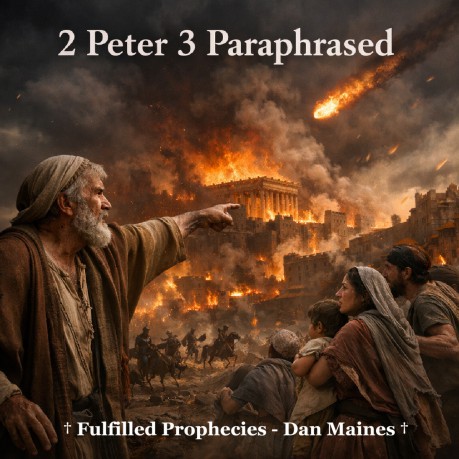
2 Peter 3 Paraphrased Introduction † Peter wrote this second letter to stir up the
believers' memory and remind them of what the prophets and the
apostles had already warned about. The early church was facing
mockers who claimed nothing had changed and that the promise of
Christ's coming judgment would never happen. Peter answers them
directly. He shows that God's past judgments prove His future
promises. The flood was real history, and the coming judgment on
Jerusalem in that generation was just as certain (Matthew 24:34; Luke
21:22). † From the fulfilled perspective, this chapter
speaks about the approaching end of the old covenant world centered
in Jerusalem. Peter wasn't warning about the destruction of the
physical planet. He was warning about the passing away of the old
covenant order that governed Israel (Hebrews 8:13). † Peter repeatedly reminds his readers that
these things were near in their time. The audience lived in the first
century and would soon witness the fulfillment of what Jesus had
already foretold concerning the end of that age (Matthew 24:1-3, 34). 2 Peter 3:1 I'm writing this second letter to you, beloved, and in both of
them I'm trying to awaken your sincere thinking by reminding you of
what you already know. † Peter says his purpose is to remind them, not
reveal something new. The apostles constantly brought believers back
to the words already spoken by the prophets and by Christ (Jude 17). † The phrase awaken your sincere thinking shows
the danger of forgetting prophecy. The believers already had the
truth, they just needed to remember it (Luke 24:25-27). † The warning about coming judgment had already
been spoken many times by Jesus Himself (Matthew 24:6-8, 21). 2 Peter 3:2 I want you to remember the words spoken long ago by the holy
prophets and the command of the Lord and Savior that came through
your apostles. † Peter connects the prophets and the apostles
as one united message. Both testified about the coming judgment on
Israel and the establishment of the kingdom (Acts 3:21-24). † Jesus had already given the command and
warning about the destruction of Jerusalem and the end of that
covenant age (Luke 21:20-22). † The apostles repeated that same warning
because it was approaching in their generation (Hebrews 10:37). 2 Peter 3:3 First of all, understand that in the last days mockers will come
with mocking attitudes, following their own sinful desires. † The last days refers to the final days of the
old covenant age, not the end of the physical universe (Hebrews
1:1-2). † Mockers denied that judgment was coming, just
like many in Israel rejected Jesus' warnings (Matthew 24:48). † Jude described the same group of mockers
appearing in the last time (Jude 18). 2 Peter 3:4 They'll say, where is the promise of His coming? Ever since our
ancestors died everything continues just the same as it has since the
beginning of creation. † Their argument was based on normal life
continuing. They assumed judgment wouldn't come because nothing had
changed yet (Matthew 24:38-39). † This same false confidence existed before the
flood, when people believed nothing would interrupt their world
(Genesis 6:5-7). † Jesus warned that people would ignore the
signs and continue daily life right up until judgment came (Luke
17:26-27). 2 Peter 3:5 They deliberately ignore the fact that long ago the heavens
existed and the earth was formed out of water and through water by
the word of God. † Peter points back to creation to show God's
authority over the world (Genesis 1:6-9). † If God created the world by His word, He also
has the authority to judge it (Psalm 33:6-9). † The mockers were willingly ignoring God's
past acts in history. 2 Peter 3:6 Through those waters the world that existed at that time was
destroyed when it was flooded. † The flood proves that God has already judged
a world before (Genesis 7:21-23). † Peter used the flood earlier as an example of
divine judgment (2 Peter 2:5). † Jesus also used the flood as a comparison for
the coming judgment in that generation (Matthew 24:37-39). 2 Peter 3:7 By the same word the present heavens and earth are being reserved
for fire, kept for the day of judgment and destruction of ungodly
people. † Heavens and earth is covenant language often
used to describe Israel's world order (Isaiah 51:15-16). † Fire represents judgment, not literal cosmic
destruction (Isaiah 66:15-16). † Jesus described the same judgment falling on
that generation (Matthew 23:36). 2 Peter 3:8 Beloved, don't overlook this one fact, with the Lord one day is
like a thousand years, and a thousand years like one day. † Peter isn't changing the timeframe, he's
explaining God's patience (Psalm 90:4). † The promise wasn't delayed because God was
slow, it was delayed because He was allowing time for repentance
(Romans 2:4). † Even so, Peter still said the end was near
for them (1 Peter 4:7). 2 Peter 3:9 The Lord isn't slow about His promise as some think of slowness,
but He's patient toward you, not wanting anyone to perish but for all
to come to repentance. † God's patience was directed toward that
generation so more people could turn to Christ before judgment came
(Luke 13:6-9). † The gospel was being preached throughout the
Roman world before the end came (Matthew 24:14). † The delay allowed many Jews and Gentiles to
enter the kingdom. 2 Peter 3:10 The day of the Lord will come like a thief. In that day the
heavens will pass away with a great noise, and the elements will be
destroyed with intense heat, and the earth and the works in it will
be exposed. † The day of the Lord is a prophetic phrase
used for covenant judgment (Isaiah 13:6). † Jesus used the same thief imagery for His
coming judgment in that generation (Matthew 24:43). † Elements refers to the basic principles of
the old covenant system (Galatians 4:3). 2 Peter 3:11 Since all these things are about to be destroyed, what kind of
people should you be in holy conduct and godliness. † Peter says these things were about to happen,
showing the nearness of the event (Hebrews 10:25). † The approaching judgment was meant to
motivate holy living. † Believers were called to separate themselves
from the corrupt system that was about to fall (Revelation 18:4). 2 Peter 3:12 Looking for and hastening the coming of the day of God, because of
which the heavens will be destroyed by burning and the elements will
melt with intense heat. † The day of God refers to the same judgment
day Jesus described (Luke 21:22). † Believers hastened that day by spreading the
gospel before the end came (Matthew 24:14). † The language again reflects prophetic
judgment imagery used throughout the Old Testament (Isaiah 34:4). 2 Peter 3:13 But according to His promise we're looking for new heavens and a
new earth where righteousness lives. † This promise comes from Isaiah's prophecy
about the new covenant order (Isaiah 65:17). † The new heavens and new earth represent the
restored covenant community in Christ (Revelation 21:1-2). † The righteousness of Christ defines the new
covenant kingdom. 2 Peter 3:14 Therefore beloved, since you're waiting for these things, be
diligent to be found by Him in peace, spotless and blameless. † Peter urges readiness because the judgment
was approaching quickly. † Believers were to remain faithful while the
old system was collapsing (Hebrews 12:28). † Peace with God through Christ was the true
preparation. 2 Peter 3:15 Consider the patience of our Lord as salvation, just as our
beloved brother Paul also wrote to you according to the wisdom given
to him. † Peter affirms Paul's writings as
authoritative teaching. † Paul also taught about the passing away of
the old covenant system (Hebrews 8:13). † God's patience resulted in salvation
spreading throughout the nations. 2 Peter 3:16 Paul wrote about these things in all his letters. Some parts are
hard to understand, which ignorant and unstable people twist just
like they twist the rest of the Scriptures to their own destruction. † Even in the first century people were already
twisting Paul's words. † False teachers misunderstood the freedom of
the gospel (Romans 6:1). † Peter calls Paul's writings Scripture,
showing their authority in the early church. 2 Peter 3:17 So then beloved, since you already know this, be on guard so that
you aren't carried away by the error of lawless people and fall from
your stability. † The danger came from false teachers leading
believers away from the truth. † Jesus warned about deception increasing
before Jerusalem fell (Matthew 24:11). † Stability comes from holding firmly to
apostolic teaching. 2 Peter 3:18 Instead grow in the grace and knowledge of our Lord and Savior
Jesus Christ. To Him be the glory both now and to the day of
eternity. † Spiritual growth was the answer to deception. † The kingdom established through Christ would
endure forever (Daniel 7:27). † Christ receives glory both in the present age
and in the eternal kingdom. Historical References † Josephus recorded the destruction of
Jerusalem in AD 70, describing the fiery judgment that consumed the
temple and the city. † Eusebius wrote that the Christians fled
Jerusalem before the destruction because they believed Jesus'
warnings. † Tacitus confirmed the Roman siege and
devastation that fulfilled Christ's prophecy. How It Applies To Us Today † The fulfilled judgment reminds us that God
always keeps His word. † Just as believers in the first century were
called to remain faithful, we're called to continue growing in
Christ. † The new covenant kingdom is already
established, and our focus now is living faithfully within it. Q & A Appendix Q: Was Peter predicting the end of the physical
universe? Q: What are the elements that melted with intense
heat? Q: What are the new heavens and new earth? Q: What did Peter mean when he said the day of
the Lord would come like a thief? Q: Why did Peter remind them about the flood in
Noah's time? Q: What did Peter mean when he said the earth and
its works would be exposed? † This is the fulfilled perspective we proclaim at
Fulfilled Prophecies † Source Index † 2 Peter 3; Matthew 24:1-3, 34; Luke 21:20-22;
Hebrews 8:13; Isaiah 65:17; Revelation 21:1-2 † Josephus, Wars of the Jews; Eusebius,
Ecclesiastical History; Tacitus, Histories 5.13
By Dan Maines
A: No. Peter used prophetic language
about the heavens and earth passing away, which refers to the end of
the old covenant order centered in Jerusalem (Isaiah 51:15-16;
Hebrews 8:13).
A: The elements refer to the basic
principles of the old covenant system that governed Israel (Galatians
4:3; Colossians 2:20).
A:
The new covenant kingdom established through Christ where
righteousness dwells (Isaiah 65:17; Revelation 21:1-2).
A: Jesus used
the same language when speaking about the coming judgment on that
generation. The point wasn't a secret arrival but suddenness for
those who weren't paying attention. The faithful were watching and
expecting it (Matthew 24:42-44; Luke 21:34-36).
A: Peter used the flood as
historical proof that God has already judged a world before. Just as
people ignored Noah's warning until the flood came, many in Israel
ignored the warnings of Jesus and the apostles before Jerusalem was
destroyed (Genesis 7:21-23; Matthew 24:37-39).
A: The phrase
refers to judgment revealing and exposing the corruption of the old
covenant system centered in Jerusalem. When the temple and the city
were destroyed, the works of that system were fully exposed and
brought to an end (Luke 21:22; Hebrews 9:8-10).
© Fulfilled Prophecies - Dan
Maines.
Links