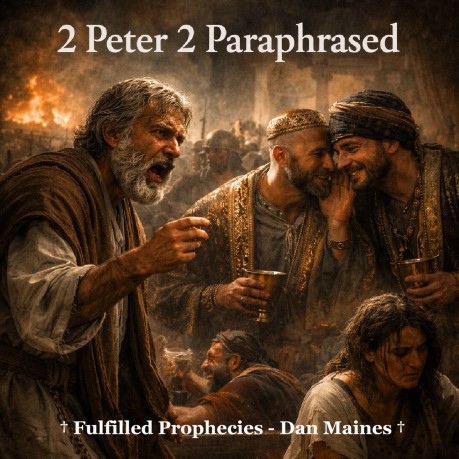
2 Peter 2 Paraphrased Introduction † Peter warns the believers that just as false
prophets appeared among Israel in the past, false teachers would also
arise among the early churches. Their influence would be dangerous
because they would secretly introduce destructive teachings while
pretending to belong to the faith. The chapter is not about minor
disagreements, it is about those who distort the gospel and lead
people into corruption. 2 Peter 2:1 † Israel had a long history of false prophets
who misled the nation, often speaking peace when judgment was coming.
Peter is drawing from that same pattern seen in Jeremiah
23:16 where the Lord warned that prophets were speaking
visions from their own minds. 2 Peter 2:2 † False teachers always attract followers
because they appeal to desires rather than truth. Paul warned of this
in 2 Timothy 4:3, saying people would gather
teachers who tell them what they want to hear. 2 Peter 2:3 † Greed has always been a motivation behind
corrupt religious leaders. Jesus exposed this in Matthew
23:14, condemning leaders who devoured widows' houses while
pretending to be righteous. 2 Peter 2:4 † Peter is showing that no being escapes God's
justice. Even heavenly beings were judged when they rebelled. 2 Peter 2:5 † The flood demonstrates that widespread
corruption does not stop God's justice. The world before the flood
was filled with violence and wickedness, and judgment came
suddenly. 2 Peter 2:6 † The destruction of these cities shows that
moral corruption eventually brings judgment. Their story stands as a
warning throughout scripture. 2 Peter 2:7 † Even within a corrupt society, God recognizes
those who remain faithful. Lot lived among wicked people but did not
participate in their practices. 2 Peter 2:8 † Lot's experience shows how deeply corruption
can trouble those who desire righteousness. 2 Peter 2:9 † This verse summarizes Peter's argument. God
delivers the faithful and holds the wicked accountable. 2 Peter 2:10 † Arrogance is a common trait among corrupt
teachers. Instead of humility, they elevate themselves above
others. 2 Peter 2:11 † Peter contrasts the arrogance of false
teachers with the restraint of angels. 2 Peter 2:12 † Peter uses strong language to describe the
behavior of those who reject truth. 2 Peter 2:13 † Their corruption was not hidden but openly
practiced. 2 Peter 2:14 † Their influence targeted those who were
spiritually weak. 2 Peter 2:15 † Balaam became a symbol of corruption
motivated by money. 2 Peter 2:16 † This unusual event demonstrated God's ability
to expose deception in dramatic ways. 2 Peter 2:17 † They promise spiritual refreshment but
provide nothing. 2 Peter 2:18 † Their teaching often sounds impressive but
lacks real substance. 2 Peter 2:19 † True freedom comes through righteousness, not
through indulging sinful desires. 2 Peter 2:20 † Returning to corruption after knowing the
truth leads to deeper destruction. 2 Peter 2:21 † Knowledge brings responsibility. 2 Peter 2:22 † Peter closes with a vivid illustration
showing how unchanged hearts return to former behavior. Historical References † Josephus described the corruption among many
religious leaders in first century Judea, showing how greed and
deception were widespread before Jerusalem's fall. How It Applies To Us Today † Believers must measure every teaching against
scripture rather than blindly trusting charismatic leaders. Q And A Appendix Q Why does Peter spend so much time warning about
false teachers? Q What examples does Peter use to show God judges
corruption? Q What lesson should believers learn from
Balaam? Q What does Peter mean when he says false
teachers secretly introduce destructive teachings? Q Why does Peter compare false teachers to
springs without water? Q What does Peter mean by saying they promise
freedom while being slaves of corruption? † This is the fulfilled perspective we proclaim at
Fulfilled Prophecies † Source Index † Matthew 7:15; Matthew 24:11; Jeremiah 23:16;
Jude 1:6-7; Numbers 22:28; John 8:34; Matthew 12:45; 2 Timothy 4:3; 2
Thessalonians 1:6-7 † Josephus, Antiquities of the Jews; Clement of
Alexandria; Irenaeus.
By Dan Maines
† Jesus warned about
the same danger during His earthly ministry. In Matthew 7:15,
He said to beware of false prophets who come dressed like sheep but
inwardly are ravenous wolves. Peter is continuing that same warning
to the first century churches facing pressure and deception.
†
This chapter also connects with the coming judgment that fell upon
Jerusalem and the corrupt leadership of Israel in that generation.
False leaders had long misled the people, and God had already shown
throughout history that He judges those who corrupt His truth.
But just as there were false
prophets among the people long ago, there will also be false teachers
among you. They will secretly introduce destructive ideas and even
deny the Master who bought them, bringing swift ruin on themselves.
† Jesus
predicted the same problem for the first century church in Matthew
24:11, where He said many false prophets would arise and
mislead many during that generation.
† Their
destruction would come quickly because God does not ignore those who
twist His truth for their own advantage.
Many people will follow their
corrupt ways, and because of them the way of truth will be slandered.
†
When leaders behave corruptly, outsiders often blame the entire
faith. This is why Peter says the way of truth would be spoken
against.
† The damage caused by false
teachers spreads far beyond themselves because it distorts the
reputation of the gospel.
Driven by greed, they will
exploit you with carefully crafted words. Their judgment has long
been prepared, and their destruction is not sleeping.
† Peter reminds
the church that judgment against such people is already determined.
God may appear patient, but justice is certain.
†
Their manipulation comes through persuasive speech, showing how
deception often works through smooth words rather than open
rebellion.
God did not spare the angels
when they sinned but cast them into chains of darkness to be kept for
judgment.
†
Jude describes the same event in Jude 1:6,
explaining that angels who abandoned their proper place were kept in
eternal restraints until judgment.
† The
point is clear, if God judged angels, false teachers should not
assume they will escape accountability.
God did not spare the ancient
world either, but preserved Noah, a preacher of righteousness, when
He brought the flood upon the world of the ungodly.
† Noah remained faithful and was
preserved, showing that God protects the righteous even when judgment
falls on the wicked.
† This example reminds
believers that God sees the difference between those who follow Him
and those who corrupt His truth.
He also reduced the cities of
Sodom and Gomorrah to ashes, condemning them to destruction as an
example of what happens to the ungodly.
† Jude also
refers to their fate in Jude 1:7, explaining that
they serve as an example of the consequences of rebellion.
†
Peter's point is that God's judgments in history prove He does not
tolerate corruption forever.
Yet He rescued righteous Lot,
who was distressed by the immoral behavior of lawless people.
† The story
illustrates God's ability to separate the righteous from the wicked
before judgment falls.
† This is the same
pattern seen throughout scripture where the faithful are preserved
while the corrupt face consequences.
Day after day that righteous man
lived among them, and his soul was tormented by the lawless deeds he
saw and heard.
†
Believers living in a corrupt society often feel the same tension
between truth and the behavior around them.
†
Peter emphasizes that God sees that struggle and remembers those who
remain faithful.
The Lord knows how to rescue the
godly from trials and keep the unrighteous under punishment for the
day of judgment.
†
Paul taught the same principle in 2 Thessalonians 1:6-7,
saying it is just for God to repay trouble to those who trouble His
people.
† The first century believers needed
this reassurance while facing persecution and deception.
This is especially true of
those who follow corrupt desires and despise authority. They are bold
and arrogant, not afraid to slander heavenly beings.
† Their rejection of authority
includes both spiritual authority and moral boundaries.
†
Such attitudes reveal the deeper rebellion within their hearts.
Yet even angels, who are
greater in strength and power, do not bring insulting accusations
against them before the Lord.
† Even
powerful heavenly beings act with reverence before God.
†
This exposes how reckless and disrespectful false teachers truly are.
These people act like
unthinking animals driven by instinct. They speak against things they
do not understand and will perish like the creatures they imitate.
† When
people abandon understanding and wisdom, they begin acting purely on
impulse.
† Their destruction comes because
they refuse correction and continue in corruption.
They will receive the harm they
have caused. They enjoy living in open sin during the daytime. They
are stains and blemishes, celebrating their deception while sharing
meals with you.
† The early church often gathered
for communal meals, and false teachers attempted to blend into these
gatherings while living immorally.
† Peter
exposes them so believers would recognize the danger.
Their eyes are full of adultery
and never stop pursuing sin. They lure unstable people and have
hearts trained in greed. They are under a curse.
† Greed and lust were
driving forces behind their behavior.
†
Peter's warning encourages believers to remain grounded in truth so
they are not easily deceived.
They have abandoned the right
path and wandered away. They followed the path of Balaam, who loved
the reward of wrongdoing.
† His story in Numbers
22:28 shows how greed can lead someone to oppose God's
will.
† Peter uses this example to show that
financial gain often drives false teachers.
But Balaam was rebuked for his
wrongdoing when a donkey spoke with a human voice and restrained the
prophet's madness.
† Even
a speechless animal became the instrument of correction.
†
Peter highlights the story to show how foolish greed can become.
These teachers are like springs
without water and clouds pushed by storms. Darkness has been reserved
for them.
† Just as a dry spring
disappoints a thirsty traveler, false teachers leave people
spiritually empty.
† Their end is described
as darkness, symbolizing separation from truth.
They speak with arrogant and
empty words, appealing to sinful desires and drawing people back into
corruption.
† By appealing to
sinful desires, they attract followers who want permission to live
without restraint.
† Peter warns believers to
recognize this manipulation.
They promise freedom while they
themselves are slaves of corruption, because a person becomes
enslaved to whatever controls him.
† Jesus
taught this same truth in John 8:34, explaining that
everyone who commits sin becomes a slave to sin.
†
False teachers misrepresent freedom by encouraging behavior that
actually enslaves people.
If someone escapes the
corruption of the world through the knowledge of the Lord and then
becomes entangled again, the final condition is worse than the first.
† Jesus
described a similar situation in Matthew 12:45,
where a person becomes worse after returning to former bondage.
†
Peter emphasizes the seriousness of abandoning the truth once it has
been understood.
It would have been better for
them never to know the way of righteousness than to know it and then
turn away from the holy command given to them.
†
Those who deliberately turn away from truth face greater
accountability.
† This warning encourages
believers to remain faithful rather than drifting away.
What happened to them proves
the truth of the proverb: a dog returns to what it vomited, and a
washed pig goes back to rolling in the mud.
†
External reform without inner transformation cannot last.
†
The gospel changes the heart, but those who reject it eventually
return to corruption.
†
Clement of Alexandria warned early believers about teachers who
distorted the gospel for personal gain.
†
Irenaeus also wrote against heretical leaders who twisted the
apostolic teaching in the early church.
†
The chapter reminds us that truth matters, and corruption within
religion causes serious harm.
† Faithfulness
to Christ protects us from deception because His word reveals what is
genuine and what is false.
A Because deception was already
spreading in the early church and Jesus had warned it would happen in
that generation. Matthew 24:11.
A The fall of rebellious angels,
the flood in Noah's time, and the destruction of Sodom and Gomorrah
all demonstrate God's justice. Jude 1:6; Genesis 6:7; Genesis 19:24.
A That greed can corrupt spiritual
leaders and lead them away from God's truth. Numbers 22:28.
A
He means their deception is subtle. They don't always openly reject
the truth at first, instead they slowly introduce ideas that
undermine the gospel and lead people away from Christ. Paul warned
about the same thing in Acts 20:29-30, explaining
that savage wolves would arise even from within the church to draw
disciples after themselves.
A A spring promises
refreshment, but if it's dry it leaves people disappointed and still
thirsty. In the same way, false teachers promise spiritual guidance
but offer nothing that truly nourishes the soul. Jesus described true
spiritual refreshment in John 7:37-38, saying those
who come to Him will receive living water.
A
False teachers often claim that freedom means doing whatever a person
desires, but Peter explains that sinful desires actually enslave
people. True freedom comes from living under Christ's authority.
Jesus said in John 8:36, if the Son makes you free,
you will be free indeed.
© Fulfilled Prophecies - Dan
Maines.
Links